My Life’s Work: Words Make a Way Through Fire by Cyra Sweet Dumitru
Words Make a Way Through Fire is a memoir told through poetry and prose that chronicles my decades-long journey of transforming traumatic memory into a creative life. While the book includes my reckoning, which sometimes is rather raw, it is most about the healing influences of writing, swimming as meditation, and the intuited guidance of a spiritual presence called Voice.
Although I didn’t know it at the time, the book began when I wrote the poem “The Faceless Day” at the age of nineteen. I was a sophomore at Indiana University in Bloomington, and my emotional life was in turmoil. Two years earlier, I had witnessed my eldest brother’s fiery suicide at our family home in Cincinnati, Ohio. Witnessing that violent act fractured my psyche deeply. I had no language for my charged and tangled feelings. Resonating trauma overwhelmed me. My capacity to grieve David and to trust myself were impeded. I tended to numb my inward ache with alcohol and marijuana.
Fortunately, I was writing poems with guidance from a poetry writing class which helped me begin to express my conflicted, tangled feelings. When “The Faceless Day” surfaced and spoke, it made clear that my creative way forward involved commitment to writing. Through a writing practice, I could learn to trust my instincts. The wisdom of the poem, embedded within a strange metaphor, changed the trajectory of my life, propelling me to embrace poetry and journal writing as vital to my health and recovery. Shaping my pain and confusion into poetic language stopped my steady slide into substance abuse.
During the next twenty years, I kept journaling and writing poems. When I was 38, another hugely healing poem called “Gift of Fire” surfaced. It gave me a spiritual way to talk directly about what I had seen, heard and smelled during David’s suicide. I felt an expansive inward shift as I wrote the poem.
For years, my brother’s suicide had obscured his life. Now I was ready to recreate his life, and give my life more coherence. My purpose then became recovering memories of David, weaving them into a larger story. This narrative focus also allowed me to explore questions: “Who was my brother while he lived? Is there a path that leads to his suicide? Was I responsible somehow for his death?” This is when the memoir took root, found an initial voice and structure.
I turned to past pages of journal entries that documented years of recollections and related dreams. My surviving parents and brothers graciously supported my purpose, sharing stories and answering questions as I wrote.
An idea emerged to craft a section where David speaks directly during the brief hours between his suicidal action and his death. Something clamored in me to give him space to speak. Yet, it felt presumptuous. How could I know what went through his mind and heart during those final hours? I considered this question for several weeks. Decided against doing so because I couldn’t be sure it was accurate; it would be purely an act of informed imagination.
One day, a voice propelled me to start writing what became his extended monologue. Since I had already written about shared experiences with him, I could imagine these same experiences from his point of view—this was a kind of accuracy. The decision was made; and I knew to listen. Once it started, this piece flowed through in long waves of words. I felt companioned by a larger presence, perhaps David’s spirit?
I developed the remembrance narratives as far as I could, turning them into chapters. I merged related poems into the chapters. Then my focus shifted to raising two children, teaching writing at the college level, publishing books of my poems, and assisting my elders as they faced complicated health issues.
In my fifties, I returned to the story as I became certified as a practitioner of poetic medicine. The final construction occurred during the pandemic. In March of 2020, I was given a month-long writing residency on a private ranch. I devoted six to ten hours a day refining the language of existing chapters, adding new insights, considering why certain poems offered such healing, and developing new chapters. What is it about poetry that nurtures transformation? Part two emerged, which emphasizes spiritual experiences involving Voice, powerful moments I have witnessed where other people felt healed through their poems. The importance of swimming as another healing practice became a chapter.
Now the manuscript felt pretty complete, and hired an editor. Jenn affirmed the overall organization of the book, helped me clarify sections throughout, and affirmed the value of sharing my story.
As I have listened through the years to what my life and thus this book most deeply want to say, my traumatized, teenaged-self has healed. I have grown into a mature, empowered woman. I am an accomplished poet and passionate practitioner of poetic medicine who helps other people nurture their creative energies in service of inner growth. I now cherish creative process as one of the greatest healing gifts to human beings from our Creator.
If you are curious about my books of poetry or more about poetry as medicine, I invite you to visit my website at: www.cyrasweetdumitru.com
About the author: Cyra Sweet Dumitru is a published poet and instructor of poetry, and one of four certified practitioners of poetic medicine in Texas. Her poems have appeared on the walls of City Hall, been spoken on national public radio and in museums, and appeared in city newspapers and national literary journals. Her collections of poems include What the Body Knows, Listening to Light, Remains, and Elder Moon. She offers therapeutic writing circles for adults learning to live with trauma, bereavement, depression, anxiety, and religious trauma. Cyra lives in San Antonio, Texas with her family.
Words Make a Way Through Fire: Healing After My Brother’s Suicide
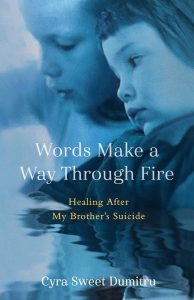 For readers in search of emotional and spiritual healing, a courageous, gripping memoir of one woman’s journey of gradually healing her traumatized memory through poetry, swimming, and the intuited guidance of a spiritual presence named Voice.
Words Make a Way through Fire is an intimate, courageous memoir of a woman shattered by witnessing her eldest brother’s horrific suicide when she was a teenager. The book traces her creative journey of recovery and healing with poetry as a constant companion.
The primary means of Cyra Dumitru’s healing process, from age sixteen through adulthood, is writing poetry and journaling. During this decades-long journey, Cyra experiences a transcendent, loving presence called Voice who guides her and helps her imagine wholeness. She finds community with others through the sharing of poems. She studies poetry as craft and as medicine—becoming a published poet with multiple books, an award-winning college instructor of poetry writing, and a certified practitioner of poetic medicine who creates spaces where others can heal through poetry.
In Words Make a Way through Fire, Cyra explores the specific medicinal properties of poetry—giving order to interior anxiety, trusting the wisdom within—and invites her brother David to speak through her as he reflects upon his final hours. In doing so, poem by poem, she shifts gradually from being traumatized and feeling haunted to feeling empowered and spiritually expansive.
BUY HERE
Category: On Writing
Subscribe
If you enjoyed this article, subscribe to receive more just like it.