Writing My Second Memoir
By Hendrika de Vries
A Journey into the Sequel
When I sat down to begin the writing of my second memoir, it felt as if I were returning to a place at once familiar and uncharted. The first memoir was born of urgency, an obligation to share my story, my experience of surviving oppression, hatred and cruelty that seems to be trending again. It surprised me with its success and awards. Friends and readers urged me to write a continuation. But the sequel, I soon realized, would be a different kind of undertaking: less about the childhood trauma of war and more about the challenges of adolescence and immigration–a story about resilience and adaptation during major turning points that are difficult times of change in our lives. It proved infinitely more challenging.
Beyond the First Telling
The luxury—and the burden—of my second memoir was the change of voice. In my first memoir When a Toy Dog Became a Wolf and the Moon Broke Curfew, the teller of the story is a little girl who experiences loss, brutality and near starvation when Nazis march through the streets of her hometown, Amsterdam, in WWII. Her story ends when she leans over the rails of a migrant ship bound for Australia, waving a tearful goodbye to her teenage friends on the shore. The next phase of her life will be as an immigrant in a new land, where she will be forced to forget her past and become someone new if she wants to belong. How would I tell this next phase of her story?
The urge to replicate the voice and style that had resonated in the first was strong, but I had to recognize that the point of view in the second memoir OPEN TURNS: From Dutch Girl to New Australian, was not that of a little girl but of a displaced adolescent on her way to becoming a woman. She dreams of being a champion swimmer and has definite opinions about the woman she intends to be. Yet, as an immigrant in a country that demands she denounce her past, she must adapt and reinvent herself as a New Australian. She will struggle to find her identity and sense of belonging.
The Turn in My Life
I was 13 when I said goodbye to my friends in Amsterdam. I lived in Australia until I moved to the U.S. thirteen years later, a young wife and mother. America has been home to my family since. The Dutch part of me is evident in my name, a slight accent, and the place of birth on my American passport. The Australian part of me exists in my children born of an Australian father, in my memories and in leaving my mark as a state swimming champion. I wondered, what about an immigrant teenager’s experiences in 1950s Australia could be of importance to a reader today?
But as I thought about it more, I recognized that my immigrant experience recounts challenges that confront all of us when we are faced with major transitions in our lives. As a therapist I have been witness to clients’ struggles when painful turning points––loss of home through natural disasters, loss of loved ones, physical ailments or other major challenges called for that same strength and resilience to grieve, adapt and reinvent themselves. I realized that writing the sequel demanded that I allow my immigrant adolescent self a full voice if my second memoir was to be as authentic and meaningful as my first.
A different Voice
When I began to write I still preferred the little girl voice in the first memoir, but as the Australia story unfolded I gained more compassion for my adolescent self, and I was able to connect to the story of the determined young immigrant swimmer, who finds a safe place in the water, a place where differences melt away for a while.
I gradually allowed myself to be patient with her thoughts and introspection and to hear her voice of confusion and self-doubt more clearly. I’ve been told that migrants tend towards introspection because our roots lie in another part of the world. As a family therapist I also know that it is an aspect of adolescence in the struggle for identity and the need to separate from the adults that spelled home. And even as I hesitated at times, it also felt important to let her share the challenges of being an elite athlete in a female body, with all its intimate details.
The Weight of Expectation
A second memoir carries with it the weight of expectation—both external and internal. I felt the eyes of my readers, real and imagined, peering over my shoulder, waiting to see what new revelations I might offer. But more daunting was the pressure I put on myself: to write with greater insight and greater vulnerability. The first book with its accolades and awards had set a standard with its tale of heroic resistance; the second required a leap into the meaning of being an immigrant, not just in the 1950s but in the world today.
I found that the writing itself became a kind of therapy. I reclaimed a part of myself that had been lost. In the process, I uncovered stories I had been reluctant to tell, wounds I had not allowed to heal, joys I had not yet celebrated on the page. The act of writing became a kind of reckoning—not only with the past, but with the person I have become that includes and celebrates the immigrant me––the New Australian part of myself. My hope is that it will inspire my readers to embrace and share their own ancestral immigrant or refugee narratives.
The Conclusion
When I finally typed the last sentence, I knew that I had not just written a sequel, but rather a companion: a book that stood beside its predecessor, in dialogue with it and expanding the story of a life still in progress.
And so, as I close the cover on this second memoir, I do so with gratitude—for the chance to revisit another aspect not just of my own life, but of the mystery of our human strength and resilience in times of challenge and change.
—
Hendrika de Vries is a retired family therapist, a teacher, and a writer. Her life experiences with oppression and resistance in Nazi-occupied Amsterdam, migration, competitive swimming, misogyny in 1950s Australia, and feminism in the US, infuse her writing with historical depth and personal perspective on challenges facing women and anyone deemed other. She is the author of When a Toy Dog Became a Wolf and the Moon Broke Curfew, award-winning memoir of her WWII childhood. She lives in Santa Barbara, CA
Open Turns: From Dutch Girl to New Australian―A Memoir
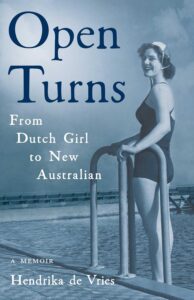 If you believe in the power of dreams and intentions, this inspirational coming-of-age memoir set in 1950s Australia where an immigrant girl swimmer turns challenges and disappointments into opportunities for success is for you.
Henny was just a little girl when she experienced brutal violence and hunger in WWII Amsterdam, but she is now a teenage immigrant swimmer in 1950s Australia where she must learn to turn challenges into success. She is smart, she swims fast, and she has definite opinions about the kind of woman she intends to be.
She hears the timeless Land speak and sees the Southern Cross as a beacon when she walks in the bush with her father. She enjoys swimming star fame and championship victories and turns to the pool in her search to belong, to face fears and dashed hopes, until at every turn she sees more clearly her unique path ahead.
“Intentions are like prayers, if you pay attention they come back as destiny,” her mother has taught her. Is it intention or destiny that propels this young New Australian into her future long life?
BUY HERE
Category: On Writing
Subscribe
If you enjoyed this article, subscribe to receive more just like it.