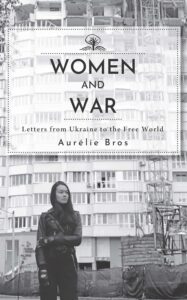
Women and War: Letters from Ukraine to the Free World
By Aurélie Bros
 I became a researcher for a simple reason—to seek truth wherever it may be found. For over a decade, I devoted myself to studying energy geopolitics, with a particular focus on the post-Soviet region. I lived there, published, taught, and conducted my research. My life was intertwined with the region in countless ways.
Then came February 24, 2022. The war that had been ravaging eastern Ukraine since 2014 suddenly became an undeniable reality for all of Europe. Cities I knew were bombed, and friends and colleagues enlisted to fight. The abstract maps I used to analyze in my lectures became battlegrounds filled with human loss. In that moment, my academic career no longer felt like a priority. I paused everything.
Shortly after, the German newspaper Handelsblatt—comparable in stature to The Financial Times —asked me to coordinate a support program for Ukrainian journalists in distress. Accepting felt natural. From the beginning of my career, I understood that scholars and journalists take different paths toward the same goal: establishing facts, making them known, and safeguarding freedom of expression.
Working alongside those Ukrainian journalists changed me forever. I organized emergency deliveries of bulletproof vests, satellite connections, and first aid kits. In return, they gave me something much greater: their words, their exhaustion, their courage, and their unyielding refusal to surrender the truth.
One day, a young journalist named Dina confided in me that she had volunteered to join the army and was waiting for the call to put on a soldier’s uniform. Unlike men, who were barred from leaving the country and were mostly waiting to be mobilized, Ukrainian women had a choice: continue reporting or take up arms; stay or leave. That night, I shared her dilemma with my husband. He said simply, “You can listen and risk forgetting, or you can make sure their stories resonate beyond Ukraine.” The decision was immediate. With Handelsblatt’s support, I launched a book project. Initially, it was intended to be a collection of letters from female war correspondents. I invited them to write intimate, personal messages, not reports.
Word spread quickly. Other women came forward. One was Olga, a parliamentarian who became a single mother after her husband was killed on a humanitarian mission. There was also Jerry Heil, a singer determined to make the Ukrainian language heard worldwide by turning art into soft power. There was also Maryna, who sent her daughter to safety in Poland before returning to Ukraine to support her loved ones financially and emotionally. Then there was Anastasiia, a ten-year-old orphan from Mariupol. She sent me a letter. Her words broke my heart. How do you answer a child who has lost everything and survived only by a miracle?
These letters forced me to confront two profound questions. The first: What is journalism in a hybrid war where civilians are deliberate targets? I began to understand that journalism isn’t just about writing for newspapers. At its core, journalism is an act of citizenship and a moral commitment to the truth. Women like Jerry, Olga, and Maryna embody this commitment in their own ways in the face of Russia’s aggression.
The second question: What does courage mean in such a context? Through their stories, I learned that courage is not the absence of fear, but rather, taking action despite it. Courage means defending what is just, persevering under trial, staying faithful to one’s values, facing threats with clarity, and maintaining dignity in suffering. Courage has the face of Dina and the fragile yet unbreakable gaze of little Anastasiia.
As the war’s repercussions became apparent—population displacement, nuclear threats, and disinformation—it became clear that these stories had to be published. The project grew beyond its original scope. The book evolved into a collection of letters from women of all walks of life, journalists and non-journalists alike. The youngest contributor was ten, and the oldest was seventy-two. They all shared the same determination: to give a human face to what elsewhere remained only statistics. Each letter reminded the world that behind every anonymous number is a life, a voice, and a memory.
The project deepened with the addition of portraits. Three Ukrainian photographers traveled across Ukraine and the EU, capturing faces and stories amidst ruins and resilience. In Irpin and Chernihiv, amid the devastation, they recorded testimonies while under constant tension. In Kyiv, Sofiia, a ten-year-old girl, posed in her favorite park. The very next day, a bomb fell on that exact spot. For the first time, she realized that she could die at any moment. Her response was simple yet piercing: “We must publish this book so that people know what is happening here!”
The project gained momentum. People from the world of cinema lent their voices: Lana Wachowski, creator of The Matrix; Stephen Fry, a beloved actor and author; and Mstyslav Chernov, director of the Oscar-winning documentary 20 Days in Mariupol. Academics such as Rawi Abdelal of Harvard Business School and Serhii Plokhy of the Ukrainian Research Institute at Harvard also offered their support. Even political leaders, including Finnish President Alexander Stubb, were moved by these accounts.
To me Women and War: Letters from Ukraine to the Free World is more than just a book. It is a tribute to press freedom, human courage, democracy, and European solidarity. These letters also remind us what it means to live under the bombs of a power-hungry invader. They awaken empathy and, I hope, responsibility.
All my royalties from the book are donated to the Center for Civil Liberties, led by Nobel Peace Prize laureate Oleksandra Matviichuk. The Center documents war crimes and proves to the world that justice is not a luxury. Justice is the only path toward lasting peace.
The genesis of Women and War is therefore both personal and collective. It emerged from a researcher’s pause, journalists’ resilience, a child’s letter, and countless courageous acts that deserved to be heard. I did not write this book alone. It was written with them, through them, and for them. The book stands as a reminder that although truth is fragile, when spoken, it can transcend borders and generations.”
Aurélie Bros (Author of the introduction, Editor, Translator)
A geopolitician who wrote her doctoral thesis on Gazprom’s export strategy to Europe via Ukraine. She has taught at several universities, including Harvard University, where she led a research program on the impact of the global energy transition on traditional oil and gas producers, such as Russia and Iran. She has given numerous conferences, including at MIT and the Université du Québec. In March 2022, she began coordinating an aid project launched by Handelsblatt (Germany’s largest financial newspaper) to support Ukrainian journalists. Since 2023 she has been writing books and screenplays.
—
Women and War: Letters from Ukraine to the Free World
How would you communicate the realities of living in a warzone to someone who has never had this experience? Thirty Ukrainian women, ages 10 to 72, answered this question in letters that emanate power, depth, pain, strength, and resilience. These fragments of life reveal the horrors of conflict but also the humanity of survivors.
BUY HERE
Category: Contemporary Women Writers
Subscribe
If you enjoyed this article, subscribe to receive more just like it.