From Messy Truths to Meaningful Fiction: Five Keys to Transforming Life into Story
Cynthia Morris
Some of us, like me, prefer to lead with our intellect. Makes sense. We want to be taken seriously. Vulnerable in public? Pass!
That may work in real life. But when I set out to write my second novel, Her Lisbon Colors, I discovered the very traits I’d hidden—my tender heart and emotional depth—were exactly what the story needed.
The book follows Darla, a 40-something who ends up in Lisbon after a profound loss. There she discovers not just a passion for a hot young rock climber, but a true connection to what makes her tick.
Along the way, I learned five things that not only changed how I write, but changed my life altogether.
The bad stuff is the good stuff. Writing Her Lisbon Colors was the most therapeutic thing I have ever done. And I’ve done it all – therapy, plant medicines, hypnotherapy. I’ve always believed that writing is one of the most powerful tools for self-awareness, but this novel took me to new depths.
At first, I didn’t want to include the drinking, drugs, and sex from the true story. I don’t want people to know about all the bad decisions I made! Then I realized, wait. That’s the good stuff! The bad decisions are what we love in stories. Those awful moments help us feel closer to the characters.
When I decided to leave that stuff in, it wasn’t from a place of plugging my nose and plunging into the icy waters of public vulnerability. Instead, I realized – wait for it – I am human too. I know, I know. It took me this long to accept that I, too, make bad decisions. Embarrassing as it may be, I was grateful to drop the façade of having it all figured out. Readers of Her Lisbon Colors tell me that it’s the raw stuff that made them fall in love with Darla and the book.
The character arc rules above all. Many of us know this craft truism, but somehow Her Lisbon Colors really drove it home. The plot arc is not the most important thing in a novel. It’s the character arc that hooks us into a story and keeps us reading. But it wasn’t easy to find this character arc and to divorce myself from Darla. How I did it was a big surprise.
I had been trying methods like Story Genius, Save the Cat, and Storywheel to unearth the character arc. It was listening to a podcast about attachment theory that helped me claim Darla’s true character arc. Exploring how Darla’s nature was formed helped me to separate her from me and create a different backstory than mine.
That’s why in Her Lisbon Colors, readers follow Darla through her adventures in Lisbon, but it’s the internal shifts that make her reinvention feel both hard-won and universal.
More isn’t better. I am an everything type: everything bagel, lots of pizza toppings, and all the colors in my palette should be used. But when it comes to subplots in a novel, less is better. My character had lots of threads: taking Portuguese classes, yoga classes, and art classes. My editor firmly nudged me to choose just one. This was tough, but once I let go, the novel became more streamlined and thus more engaging.
Focusing on Darla’s evolution as an artist made her arc potent and aligned with my purpose: to ignite creativity in everyone.
Being emotional is required for the job. All my empathy and sensitivity may cause emotional rollercoaster rides in daily life. But for a novelist, these traits are essential. How the protagonist feels, how the reader feels, those are the main work of fiction writing.
This also applies to the pitch sentence we need when asked, “What’s your book about?” This has to strike an emotional chord. Straight to the heart, bypassing the brain, is the way people feel and say, “I want to read that!”
Dumbing it down isn’t always bad. The aforementioned prioritization of intellect can really complicate things for us. We tend to like complex things. Complex movie and book plots, complex problems to solve, and complex ideas to puzzle through.
But when it comes to actually making things like a novel, we need to simplify it. This was painful to learn. It meant cutting meaningful sections—such as Italy!
Cutting other locations allowed Lisbon to shine. I fell in love with the city all over again on research trips.
This also applies to being able to describe your book in one sentence. Not a compound sentence. Not a run-on sentence. And definitely not two sentences.
I believe in the power of story to guide us toward our own truths. Self-help may point to change, but role models show us how to be daring and creative.
All of these lessons come alive in Her Lisbon Colors. The story of one woman’s messy, luminous, and daring reinvention is as personal as it is universal. And I’m not just a better novelist; I am a more well-rounded human.
—
HER LISBON COLORS
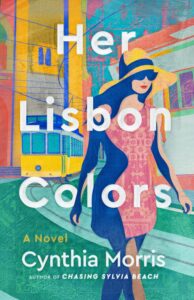 What happens when you’ve made all the right moves, but ended up in the wrong place?
At forty-one, Darla Clarke has mastered the art of having it all—almost. Her career as a high-powered project manager in Boulder is picture-perfect, but the frame feels increasingly empty. When a friend’s death shatters her carefully controlled world, Darla realizes that sometimes the biggest risk is playing it safe.
Armed with an unexpected inheritance and a ticket to Europe, she trades spreadsheets for sketch pads. When she lands in sun-drenched Lisbon, all her perfect planning goes awry. She meets André, a fearless young rock climber who teaches her that the most beautiful views come after the scariest climbs.
Their white-hot romance ignites against the backdrop of Lisbon’s cobblestone streets and Portugal’s gorgeous beaches, bringing Darla alive in ways she never knew possible.
She rediscovers the artist she abandoned for practicality and her life blooms in full color. But her next stop is Paris, and she’s learning that the hardest part of living boldly isn’t the leap—it’s deciding whether to fly or return to solid ground.
Her Lisbon Colors is a sensual, life-affirming novel about the art of beginning again. This unforgettable story reminds us that it’s never too late to paint your life in the bold strokes you’ve always dreamed of.
BIO: Cynthia Morris is obsessed with books. She’s either reading one, writing one, or coaching others to write their books. A certified coach since 1999, she helps writers, artists, and creative teams access and enjoy their creative gifts. Cynthia is a watercolor illustrator and leads creativity workshops in Paris, Lisbon, and online. She lives in Denver with her husband Steve where she loves to garden and go to the library.
Substack https://cynthiamorris.
Website https://www.originalimpulse.
Instagram https://www.instagram.com/
Category: How To and Tips
Subscribe
If you enjoyed this article, subscribe to receive more just like it.