Developing Complex Characters
By Mary Alice Stephens
My book, Uncorked: A Memoir of Letting Go and Starting Over (Sibylline Press, August 2025), explores my search for identity after ending a 30-year abusive relationship with alcohol. The central conflict is between two opposing parts of my personality: Fun Mary and Sober Mary. During my drinking days, I was Fun Mary—the life of the party and an impulsive risk-taker. Fun Mary makes it difficult for Sober Mary in early recovery, tempting her to drink and criticizing her for being boring.
Creating complex characters is essential for crafting a compelling story, whether it’s fiction or nonfiction. Characters bring stories to life, provide context for actions, and shape how readers experience the story. Literature features many character archetypes: the hero, the outlaw, the lover, the mentor, and more. However, we writers shouldn’t create one-dimensional characters; it’s not engaging if the villain is always evil or the heroine perpetually virtuous. To reflect our nuanced reality, we need to develop multidimensional characters. For example, a character might be the Bad Guy, but when with his daughter, the Nurturer emerges, and with friends, Mr. Nice Guy appears. Another character might be the Good Girl by default, but when triggered by her ex-boyfriend, the Angry Bitch emerges. Developing these different facets of our characters is key to good storytelling, and we can look to therapy for guidance.
In the early 1980s, Dr. Richard Schwartz created a therapy model called Internal Family Systems (IFS), which uses a systemic approach to working with subpersonalities—informally known as parts—to understand human behavior. Dr. Thomas Holmes expanded on this idea in his book Parts Work: An Illustrated Guide to Your Inner Life. According to Holmes, each person has their own set of parts living inside, such as the Critical Parent, the Rebellious Teen, and the Wounded Child. Sometimes, these are called the voices in your head. Each part sees the world in a specific way, which explains why we can seem like different people at different times. These parts have feelings, they clash with each other, and they influence our thoughts. The positive qualities of each part serve a useful purpose—for instance, the Worrier warns us of potential danger. Anger gives us the energy to defend ourselves. Sometimes, the less welcome parts can take over our conscious mind. Certain situations can trigger our parts to become rigid, extreme, and maladaptive. Worry can turn into Fear, and Anger can escalate into Rage. This is where the juice is in your story.
You want to be aware of which parts of your character are showing up in each scene to inform how they will speak, feel, and act. In that moment, are the character’s dominant parts maladaptive, or are they balanced? If your character remains balanced the entire time, that’s bad for your story: there is no conflict, tension, or transformation. Throw your character off balance—through internal and external conflicts—to create a compelling story.
Here is an example from my book, Uncorked. In this excerpt, I was at a New Year’s Eve party, newly sober. I’d been advised to come up with a mantra to keep calm when I felt triggered to drink, so I chose, “I create my own path and walk it with joy.”
Sniffing a weak moment, Fun Mary whispered in my ear: Just one drink would be sublime. Don’t you want Fun Mary back, just for a minute? You could turn this party around and own it.
Sober Mary fought back: I create my own path and walk it with joy. I create my own path and walk it with joy. I looked at the bar. It was getting close to midnight, and the bartender was now making several vodka cranberry drinks, ready for the taking.
As he added the lime wedges, Fun Mary whispered again: You could take one, you know. Nobody would notice. They’re the exact same color as your pomegranate and soda.
My heartbeat quickened, gaining momentum at a scary speed, as Fun Mary turned up the pressure: It’s New Year’s Eve, for God’s sake! Just sneak one to the bathroom, slam it in one gulp, and leave the glass there.
Sober Mary tried to resist: I create my own path, I create … Oh, fuck it! I could act like I was bringing one to Nate. And I’d quit again tomorrow. Like a real New Year’s resolution.
Fun Mary nodded encouragingly: Yes! Now’s the time. Go for it!
My adrenaline surged. There were only six steps to the bar.
As the writer, you are the conductor of your characters’ parts. You want to create characters with multiple active parts – including, and perhaps especially, their maladaptive versions where conflict and dramatic tension often exist. You need to know their backstories: What events in their past caused them to react in specific ways when triggered? Who influenced them to become this way? And how do they behave when that person is around? Figure out what each part loves, fears, desires, and needs, and you will be well on your way to developing complex, compelling characters that will make your story come alive.
Follow Mary on her website, maryalicestephens.com, or on socials at IG @maryalicestephenswrites, and FB: @MaryAliceStephens.
Uncorked: A Memoir of Letting Go and Starting Over
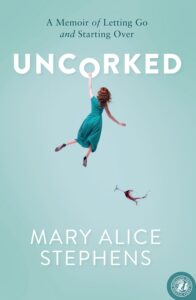 Getting sober is one thing, staying sober another…
With a glorious bang, alcohol freed Mary Stephens from her lonely, self-critical teenage shell and fueled Fun Mary. For three decades, booze had been her best friend, the reliable spark igniting good times and (she thought) good friendships. But Fun Mary had a dark side: debilitating hangovers, blackouts, and perilous behavior. Not even a three-story fall that left her in a body cast could stop her from drinking. But finally, after putting her young son in danger and her marriage in jeopardy, Fun Mary had to go.
Now sober at age 45, everything Mary once cherished becomes a trigger—date nights with her husband, friendships centered around wine, and a father who expresses his love through alcohol. This new Sober Mary is lonely and vulnerable—feelings she drank to escape. Now what?
Told with heart and humor, Uncorked: A Memoir of Letting Go and Starting Over is the inspiring and relatable story of a woman’s pursuit of a better life through sobriety.
BUY HERE
Category: On Writing
Subscribe
If you enjoyed this article, subscribe to receive more just like it.