The Magpie Way to Becoming a Writer
By Nina Schuyler
 There’s my desk. Here is a jar of my favorite pens, Pilot, Precise, V5, black ink. I keep a thesaurus here. While it’s not a room of my own (I wish, Virginia), it is a corner of the bedroom with a view—oak trees with mossy arms, squirrels doing astonishing acrobatics. Towers of books are all around me like little plants emerging from the wooden floor: fiction, nonfiction, poetry, science, philosophy. One boss called me “eclectic,” though I think “magpie” is a better description.
That boss didn’t mean it as a compliment (he saw my copy of Mrs. Dalloway on my desk) because to work for him, the managing director of an investment bank, meant to offer up undivided focus, eighty hours a week, and a mind full of numbers and money. As a magpie, I didn’t have that kind of mind. After putting together a merger proposal, I’d write a poem. I knew I had to get out of there.
So I went, as one does, to law school, where adverbs and adjectives were against the law. Thankfully, magpies are curious and know how to keep things interesting. I went to class, picked through the laws, found the new ones —the ones reshaping the landscape —and wrote about water law, criminal procedure, and discrimination. When I met with professors, I took notes, including details about comb-overs and brilliantine, and the repeated use of “hence”; how black shoes shone in the sun, and how pale an ankle looked against a black sock.
Eventually, I graduated from law school. I could now hold a massive amount of information in my brain and dissect things to the atomic level. I even took the bar exam. But I knew I had to get out of there.
With magpie wings, I flew to the legal newspaper, and I became a reporter, covering whatever needed to be covered. I loved it! Trials, lawsuits, law firm reorganization, drug court and task-based billing, the regulation of the electrical industry, on and on. If I didn’t know anything about the subject matter, I’d call the experts. No big deal. I learned to write fast. Deadlines, at first intimidating, were like espresso beans, revving me up. There wasn’t time to procrastinate. I see how much this job helped me as a fiction writer. The blank page is not a bully. I’m not intimidated. I don’t confine myself to autobiography (my life just isn’t that interesting) and follow my curiosity, which usually leads me to glorious unknown territory.
A newspaper article has a defined shape. So much is cut, dumped into the trash, huge swaths of words and paragraphs, and most of the humanity. It seemed a terrible waste. What could I do with these scraps that seemed to radiate meaning? I didn’t know but I kept collecting:
A man’s lopsided smile, an office that smelled of vanilla and dirt. (She was overwatering her palm); a sole practitioner’s wall-sized poster of Einstein sticking out his tongue; the files of tragedy on the public defender’s desk. I wrote a passage about a man who had an epileptic seizure during the interview, his face froze, his right hand shook violently. I ran to get his assistant, and by the time we got back to his office, he was on the phone with a client about shareholder liability.
I loved the irrelevant, useless details that the newsroom dismissed. I tried to knit them together into something. What kind of character smokes an unlit cigar? Or a woman who brags about working an hour after giving birth? I didn’t know what I was doing. What is a story, anyway?
After work, I willingly surrendered to the infinite imagination. Meaning: I took creative writing classes at night. The more I fed it, the more my imagination grew huge —huger—demanding more time, more mental acreage. I applied and got into an MFA program that offered night classes, 7:00-10:00 pm, and allowed you to study for 7 years (I did). My magpie-ian pile of details was incredibly valuable here; every experience, good or bad or bland, was a treasure because memory feeds the imagination and reality is the substrate for even the wildest story.
I wrote stories, poems, and a novel: The Painting, about a painting that travels from Japan to Paris during the Franco-Prussian War. It became my first published novel (Thank you, Professor Phyllis Burke, for believing in me!). I wrote more and then a second novel, The Translator, about a Japanese translator who mistranslates not only a Japanese novel but also her daughter. Then a third, Afterword about a female pioneer in artificial intelligence who brings back the voice of her beloved. My fourth, In This Ravishing World, with nine points of view, including Nature, that swirls around the climate crisis. I wrote some craft books, How to Write Stunning Sentences, and Stunning Sentences: A Creative Writing Journal (pub. January 2026). Each time, I try something different. I like collecting.
Look around. Among the towers of books are towers of papers, some nearly four feet high—revisions of novels, short stories. There’s no straight line to my desk in the corner, just as there’s no straight path to becoming a writer. Nothing to climb, no ladders, no clear road map; only a desire to do something that requires every bit of you, your imagination, logic, experience, memories, curiosity, flights of “what if,” and to sit in the thickest quiet.
—
Schuyler’s story collection, In This Ravishing World, won the 2025 PEN Oakland-Josephine Miles Literary Award and was a finalist for the Northern California Book Award. It also won the W.S. Porter Prize and the Prism Prize for Climate Literature. Her novel, Afterword, won the Foreword INDIES Book of the Year Award for Science Fiction and Literary. Her novel, The Translator, was shortlisted for the William Saroyan International Writing Prize and won the Next Generation Indie Book Award for General Fiction. The Painting was a finalist for the Northern California Book Award. The second editions of her bestselling craft books, How to Write Stunning Sentences and Stunning Sentences: A Creative Writing Journal, will be published in January 2026. Her stories have been nominated for the Pushcart Prize and won Best Microfiction 2025 and 2025 Best Small Fictions. For nearly a decade she taught for the University of San Francisco’s MFA program and currently teaches creative writing for Stanford Continuing Studies.
Stunning Sentences: A Creative Writing Journal with 80 Prompts from Beloved Authors to Improve Your Style
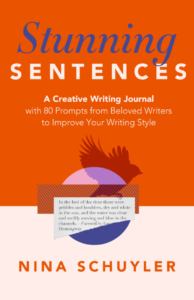 Sentences are alive. Done well, they can help us see the world anew.
To create such sentences you need fresh, varied rhythms and imagery. In this creative writing journal, Nina Schuyler, award-winning author of the bestseller How to Write Stunning Sentences, presents 80 new prompts that show the breathtaking stretch of language. With stunning sentences from beloved writers like Toni Morrison, Lauren Groff, Virginia Woolf, and Jesmyn Ward, coupled with Nina’s precise analysis, you will be excited to create your own striking sentences. This journal will renew your writing skills and allow you to see through any sentence to the bones of style.
PREORDER HERE
In This Ravishing World
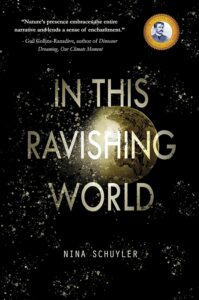 In this Ravishing World is a sweeping, impassioned short story collection, ringing out with joy, despair, and hope for the natural world. Nine connected stories unfold, bringing together an unforgettable cast of dreamers, escapists, activists, and artists, creating a kaleidoscopic view of the climate crisis. An older woman who has spent her entire life fighting for the planet sinks into despair. A young boy is determined to bring the natural world to his bleak urban reality. A scientist working to solve the plastic problem grapples with whether to have a child. A ballet dancer endeavors to inhabit the consciousness of a rat. In this Ravishing World is a full-throated chorus— with Nature joining in— marveling at the exquisite beauty of our world, and pleading, raging, and ultimately urging all of its inhabitants toward activism and resistance.
BUY HERE
Category: Contemporary Women Writers, How To and Tips
Subscribe
If you enjoyed this article, subscribe to receive more just like it.