Responsibility From Within: When You’re Bosnian, But Not a Survivor
By Amra Pajalic
 My historical mystery novel Time Kneels Between Mountains is about a young girl surviving under siege and was completed as part of a PhD in Creative Writing.
As an author I sit uneasily between insider and outsider: being Bosnian, yet not a genocide survivor. I lived in Bosnia as a child from 1985-1989 and my family lived through the war in different ways; I carry the cultural memory, the inherited trauma and the fractured sense of home.
But I did not walk through the killing fields of Srebrenica. I did not hide in the forests for days without water. And so, even as a Bosnian author, I’m not exempt from the responsibilities I place on non-Bosnian writers.
When I wrote Time Kneels Between Mountains, I found myself constantly negotiating this tension. The novel is set during the siege of Srebrenica, but I wrote it from historical knowledge, survivor testimony, ICTY transcripts, and the academic frameworks that shaped my PhD—not from memory.
And that meant I had to confront an uncomfortable truth: I am not writing my trauma. I am writing our trauma. And that difference matters.
Where I believe the novel contributes meaningfully is in its microhistorical perspective – a teenage girl trying to survive starvation, shelling, black-market corruption, and the moral decay that takes root when a community is abandoned.
Seka’s story is grounded in the everyday realities that historians like Sudetic, and Rohde, and survivor testimonies from Suljagic and Hasanovic, who documented the lived reality of Srebrenica: the queues for flour, the patriarchal restrictions intensifying under siege, the moral compromises that keep you alive one day and haunt you the next. Those details emerged from deep research, especially women’s testimonies—from Selma Leydesdorff’s narratives of survival, grief, and domestic labour under siege were foundational. I wrote to honour those voices, not overwrite them.
But the novel also has limitations. I made aesthetic decisions, compressions of time, fictionalised characters, emotional arcs, that inevitably shape how readers experience a genocide they may know nothing about. The question is whether the simplification is ethical.
The most significant tension is this: Seka investigates local corruption instead of focusing solely on the encroaching genocide. This macro-to-micro shift is historically truthful – corruption was endemic; aid did disappear; local powerbrokers did exploit hunger – but it risks reframing the siege around internal failings rather than the external machinery of genocidal intent.
I chose to write my novel as crime fiction as these are the readers who read fiction that deals with heavy themes, and so this aspect of the siege was used to re-create this plot. However, it’s a delicate balance. My intention was to show how genocide corrodes a society long before the killing begins. But intention isn’t immunity. The novel must be read alongside survivor testimony, not instead of it.
What I hold onto is the novel’s function within cultural memory. Fiction—when responsibly crafted—can make readers stay longer, feel deeper, and ask harder questions than they might when reading historical nonfiction alone.
Time Kneels Between Mountains brings Srebrenica into the intimate space of adolescence, friendship, first love, and moral awakening. It asks what resilience looks like when the world has abandoned you. It forces readers to confront a genocide not as an abstract political event, but as a daily lived reality.
But I remain wary of ever positioning my novel as the narrative. It can only ever be a narrative – one voice among many, contributing to a larger tapestry that must always be led by survivors. My responsibility, even as a Bosnian, is the same as any novelist writing genocide: to remember that I am a custodian, not an owner, of this history. My job is not to speak for survivors, but to stand beside them, amplifying the truth with as much integrity, humility, and honesty as the story demands.
Responsibility to Reveal the Research: Why the Companion Essays Matter
One of the most significant responsibilities I feel as a Bosnian writer who is neither a genocide survivor nor a detached outsider, is transparency. Fiction can illuminate, but it can also obscure. It chooses one thread out of a thousand. And when you’re writing about a genocide, those choices matter. They shape what readers think happened, why it happened, and how they emotionally locate themselves in the story.
That’s why I began writing Fragments of History: The Essays Behind the Stories, a companion book that lays bare the research underpinning Time Kneels Between Mountains. If I was going to fictionalise Srebrenica for readers, I needed to also show them the scaffolding: the primary sources, the academic debates, the survivor testimonies, the historiographical tensions, and the ethical crossroads I faced at every narrative decision.
In a world where genocide denial is rampant and misinformation spreads faster than truth, giving readers access to the research is not optional; it’s an act of resistance. The essays do several things:
- They direct readers back to primary sources, not fictionalised memory.
I draw on ICTY transcripts, UN reports, Sudetic’s investigative work, Rohde’s granular timeline of the enclave’s fall, Leydesdorff’s oral histories, Suljagic’s anecdotes of being a young person in siege and Hasanovic’s story of surviving the death march. By exposing readers to these materials, I’m inviting them to engage with the documented historical truth instead of relying solely on the emotional truth of the novel.
- They model a method.
I show how one transforms archival material into fiction without exploiting or distorting it. Readers see how I negotiated the ethics of representing trauma, how I balanced narrative with accuracy, and where I pulled back because the truth was not mine to dramatise.
- They position the novel inside a wider ecosystem of memory.
The novel is not an artefact floating on its own; it sits within cultural memory, legal memory, and familial memory. The essays explicitly articulate those connections. They make visible what Jerome de Groot calls the “paratextual frame”—the interpretive instructions that shape how fiction is read, understood, and used.
- They allow readers to interrogate me.
And that’s crucial. I don’t want readers to trust my novel blindly. I want them to question it, to cross-reference, to pause and say, “Is this how it really happened?” The essays give them the tools to do exactly that. They democratise the research behind the fiction. They make the historical record accessible.
- They challenge the passivity that fiction can sometimes create.
It’s easy for readers to consume a novel, feel moved, and move on. But engaging with testimony and archival evidence demands something different. By offering both the novel and the essays, I’m asking readers to step into that discomfort. To return to the facts rather than retreat into the safety of the story.
Ultimately, the essays complete the ethical circle:
If the novel is the emotional pathway into Srebrenica, the essays are the bridge that leads readers back out into the world of documented truth.
As a Bosnian writer contributing to the ongoing work of memory, I don’t want my fiction to be the final word. I want it to be a door. The essays are me holding it open.
—
Amra Pajalic is an award-winning Australian author, educator and indie publisher known for crafting compelling stories that blend heart, humour and heritage. Her work explores themes of identity, belonging and resilience, often drawing on her Bosnian background.
She won the 2009 Melbourne Prize for Literature’s Civic Choice Award for her debut novel The Good Daughter, re-released as Sabiha’s Dilemma (Pishukin Press, 2022). The anthology she co-edited, Growing up Muslim in Australia (Allen & Unwin, 2014), was shortlisted for the Eve Pownell Award in the 2015 Children’s Book Council of Australia Book of the Year Awards, and her memoir Things Nobody Knows But Me (Transit Lounge, 2019) was shortlisted for the 2020 National Biography Award.
Amra is committed to accessibility and inclusion in publishing. Through her micro-press, Pishukin Press, she releases her titles in a wide range of formats – including audiobook, large print, dyslexic font, paperback, ebook and hardback – to ensure all readers can experience her stories.
A Creative Brimbank Artist in Residence since 2023, when she’s not writing, Amra is podcasting on Amra’s Armchair Anecdotes, mentoring emerging writers, and delivering workshops across Australia on self-publishing, writing craft and creative resilience.
Find out more about Amra on her website https://www.amrapajalic.com/
Amra Pajalic’s book Time Kneels Between Mountains is available here.
Bibliography:
De Groot, Jerome. 2009. The Historical Novel. London: Routledge.
Hasanovic, Hasan. 2016. Surviving Srebrenica. Aberdeenshire: Lumphanan Press.
Leydesdorff, Selma. 2015. Surviving the Bosnian Genocide: The Women of Srebrenica Speak. Bloomington Indiana: Indiana University Press.
Rohde, David. 2012. Endgame: The Betrayal and Fall of Srebrenica, Europe’s Worst Massacre Since World War II. London: Penguin Books.
Sudetic, Chuck. 1998. Blood and Vengeance: One Family’s Story of the War in Bosnia. New York: W. W. Norton & Co Inc.
Suljagic Emir. 2005. Postcards from the Grave. London: Saqi Books.
TIME KNEELS BETWEEN MOUNTAINS
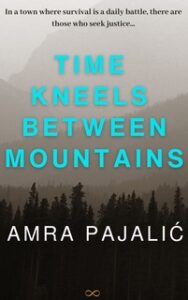 In a town where survival is a daily battle, there are those who seek justice…
Overnight, Seka Torlak’s life as a regular teenager is upended as Srebrenica, her once peaceful town, falls under siege and she faces starvation, shelling, and sniper attacks. When desperately needed antibiotics and food disappear and are sold on the black market, Seka vows to investigate the corruption and bring the culprits to justice.
As the war ravages Srebrenica, Seka’s resilience is tested as she navigates loss, fear, and the harsh realities of war. Yet, amidst the devastation, she finds a glimmer of hope as her relationship with Ramo blossoms from friendship to love. But as she fights for justice and love, will Seka triumph, or will the brutal war tear everything she holds dear apart?
BUY HERE
Category: On Writing
Subscribe
If you enjoyed this article, subscribe to receive more just like it.