How Science Shapes What I Write
On a freezing night in Illinois, I received a phone call from India.
A scene from a Bollywood movie flashed through my mind: a beautiful heroine, phone slipping from her hands, her life fracturing into a before and after, aptly depicted by the movie screen splitting into two.
But I was not, am not, a beautiful Bollywood heroine. I was a 26-year-old graduate student.
This was my life, and my mother had just died of a heart attack.
The only similarity to the heroine was my life now had a “before” and an “after.”
In the “before,” I read Mills and Boon romance novels. In the “after”, I read grief memoirs and began writing my own.
I wrote about the incomprehensible loss of you—Mummy, Mommy, Matashri—my endearments for you over the years. I wrote about how much I missed you and the tragedy of not having more time. I railed against a world that did not care that you were no longer in it, against a God who could take you away just as I was about to finish my doctorate, an accomplishment you boasted about to all our relatives.
The timing seemed cruel, almost scripted. Something plotted out in a movie, to maximize the melodrama.
As a scientist, I knew how to interpret complex data, see patterns that are hard to spot, and connect the dots. So I applied the same skills to my grief. I analyzed it, observing it like a mammalian cell under a microscope.
At 5X magnification, the cell looked intact. Just as I felt intact in my grief. A terrible thing had happened, and I needed to make sense of it. I would do so by observing and documenting—not feeling or talking about my feelings.
I wrote about the low-resolution image I saw in the microscope: the profound grief of losing the one person who would take my call in the middle of the night to listen to how mean my boss was.
“He is the worst,” you would say, encouraging me to talk to him instead of getting angry.
I wrote how unique you were—my rock, my special person.
But just as when I applied special staining and high magnification in the lab, on the page I was able to observe the endoplasmic reticulum and the essential cellular factory, twisted into whorls: the morphology of stress.
The more I wrote about the minute details, the more distorted my perfect image my mother became.
I tried to forget that I could never share with you how my heart thudded and my palms sweat whenever the headmistress came in my direction at school. I expected her to scold me in front of the entire class because my tuition was not paid on time. She saw our big house but didn’t know Papa’s business was failing, or that you couldn’t work because you were raising two daughters.
Then I zoomed out: I wrote about how well we knew each other—so much so that I did not hesitate to let you pick out my wedding lehenga without my input. The image of deep mother-daughter bond.
Then I zoomed in again.
I wrote about how desperate I was to move out of the house, where you and Papa fought about money. Love did not conquer the scarcities of life.
I couldn’t wait to return to Illinois, to that small apartment where no one shouted. I liked my solo life where my modest stipend seemed plenty for my needs.
And yet, I also looked forward to those four weeks every year with you and Papa. In the house in the quiet neighborhood of Nasik. Papa’s business was stable by then. We no longer lived in a rented apartment on the second floor. I loved the tall trees around the house and my room with the red curtains. We never talked about the past during those visits. Never questioned why I chose a career that took me so far away. Was it really just for higher education—or was it also a way to escape?
I tried not to write about the fear I carried at that time: that your love was conditional, that it depended on my success, my self-reliance. But the words spilled out on the page. Would you have loved me less if I had failed? You taught me that education was everything. A woman must earn her own money, you said, ever since I was eight. What if I had not earned a PhD or gotten a job?
Maybe I wrote to prove that my love wasn’t conditional.
Maybe I wrote to preserve the version of our relationship where we were close—where grieving you meant I was grieving the happy childhood I must have had.
You were the center of our family, the node connecting Papa, Didi and me.
After you died, the rest of us stopped sharing the specifics of our lives, as long as we were alive we were fine. But in truth, the cracks were already there a long time ago. Your death snapped us in a high-resolution image that revealed that our family was breaking long before your heart failed.
I loved you. But I never wanted to return to you.
I wanted to love you from a distance: just far enough away to feel the sweetness of missing you, without the bitterness of sharing that hard life.
Perhaps I wrote to keep the illusion alive—that we were simply unlucky, not that we were unwilling to make a greater effort to be whole. That life in India pulled us apart—not my choice to leave.
I wanted to believe I lost something perfect. That mine was a plain tragedy, like the movies. Not a complicated reality. But I was no heroine. I was a scientist.
So I returned to the microscope. To the grief. The low-resolution image gave me one kind of information—the high resolution, another. Each layer was part of reality. A reality that made me feel guilty for being relieved to be far away from you, and ungrateful for questioning your love.
My analysis of grief and collecting of data seemed to be a mature coping exercise befitting of my training—but I still float untethered in my world of “after,” studying our bond in the “before.” As I observe and re-observe the shifting morphology of a blue stained nucleus after exposure to a DNA damaging agent, I write so I can keep returning to you, to make sense of the present and the future.
THE SKY IS DIFFERENT HERE
F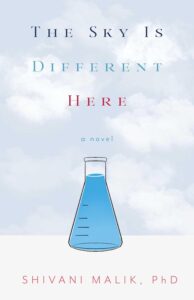 or readers of women’s fiction, a debut novel that celebrates the depths of the mother-daughter connection, and having faith in oneself among the hustle and bustle of academic life in the late-aughts.
Eight thousand miles from her Kolkata home, Shani spends most of her time hard at work in the campus biochemistry lab chasing her lifelong dream of becoming a scientist. However, following her dream proves to be anything but easy. As the daily battles and complexities of lab life escalate, she leans into the support of her biggest ally—her mother. Despite now being continents apart, they’ve always shared an unwavering belief in Shani’s dream: a future built on intellectual and financial independence.
But when her mom passes away suddenly, Shani is left adrift. The home they once shared feels foreign; her academic aspirations and the future they had dreamed of together, uncertain. Is she truly driven by genuine passion for science, or has she been trying to escape the expectations placed on her as a woman? Alone, Shani must confront these questions and discover where she truly belongs.
Shani’s journey, a poignant exploration of grief, identity, and belonging, will resonate with anyone who has ever questioned their place in the world.
BUY HERE
—
Shivani Malik was born and raised in India. She immigrated to the US to pursue her PhD and completed her training at Stanford University and University of California San Francisco. The Sky Is Different Here is her debut novel. She currently leads a group of researchers in an oncology focused biotech in San Diego where she resides with her husband and their dog.
Category: On Writing
Subscribe
If you enjoyed this article, subscribe to receive more just like it.