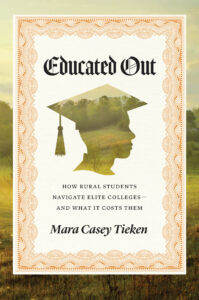
On Writing Educated Out: How Rural Students Navigate Elite Colleges—And What It Costs Them
By Mara Casey Tieken
 I spent thirteen years working on Educated Out. That’s longer than my daughter has been alive. Longer than I’ve been married. Longer than my Subaru lasted.
The book started with getting approval from my college’s Institutional Review Board—a very unexciting way to begin a book, but, because it was a research study, necessary. The IRB approval process also forced me to think through the details of the study: what are my questions? How would I answer them?
I knew that I wanted to look at college access for rural students. Years before, I’d been a third-grade teacher in rural Tennessee. Just as I was starting my first faculty job, my former third graders were graduating from high school. And, as I received graduation announcements in the mail and on Facebook, I noticed this: they weren’t going to college. I wondered why. After a year of teaching at a small, selective, liberal arts school, I had another question: what if they had gone? What would it have been like for them? For their families? And that led me to this study, in which I followed nine rural, first-generation students at an elite college.
After receiving IRB approval, I still needed funding, and I began applying to—and getting rejected for—grants. But you only need one “yes,” and, a year later, I had it.
Then I began recruiting students—in this case, sending out invitation letters, and anxiously waiting for interested students to contact me. I only got three responses that first year, and so I tried again the next year—and got six more. Nine students… students who I’d come to know intimately and who would, over the course of our years, also come to know me.
We often think of research as a one-way process, a passing of “data” from “subject” to “researcher.” But that approach is neither ethical (in fact, it’s often quite exploitative) nor useful. So much more can be learned when the relationship is actually relational.
Our lives were unfolding together. For them, it was new relationships, decisions about majors and careers, and, eventually, graduation; for me, it was marriage, tenure, and, eventually, a baby. We talked about all of these milestones, theirs and mine. One student and I commiserated over the challenges of long-distance relationships. I gave advice about picking classes and getting sleep; they told me how to write fair assignments and jump-start my car. We complained about the opacity of higher education and the challenges of balancing school, work, and life. To be clear, they encountered barriers and challenges I never faced. But we did connect over the messy realities of “growing up,” regardless of life stage. And I think these discussions kept them connected to the world beyond higher education—a world they often desperately missed.
I share these details to make two points. The first is that intensive research conducted over many years is valuable. I learned so much from my students through repeated conversation and new takes on old topics. I watched them navigate hurdle after hurdle and witnessed them changing their minds and approaches. They grew comfortable with me, and I think they shared things that they wouldn’t have in the context of a shorter, less engaged relationship. I got a more accurate understanding of the challenges—and triumphs—of college-going for rural, first-generation students. But, in general, the academy doesn’t value this kind of long-term, entangled work. It doesn’t fit easily into the three-articles-a-year formula of tenure and promotion. And so many researchers don’t do it, and we all lose out.
The second is that this book—the research and the writing—changed me. I’m a more patient researcher and writer now; my days are filled with small goals and incremental progress. I’m also a different teacher. I know exactly what college cost these students and what a degree means—and these nine students know that I know. That’s forced some accountability. So all those recommendations that I make in the book’s final chapter? I have to do them, too, and I feel obligated—in a really good way—to encourage others to do them, as well.
I think the book also shaped how I now parent that daughter that arrived in the middle of writing. I remember the anxiety I felt when the students were first-years. Because I am a professor at a similarly elite school, I knew that the classes would be hard and the transition would be rocky. Because I am a researcher of geography, I suspected that some of the challenges might be even harder and more consequential for these students, simply by virtue of their zip code. And, because I knew these students so well, I really cared. And so I dreaded what they might encounter. It made me nauseous to think of the abundant alcohol, the bad roommates, the unsafe sex—all of the dangers that awaited. I wanted to protect them, but knew I couldn’t—and shouldn’t. I also wasn’t the parent.
I thought about this as I recently watched my own daughter climb onto the bus for the first day of kindergarten. I thought about these nine students’ courage. I also thought about the grace with which their parents let them go. And so I waved, and walked home.
BUY HERE
—
Mara Casey Tieken is a professor of education at Bates College. She is also the author of Educated Out—How Rural Students Navigate Elite Colleges—and What it Cost Them (University of Chicago Press, 2025) and Why Rural Schools Matter (University of North Carolina Press, 2014).
Category: On Writing
Subscribe
If you enjoyed this article, subscribe to receive more just like it.