My Journey into the Sphere of Memoir
By Jane Little Botkin
I picked up my nine-year-old grandson from school recently. After throwing his backpack onto the car’s floorboard while climbing into the seat simultaneously, he sighed. My cue. “How was school today?”
Cam gave me a side glance. “I’m writing the story of my life, and it’s so hard.”
“Why is it hard?” I asked.
“Because I have to remember things I forgot.”
There it was. A memoirist’s predicament once she steps into the realm of recall, searching for emotional truth among facts that may not be linear, specifics that may morph unexpectedly into conjectures. When I wrote The Pink Dress, A Memoir of a Reluctant Beauty Queen, I came to this realization several chapters into my narrative. I wrote
Memories can be beguiling when good. If you have the luxury of time to puzzle the memory pieces back together for the mind’s eye, even after all that work is done, the memory may still be faulty with omissions, each rumination colored with emotion. But if the memories are abhorrently jagged—like shards of glass—and you must digest them suddenly, they may force unwelcome pain, repugnant smells, and even gut-wrenching fear to bubble out into your reality.
I had been sexually assaulted when I was seven years old, and my healing response had been to hide from the facts of the event as well as the emotional damage that my parents’ inaction caused. But such memories never disappear completely. They hide. This was not the memory I thought would enter my memoir.
I turned to Cam. “So, what do you remember?”
“The sirens,” he said.
I’m a western biographer, a historian who deals with facts. So, when I accepted an opportunity suggested by a group of authors at a writers’ conference to tell my own narrative, I began my writing process much the same way as researching and writing another woman’s story. How could the process be much different from writing about my own experiences? As it turned out, it was—and it wasn’t.
A desire for escapism is the real reason many folks turn the pages of biographies and autobiographies, including memoirs, snapshots of subjective autobiographical experiences. The allure to reading memoirs, especially, is about readers losing themselves in someone else’s “soap opera,” the author’s conflict, emotional journey, and, hopefully, resolution. Unlike biographers and autobiographers, who are inspired by true events and typically write both linearly and authentically when it comes to context, memoirists depend more on reflections and personal memories that may be faulty. I soon realized that a memoir should also include essential context for the reader while also enabling the author to discover her truth during her writing journey.
My memoir is set during the American counterculture, the 1960s and 1970s. Is that context important? You bet! If an author is writing a memoir solely for herself or family members, perhaps not so much. But if a memoirist writes for the public, readers might be able to identify with the context, whether it be time, mutual experience, shared feeling, and/or conflict, enhancing their own experiences. One reader wrote to me to say how freeing my memoir had been for her. She had grown up in a San Francisco commune and understood my personal dilemmas.
Did I recall the 1960s and 1970s well? Absolutely not. Like most memoirists, I could recall only flashes of moments, experiences, and feelings. The historian in me researched the context—Vietnam War protests, radical Weather Underground bombings on university campuses, the women’s liberation movement, and racial tensions—all documented in histories and newspaper articles that supported my account. How had I fit in? My closest friends filled in what I refused to quarry out of my brain. And, like a good storyteller, I walked my story, that is, I traveled to all the locations described in my tale so my readers could taste, see, and feel it.
My memoir did not depend on dialogue, as some propose memoirs should do, perhaps for the very reasons stated above. An author should feel free to break from norms. Aside from authentic dialogue, I enjoyed incorporating all those other literary elements—flashback and foreshadowing, prologue and epilogue, abstract and concrete description—keeping the readers on their toes. I made a linear outline first, then rearranged the narrative once I recognized the various threads I would include. The outline depended on me looking at myself in a historical sense—the rearrangement effectively incorporating reflections, words, emotions, and hard truths using literary devices.
Finally, both fact and emotional truth are key, and both should be honest. My husband and sons wanted me to leave out the personal experience I mentioned above. But I realized this event shaped how I reacted to later events. I had signed a pledge on a cocktail napkin in a San Antonio hotel bar, promising to tell the story. By the next morning, after a restless night, I knew my parents, particularly my mother, would have to be included in the narrative as well. Challenge accepted!
My grandson recalled sirens ushering a frantic population of almost 8,000 residents out of town, even as a wall of flames from an apocalyptic fire rose toward the stratosphere. It had been a horrible time for children especially, a third of their homes lost and pets left behind. Cam held a moment in his life story that had singed his memory. I knew he would sort out the facts first, but his emotional truth would carry his tale.
—
The Pink Dress: A Memoir of a Reluctant Beauty Queen
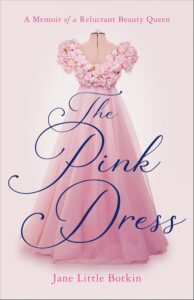 For fans of Little Miss Sunshine and Secrets of Miss America, this memoir from a national award-winning author reveals the reality of being the first Guyrex Girl in the 1970s. Beauty pageant stories have never been this raw, this real.
Growing up in West Texas, Jane Little Botkin didn’t have designs on becoming a beauty queen. But not long after joining a pageant on a whim in college, she became the first protégé of El Paso’s Richard Guy and Rex Holt, known as the “Kings of Beauty”—just as the 1970’s counterculture movement began to take off.
A pink, rose-covered gown—a Guyrex creation—symbolizes the fairy tale life that young women in Jane’s time imagined beauty queens had. Its near destruction exposes reality: the author’s failed relationship with her mother, and her parents’ failed relationship with one another. Weaving these narrative threads together is the Wild West notion that anything is possible, especially do-overs.
The Pink Dress awakens nostalgia for the 1960s and 1970s, the era’s conflicts and growth pains. A common expectation that women went to college to get “MRS” degrees—to find a husband and become a stay-at-home wife and mother—often prevailed. How does one swim upstream against this notion among feminist voices that protest “If You Want Meat, Go to a Butcher!” at beauty pageants, two flamboyant showmen, and a developing awareness of self? Torn between women’s traditional roles and what women could be, Guyrex Girls evolved, as did the author.
National award-winning author Jane Little Botkin melds personal narratives of American families, often with compelling stories of western women. Her books have won numerous awards in biography, western historical nonfiction, and women’s studies, including two Spur Awards in Biography, two Caroline Bancroft History Prizes (Denver Public Library), the Barbara Sudler Award for best book about the American West by a woman (History Colorado), and the Texas Book Award. Finalist awards include two Women Writing the West’s Willa Literary Awards, the Colorado Book Award, Oklahoma Book Award, High Plains Book Award, Foreword Reviews Indies Biography Book Award, the Sarton Book Award in Women’s Studies, and Forewords Reviews Indies Award Honorable Mention in Pop Culture. Her newest book, The Breath of a Buffalo, A Biography of Mary Ann Goodnight, will release spring 2027 from the University of Oklahoma Press.
A member of Western Writers of America since 2017 and past vice-president of its board of directors, Jane judges entries for the WWA’s prestigious Spur Award, reviews new releases, and writes articles for Roundup Magazine and other periodicals. Her August 2024 Roundup article, “How to Write an Honest Biography,” won the Women Writing the West’s Downing Journalism Award.
A late-bloomer, Jane served as a public-school teacher for thirty years before turning to historical investigation and writing. In 2008 the Texas State Legislature honored her career in education and publication of historical journals by formal resolution. Now Jane blissfully escapes into her literary world in the remote White Mountain Wilderness near Nogal, New Mexico.
Website: https://janelittlebotkin.com/
Facebook: https://www.facebook.com/JaneLittleBotkin
Instagram: https://www.instagram.com/janebotkin/
Category: How To and Tips
Subscribe
If you enjoyed this article, subscribe to receive more just like it.