From Barnyard to Bookshelf: Writing My Life as a Dairy Vet
By Linda Rhodes
Other than various essays in college, all I had experience writing were scientific papers published in peer review journals. I’m not sure why I signed up for a weeklong course in memoir writing. I knew I had some crazy stories from the late 1970’s when I was the only woman large animal veterinarian in Utah, taking care of dairy cows.
The teacher told us to spend the morning writing a scene, and we would spend the afternoon sharing our stories. When I sat down in the student lounge with my computer, a memory just poured out of me onto the page—it was a memory of a job interview where I was tasked with castrating piglets, in a dirty barn in Upstate New York, with the hiring veterinarian watching and waiting for me to fail, and then telling me that he didn’t think women were cut out for the job.
That class made me realize I had a story to tell—a story of discrimination, grit, challenges, and the tradeoffs required when you are a woman breaking into a man’s profession. If you fail, it means women can’t do the job. But I was not yet a writer, as that first class demonstrated. I wrote like a scientist. I had no idea about developing a character or getting a sense of place down on the page, or how to write dialogue. I did have a list of stories that I wanted to tell—more awful job interviews, delivering triplets by c-section, stitching up a wound on a Clydesdale horse whose kick could kill me, rescuing a bull who almost bled to death. All the animal stories.
With a full-time job and a young son, there was little time to write, but slowly each of these stories piled up in draft form on my computer. I spent the next ten years or so taking a few more writing courses at the Sarah Lawrence Writing Institute, where I worked with some very talented teachers who helped me to leave the scientist voice at work, and add depth and color to my memories.
We talked about the hero’s journey, and I realized my memoir wasn’t just good stories about my animal work, but it was also the story of who I was, my past, my marriage and its issues, all the messy personal stuff that makes up a compelling character. I went on a quest, I encountered many obstacles along the way, I met a final challenge and overcame it, and returned back home with some wisdom.
I added smells to my descriptions, and color and sounds. The hay barn smelled like fresh oats, the golden bales stacked up to the ceiling, the straw crackling under my feet. One teacher told me that every time I introduced a new person in the book, I mentioned their hair! I hadn’t noticed, and I worked harder on descriptions. I read many memoirs and noticed how other authors described people. That helped.
The book was called Lady Cow Vet, as that is the name my dairymen gave me, once they decided a woman could, after all, do the job. When I went to my first conference on publishing, everyone told me the book was too long. My manuscript had grown to over 120,000 words as I included long sections of how I managed to get into vet school and many stories about those four years as a student. Chop all that out, was the good advice I got at that conference, difficult surgery, but necessary to make the patient live.
Now I had a manuscript that needed additional work, but was about 80,000 words, much more readable. After many queries, I finally got an agent, who informed me that I had to write a book proposal, which was news to me, and I spent another nine months on getting a proposal into shape that my agent liked. She took it to thirteen publishers, and in spite of some very nice comments, no one wanted it, and worse, my agent decided publishing was not for her, and she quit, giving me the rights to the book back.
I sent the manuscript to a variety of small presses and independent publishers, and got a lot of feedback, most of it unhelpful. While this was going on, I was editing. Each sentence got a hard look. I deleted a lot of unnecessary words. It’s amazing that each time you read a page, you can find more words that don’t need to be there.
One publisher told me they had been waiting for a “lady James Herriot” to come along, and they had so hoped it would be my book, but they were disappointed and suggested I hire a “developmental editor” and completely redo the book. My gut told me they were wrong, that the book they wanted wasn’t my book. I ignored them.
Finally, one of my wonderful writing teachers suggested I send a chapter to University of Nevada Press, as she thought the editor there might like it. Sure enough, she was right, and after a long process of their editorial review, two peer reviews, and their Board review, they sent me a contract.
Many of my readers say they are surprised at how vulnerable I was willing to be in the memoir. My memoir tells the story of how difficult it was, so long ago, to succeed in a man’s world, with very few resources except my training and determination. I hope readers come away with some inspiration about following dreams, combined with a real understanding of what it takes to go up against tough odds. I think that grit I learned in the barn is what helped me not give up on an almost twenty-year journey to write this book and get it out into the world.
—
Linda Rhodes began her career as a dairy cow veterinarian after she graduated from the University of Pennsylvania summa cum laude in 1978. After several years in dairy practice, she was granted a fellowship at Cornell University, where she obtained her PhD in 1988. The rest of her career was spent in the pharmaceutical industry, helping to develop medicines for many species of animals. She retired in 2016 and has subsequently served on several corporate and start-up boards in the animal health industry. She has received the Iron Paw Award for her lifetime achievements. Breaking the
Breaking the Barnyard Barrier: A Woman Veterinarian Paves the Way
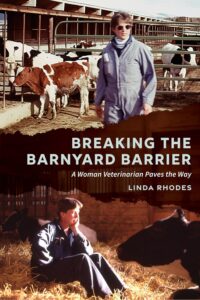 In the late 1970s the golden valley between Utah’s Wasatch Mountains was home to some of the best dairies in the country. That was also where Linda Rhodes, a newly minted large animal veterinarian, had to prove that a woman could do what the Mormon dairymen were sure was a man’s job. She was often scared that they were right. Throughout her experience, she tackled a menagerie of challenging medical and surgical cases that forced her to be fearless. Every bovine life she saved helped her confidence grow, but each failure left her feeling defeated—as did the mounting tensions between pursuing a demanding career and saving a crumbling marriage.
In Breaking the Barnyard Barrier, Linda Rhodes tells the story of how a woman, through grit and tears, made her way in a man’s world and blazed a path that prevailed against career stereotypes.
BUY HERE
Category: On Writing
Subscribe
If you enjoyed this article, subscribe to receive more just like it.