Naked Writing: On Truth, Vulnerability, and the Words We Didn’t Know We Had
By Marijke McCandless
Nearly a hundred of us had gathered for a three-day retreat hosted by Outwild™, devoted to building outdoor, value-driven lives. On the second afternoon, we sat beneath long wooden shelters at Earth Trek Retreat Center, the South Fork of the American River flowing beside us in Lotus, California. I was leading a session titled “Going Outwild Inside: Cultivating a Writing Practice.”
Most of the group were hikers, climbers, and big-dream adventurers. Few considered themselves writers. Some had admitted they were skeptical. Still, I suspected stories were waiting just beneath the surface.
We had finished a five-minute write in response to a simple two-word prompt, “I remember…” When the timer ended, I asked if anyone wanted to share.
A man raised his hand.
“I almost didn’t come to this,” he said. “I’m not a writer. But… I didn’t know this was inside me.”
He began to read. In his unedited words, he found himself at his mother’s deathbed—writing about what had gone unsaid, about gratitude tangled with regret, about loving someone imperfectly and fully at once. His voice trembled. Tears slid down his face. I felt my own rise. Around us, others wiped their eyes.
The river moved steadily in the background, but our circle had gone still. In five raw minutes, a man who had entered guarded now stood open. His vulnerability widened the space for all of us. It wasn’t a dramatic life story. It was a five-minute moment. But it carried the emotional weight of an entire memoir.
This unexpected impact is the power of “Naked Writing.” In a few unguarded minutes, it can reveal the heart of a lived moment — the place where we stop performing and start telling the truth.
Naked Writing is both simple and disarming. It is similar to a practice called freewriting — pioneered by Natalie Goldberg — but I think of it as a kind of creative undressing. We write to a brief, open-ended prompt for a set amount of time. We keep the hand moving. We don’t edit. We don’t think. We don’t worry about grammar, punctuation, or eloquence. We are free to write the worst junk in the world.
When we do, something truer begins to surface. We start to hear our natural voice — the rhythm and language that belong uniquely to us. We notice the images and themes that arise without effort. The blank page becomes less an adversary and more an invitation to discover what wants to be said.
Naked Writing has a secondary benefit, too. When we dare to share our uncurated words, we invite others into something real. On the flip side, as readers, we learn an important tool for writers—how to listen deeply. When one person allows themselves to be vulnerable, it opens a pathway to connection. It becomes clear that it isn’t polished perfection that draws us in but authenticity.
Over the years, I have repeatedly seen the impact of this practice. I started teaching a version of it that I call Write Now Mind just before COVID. Writers participate online on their own schedule, offering only anonymous feedback. What astounded me was the sense of community that quickly formed among people around the world who had never met or even seen each other, didn’t even know each other’s names, yet still felt connected.
Not only has Naked Writing fostered a sense of community among disparate people, but it has also been a formidable writing technique in its own right.
I taught a version of this class, called Write by the Sea, a couple of years ago while in Loreto, Mexico. One 66-year-old woman joined the class. She had never written anything before, had been a housecleaner her whole life, and didn’t even journal — yet she decided to participate. I was struck by her very first three-minute timed writing, in which she wrote about her beloved sewing room: the colors of bits of fabric, the comforting hum of her machine, the quiet joy of creating. A year later, she transformed this image into a five-page essay — her very first — using her sewing as a metaphor to revisit and reframe difficult childhood experiences: ripping out seams, backstitching her life, mending what had been torn. This summer, she entered the San Miguel de Allende Conference memoir essay contest — and won first place.
Naked Writing permits us to stop editing ourselves, to sit with what surfaces, and to follow it wherever it leads. It reminds us that the path to truth — both on the page and in life — is rarely straight. It winds through memory, sensation, and the unguarded corners of the heart.
The river beside us that day has become my reminder: writing, like water, already knows where it wants to go. Our only job is to stop blocking it. And when we share what emerges, we open a space for connection, empathy, and even healing.
—
Marijke McCandless is a writer, mindfulness coach, and playfulness instigator whose work explores the intersection of presence, truth, and storytelling. Her latest book, Naked in the Now: Juicy Practices for Getting Present, won the Chanticleer Grand Prize for Mind and Spirit in 2024. Through her Naked Writing workshops — offered online and in locations from California to Mexico — she has helped writers at every level discover the stories only they can tell. She believes the path to truth on the page runs straight through the unguarded heart.
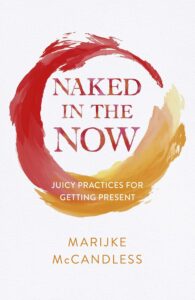 Start the New Year fully present—what if getting present felt less like work and more like being seduced by life? Naked in the Now invites you to awaken to joy, curiosity, and connection—one playful, mindful moment at a time. Even just minutes per day can open the doorway to a life that feels lighter, freer, and more alive.
GRAND PRIZE WINNER – CIBA 2024 Mind & Spirit Awards (Non-fiction)
“Get it!” verdict from Kirkus Reviews
Award-winning author Marijke McCandless shares short, practical exercises that help you:
- Feel more grounded and alive without needing to “fix” yourself
- Spark insight and self-compassion
- Quiet the inner critic
- Encourage authenticity, play, and connection
- Reconnect you to what really matters
Highly praised by readers for its fresh, transformative approach, this book is your gentle invitation back to yourself. “Brimming with practical insights to help you forge a deeper connection with your true essence. Consider this book a trusted companion.” – Ari Honarvar, A Girl Called Rumi
Other accolades include:
- GOLD Medal – Readers’ Favorite 2024, New Age Non-fiction
- FINALIST – 19th Annual NIEA Awards 2024, New Age Non-fiction
- SILVER – Wishing Shelf Book Awards 2024, Non-fiction
- International Impact Book Awards – Personal Growth
Tiny practices. Real relief. A fresh way to feel better—starting today.
BUY HERE
Category: On Writing
Subscribe
If you enjoyed this article, subscribe to receive more just like it.