The Silence Between Headlines
By Fartumo Kusow
Most writers would agree that fiction grows from lived experience. That is, real life and imagination meet at the point where humanity reveals itself. It is in that meeting place that fiction finds its purpose. Not to replicate events, but to illuminate their human core. As Alice Munro once said, stories are often “real but not true.” They take their emotional truth from the world around us.
It was in this spirit that, in 2014, news of the Chibok schoolgirls’ kidnapping by Boko Haram became the catalyst for Winter of My Spring. The world responded to the tragedy swiftly. Public figures amplified the hashtag #BringBackOurGirls and for a moment, global attention turned toward the girls. The solidarity was powerful. Yet as I watched the coverage, I became aware that the conversation revolved around governments, policies, and outrage. The girls themselves remained distant, reduced to numbers and photographs. Their voices, their thoughts, their fears, their future left silent. I wondered: What were they thinking in those first hours? Were they comforting one another? Were they remembering home? Were they angry? Afraid? Hopeful? Those unanswered questions unsettled me more than the headlines themselves.
As the news cycles moved, public attention shifted away from the girls, but I could not stop imagining the interior world. I thought about their whispered conversations after dark, the small gestures of comfort, the quiet negotiations between fear and hope that must have taken place in the privacy of their thoughts. Did they create a refuge within their memories: a mother’s voice, a classroom desk, the ordinary rhythm of a morning that now felt impossibly distant. I began to understand that what troubled me most was not only the violence done to them, but the absence of their voices in the global narrative.
When we speak of girls only as victims, we risk flattening them. We see what was done to them, but not who they are. They become symbols of terror, of politics, of outrage, rather than young women with distinct fears, humor, faith, and longing. And symbols, however powerful, are easier to distance than people. The more I reflected on their absence from the storyline, the more I felt the limits of outrage alone imposes on the account. Solidarity is necessary. Advocacy matters.
But I am a novelist. My contribution cannot be policy or protest. It has to be story. Story allows us to enter where statistics cannot, into thought, memory, and contradiction. That is the role Winter of My Spring is attempting to play. Having the characters speak for themselves, describe life under their captors and face painful rejection after escape, forms the core of this story.
It was important to me that the girls maintain their agency as they narrate the assault and abuse they had experienced. Even in captivity, I wanted them to think, to question, to choose however limited those choices might be. I felt an immense responsibility in writing this novel because I know these girls are not statistics. They are daughters, sisters, dreamers. I know what it means to be silenced. I lost my daughter to femicide and my mother to Alzheimer’s, two different ways of silencing. I watched my mother’s words slip away slowly. Sentences that once came easily began to falter. She would search for a name, for a memory, and sometimes find nothing.
It was a gradual erasing, almost imperceptible at first, until silence filled the spaces where language had once lived. My daughter’s silence was different. It was sudden and irreversible. A future that had just begun to unfold was taken from her. The dreams she carried, the life she was building, were cut short. Grief has made me acutely aware of how a woman’s voice can be diminished by illness, taken by violence, or overlooked by society. Silence, I have learned, is rarely neutral. That is why giving the girls the space to tell their story was crucial.
When I thought of the kidnapped girls, I could not allow them to remain invisible in my imagination. Giving them the room to share their account was not only a creative decision; it was a responsibility. Fiction cannot undo violence. But it can insist on humanity. It can refuse silence. And in giving these girls imagined voices, I hope readers listen more closely to the real ones around them. That is where fiction begins for me, in the space between what is real and what must be imagined so that we do not forget one another’s humanity. Writing this novel became my way of answering the question that first haunted me: If they could speak, what would they say? Stories may not change the past, but they can change how we see. And sometimes, that is where change truly begins. In listening.
—
Fartumo Kusow was born in Somalia but immigrated to Canada in 1991 at the start of Somalia’s civil war. Her novel Tale of a Boon’s Wife, published in 2017, received positive reviews from Harvard Review, Booklist, and This Magazine. Her first novel, Amran, was serialized in October Star, Somalia’s national newspaper, in 1984. She is the creator and host of two podcasts: Break the Silence, Build a Future, dedicated to advocacy and empowering survivors of intimate partner violence, and My Mother: The Person and the Patient. Fartumo lives in Windsor, Ontario, Canada.
Find out more about Fartumo on her website https://fartumokusow.com/
—
Winter of My Spring
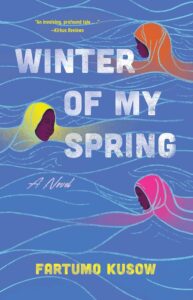 Perfect for readers of The Girl with the Louding Voice by Abi Daré, a searing and timely novel of survival, resilience, and reclaiming identity in the face of unthinkable adversity.
Set in the Lower Shabeele region of Somalia, Winter of My Spring is a story of what happens to Rada and her friends Mika and Sara after they are kidnapped by Al-Shabaab and forced to become child brides. For months, the girls live in fear and endure the harshest of conditions among their extremist kidnappers—but after Rada and Mika see Sara die as a suicide bomber, they know they must escape.
After running away from their captors, Rada and Mika manage to return home, only to find themselves rejected by their community because they’ve “known a man’s bed” and are therefore, according to their customs, considered ruined and broken women.
Winter of My Spring explores what happens to kidnapped girls during their captivity and after they survive the violence and abuse of their abductors. Like the protagonist in Call Her Freedom, by Tara Dorabji, Rada and Mika are forced to navigate a world that denies them autonomy, yet they find resilience and hope in the process of healing and self-discovery.
BUY HERE
Category: On Writing
Subscribe
If you enjoyed this article, subscribe to receive more just like it.