Owning the Story: Marie Kuipers on Healing, Humor, and Writing We’re All Mad Here
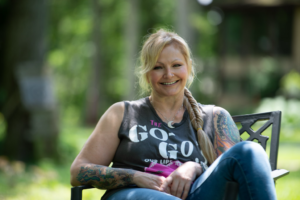 In her fearless and deeply personal memoir, We’re All Mad Here, Marie Kuipers transforms a lifetime of complicated family dynamics, survival, and healing into a story that speaks powerfully to women navigating their own pasts. With striking honesty and a sharp sense of humor, Kuipers explores how the chaos of childhood can shape a woman’s identity, relationships, and resilience—and how reclaiming one’s voice can become an act of liberation. Her memoir is not only a reflection on trauma and growth, but also a reminder of the strength women carry when they confront difficult truths and tell their stories anyway. In the conversation below, Kuipers discusses the emotional journey of writing her memoir, the role humor played in her healing, and why she believes women sharing their stories can help others feel seen, understood, and less alone.
What was the moment when you realized your life experiences could become the foundation for a memoir like We’re All Mad Here?
I think the moment I knew it was important for me to write this book was the moment I realized that my life experiences were NOT NORMAL. That all the chaos and trauma that surrounded me as an adult were actually echoes (i.e., foregone conclusions) from the absolutely bonkers dysfunction of my childhood family. I assumed that everyone’s mother was frantically informing their five-year-old kid that each new freckle or sore throat was Probably Cancer. That 20 years later, that same mother would be breaking into her grown daughter’s house to look for her murdered corpse every time that daughter didn’t answer the landline. It wasn’t until I started telling those stories that I understood how far that life was from most people’s reality. That I didn’t have the same story as everyone else.
Writing honestly about family dynamics and personal struggles can be difficult. How did you decide which parts of your story to share and which to keep private?
There honestly wasn’t much that I kept private. Aside from withholding certain details that may have been harmful to living humans (the ones I like, anyway), I didn’t hold back any of it. That was the whole point. You can’t tell a story like mine politely. The extremes are where the truth is: My mother was kind and generous; she was also, at times, an absolute monster whose refusal to tend to her mental health broke things. Both can be true. I wrote this book with a kind of manic honesty that I felt was the only option. I also did it after both of my parents were dead, so I didn’t have to worry about getting in trouble.
Memoirs often require revisiting painful or complicated memories. What was the emotional process like for you while writing this book?
I wrote the book with the benefit and perspective of some pretty profound healing; the stories were ones I’d told, dissected and analyzed for decades in therapy, and they really couldn’t hurt me anymore. I’d already done the terrible work of dredging and discovery, so it felt more like transcribing my memories onto the page for the benefit of the people who might need to hear them. It was actually a pretty joyful process, which I do realize sounds bananas. Like, “Yay, today I’m gonna write about the time my ex-husband catfished and terrorized me while I sat trembling and trapped in my home holding a very large gun while he circled the block for hours! Good times.” But truly, the power that those memories had over me was already long gone. The book just came out of me.
Your voice balances vulnerability with humor. How did you find that tone while telling such personal stories?
Using humor was the only way for me to tell these stories. It’s elemental to who I am, and to how I’ve survived. Permitting people to laugh at the absolute bedlam of my life will hopefully encourage them to look at some of their own damage through a different lens. Making those dark realities relatable and communal is my way of bringing them into the light. And shifting focus from victimhood to ownership creates a huge shift towards freedom from that darkness. It’s liberating to realize that just because something is cripplingly painful doesn’t mean it can’t also be hilarious. It most certainly can.
Did writing We’re All Mad Here change the way you see your past, or even yourself, as a storyteller?
Not necessarily, but it did reinforce my sense of how important it is for folks to tell their own stories. It’s been mindblowing how many people have written to tell me how much it meant to them to hear someone else “say it out loud,” even when their painful details were different from mine. How they felt less alone in their damage. How they felt seen, understood, and hopeful in their healing journey. That’s the power of storytelling.
What advice would you give women who feel they have powerful stories to tell but aren’t sure how to begin writing them?
My advice is not to try to do it alone. Surround yourself with people who will hold space for you while you go through the process — anyone who discourages you or makes you feel silly for having the audacity needs to be escorted off the premises, at least while you’re at it. Writers already have enough paralyzing self-doubt and flimsy excuses as to why they shouldn’t do it…We don’t need anything added to that noise. Hire a book coach if you can. They have invaluable insights into the technical elements and architecture of turning a story into an actual book. They also serve as your hand-holder, cheerleader, tissue-passer, and accountability police (if you get a good one). Find other in-process writers and form an emotional support coven. Having a supportive team is essential.
Looking back now that the book is finished, what do you hope readers, especially other women writers, take away from your journey?
I want them to know that healing is possible. Bravery is badass. Laughter is non-negotiable. And the world needs their stories.
—
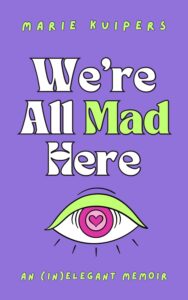 If it’s not one thing, it’s a mother.
Fiercely opinionated and unapologetically peculiar, Marie Kuipers points to her New Jersey upbringing for her no-f*cks-given philosophy. As for why she spent most of her adult life underemployed, she credits her mom—who believes she knows better than God Himself—for that.
As if ties to the Dirty Jerz and Ol’ Sky Dad weren’t enough, add a psychotic catfishing ex-husband, a lifesaving Solo cup, heaps of grief, and a dash of Lyme, and you’ve got the recipe for a (mostly) hilarious roller-coaster ride of a read.
We’re All Mad Here dares to peer behind the curtain of one woman’s unhinged life. Meet Bucky, the depraved, wildly inappropriate rescue pup. Join her in censuring such horrors as murderous umbrellas and, obviously, Steely Dan. Experience the epiphany that saves a beloved rooster from an evil HOA Karen. Bond over such atrocities as puke, the patriarchy, and plus-sized effrontery. Find unexpected solace in a simple feather. We’re All Mad Here forms the gooey center of a Venn diagram for “dark,” “irreverent,” and “raucously funny.”
This collection of sketches explores life as an outlier in a family bound by generational trauma. For everyone who has dreamed of conquering calamity, embracing chaos, or banging a hot vampire, We’re All Mad Here plunges you into a maelstrom of heartbreak, hilarity, and, finally, forgiveness.
BUY HERE
—
Marie Kuipers is the “Grammar Hammer,” an eagle-eyed copy editor and proofreader dedicated to fine-tuning even the clunkiest prose, making it purr like a horny cougar. She graduated from Georgetown University two hundred years ago and holds an editing certification from the prestigious University of Chicago Graham School, which, according to her mother, makes her “unemployable.” She lives with an assortment of flatulent dogs and coddled chickens near Chicago, where she coaches junior roller derby while still longing for New Jersey and its dubious assortment of encased meats. This is her first book.
For more info on Marie Kuipers, please visit https://www.mariekuipers.com/
Category: Interviews, On Writing
Subscribe
If you enjoyed this article, subscribe to receive more just like it.