Plotting a Novel by Reanimating the Objective Correlative (And Imagining a Near-Future Plagued by Organ Traffickers) by Lee Upton
Several years ago I came across a newspaper article about tourists who died while abroad. When their bodies were returned to their home country a terrible discovery was made: their internal organs had been removed.
The memory of that article festered as a nightmare.
The statistics I’ve seen replicated most often come from the World Health Organization—it’s estimated that 10 to 20 percent of organs are harvested illegally. The United Nations reports that illegal organ removal may amount to as much as 1.7 billion in profits for trafficking networks. Most often kidneys and portions of livers are procured from impoverished people lured by false promises. In some cases multiple major organs are forcibly removed, leading to death. Reading more about the commodifying of human organs and the extreme horror of such violence led me to write The Withers. Organ donations save lives, but my novel is set in a future imaginary world where medical protocols depart dramatically from ethical standards requiring that brain or circulatory death must be determined by a medical team before organs are retrieved.
In terms of crafting a dystopian novel in which the near-future gives rise to widespread organ trafficking, it was helpful to remember T. S. Eliot’s popularizing of the notion of the objective correlative: “a set of objects, a situation, a chain of events which shall be the formula of that particular emotion.” Published in 1919, Eliot’s definition still remains useful as a way to consider how a plot may be based on a recurrent dynamic in which the actual and the symbolic elements in a novel are connected and sustained. While not part of a “formula” for writing my novel, organ trafficking performed as a reverberant situational matrix of sorts that kept leading toward more plot elements and more questions about trauma and our varying experiences of bodily integrity.
I didn’t want organ trafficking to be the only focus of the novel—and I didn’t plan to write a novel that was bleak and somber, although I knew that the balance between dread and hope would be a challenge for some of my characters. I wanted to write about loss, betrayal, deep friendship, developing love.
For The Withers I sought an underlying cohesiveness, and that’s where the idea of reanimating the notion of an objective correlative proved helpful. Considering organ piracy led me toward enacting multiple other threats, including new forms of prejudice and chronic injustice, and even seemingly small moments of emotional manipulation. I soon thought about how magical thinking allows some of us to imagine we can avoid grief and how relationships may be transactional and propelled by unspoken power dynamics. Organ trafficking even informed my depictions of traditional romantic attraction as physical and psychological boundaries became permeable.
In The Withers an epidemic linked to a food-borne illness creates organ failure in a genetically predisposed population in much of the northeastern United States. The government mobilizes pop-up clinics and fast-tracks new hospital complexes that adapt to the emergency through unregulated experiments. Rogue agencies develop, and artificial organs and new antibiotics save many while a subset of sufferers, due to their genetic makeup, survive only through experimental transplantation of diseased human organs.
An unexpected consequence: such transplant recipients inadvertently develop “withers,” glistening scale-like formations. My novel’s primary character, Riatta, describes the withers on her skin as “little constellations [that] spread and clustered and began their ascent, sometimes breaking apart, sometimes joining. It was like watching coral reefs forming in fast motion.”
A dysfunctional culture will target the innocent. In my novel those with withers are repeatedly scapegoated and endangered. Within the novel’s broader culture, the withers are reminiscent of what most would rather forget: the widespread death and suffering as well as the still murky source of the epidemic.
I finished the first several drafts of the novel before Covid struck, but what I wrote tracks with many experiences of the pandemic and our post-pandemic period: the “warp speed” of early medical interventions, the emergence of uncanny symptoms among the suffering, the proliferation of conspiracy theories and, as the pandemic appeared to ebb, the profound desire to forget the particulars governing the fear and uncertainty that we had endured.
The Withers is narrated by Riatta, destitute and weakened from the epidemic and the after-effects of a mandated heart transplant. She is taken into the home of a married couple: a therapist and her husband, the surgeon who was among those who saved her life through experimental protocols. Although tucked away with the couple and their small child in a housing development, Riatta becomes increasingly endangered as she seeks to protect her friends from murderous traffickers.
The plot of The Withers may sound grim, but friendships deepen into love, and characters who are marked by withers are given a sly power: their exuberant irreverence allows them to laugh at the exalted sense of superiority of the medical professionals who treat them. Their humor provides transgressive moments for rendering their resistance active. Riatta and her friend Diana, both marked by withers, refuse to collude in the dehumanization that their society has not only tolerated but reinforced.
A last note: My novel was already edited and typeset when I read a BBC report of the chilling conversation between Russian President Putin and Chinese President Xi. In September 2025 they discussed organ transplantation as a way to extend life far beyond the natural age span. They chatted, seemingly with the comfortable expectation that organs could easily be accessed for that purpose. With all the horror that their conversation implies, how could we not shiver at the escalating prospect of organ trafficking, as well as the continual regeneration of dictators?
—
Lee Upton is a multi-genre author who was named a semi-finalist for the 2026 Thurber Prize in American Humor Writing for her comic novel Tabitha, Get Up. A sequel, Tabitha, Stay Up, is forthcoming in September 2026. She is also the author of the literary mystery Wrongful (2025) and the dystopian thriller, The Withers, which will appear in June 2026. Her poetry has appeared in the New Yorker, Poetry, Agni, and in many other magazines as well as three editions of Best American Poetry. A volume of her new and selected poems is forthcoming in 2027 from Saturnalia Books. www.leeupton.com.
THE WITHERS
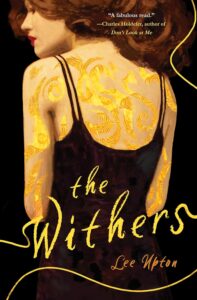 In the aftermath of a devastating epidemic, bodies marked with eerie patterns called withers become symbols of a painful past— a past many want to forget. Riatta, one of the marked, finds herself cast out, a survivor of controversial surgeries that saved her life but cost her everything else. Seeking refuge, she recovers in the home of a surgeon who once saved her. But when she learns his wife is pregnant, a shadow falls over this fragile sanctuary.
Ruthless organ traffickers roam the streets, and Riatta is drawn into a desperate fight to protect the unborn child and her friends. With what Lisa Gornick calls “ the creeping terror of a Grimm’ s fairy tale,” The Withers is a haunting exploration of obsession, loss, loyalty, and the fragile threads of memory. In a world plagued by betrayal, can trust ever be reclaimed?
PREORDER HERE
Category: On Writing
Subscribe
If you enjoyed this article, subscribe to receive more just like it.