A Sentimental Hoarder and Her Accidental Memoir By Erin O’Malley
Progress doesn’t happen in a straight line—and neither did writing my book.
It started with a letter.
Back in 2014, a new Lusitano website advertised a launching competition. The grand prize: a week at a Portuguese hacienda called Herdade Pero Viegas, with daily riding lessons from working equitation pro Nuno Jose Avelar. To enter, you had to answer four trivia questions and explain your “motivation” in a short letter.
Turns out, they liked the letter. I won.
Only the letter hadn’t come from me; it had come from my horse, Arty. He explained how his new mama needed guidance from Lusitano aficionados so she could become a better owner and rider.
The trip was a once-in-a-lifetime experience. After, the website’s founders invited me to write a bi-weekly blog from Arty’s point of view. A few months later, a small press publisher reached out to say she thought I had a book in me.
That’s when I began writing Arty’s life story in earnest—as a novel. I prefer writing in the early morning. That liminal state between dreaming and waking is when I have my best ideas. I also love to light a candle when I “sit in the chair.” For this book, I burned Homesick candles: Brazil, France, Summer Camp. And Grey Horse Candles: Wash Rack, Trail Ride, Fresh Cut Hay.
I wrote what I knew from personal experience and interviewed others to fill in the gaps. Where details were limited, as they often are with horses, I made educated guesses. What I couldn’t know at all, I invented.
I’d heard writers talk about characters appearing on the page out of nowhere. But I’d also heard about runners getting a second wind.
Right.
Then one day, a new character was there. Then, another. Those moments became some of my favorites in the writing process, when I trusted my imagination to bring me someone new. Or take me somewhere I’d never been.
Like into a horse’s mind.
Writing from a horse’s point of view was not without its challenges. As much as I beg of the reader a willing suspension of disbelief—for example, Arty knowing about art and history—I had to constantly ask myself, would a horse know this? Would he describe it that way? And if he did, would a reader stop and go, no way?
About seventy percent through, I hired a developmental editor. One of her first questions was: Why are you writing this story?
Out of nowhere, it hit me.
“I’m an Army brat. I know what it’s like to be moved around without a choice. The same happens to horses every day. It wasn’t easy for me, and I knew what was happening; horses don’t. One day, a horse is home, with its herd; the next, stuffed into a metal box, hauled for hours or days, dropped somewhere unfamiliar and frightening, often never to return to the security of known routines, friendships, lives. I wanted to give a horse a voice—because horses helped me find mine.”
She immediately suggested I weave my own story into the book.
I immediately laughed. Then added: No one wants to read about me.
“Try,” she said. “See what happens.”
The process of writing is writing—and then rewriting. Countless times.
My editor encouraged me not to constrain myself with a linear story as I thought how to cherry-pick the relevant bits of my life, braid the narratives, differentiate our voices. I worked for a few months before resubmitting my pages.
She came back: “I think it needs to be chronological after all. Like Arty’s.”
What did I say about rewriting?
I spent more months chopping chapters, rearranging, rewriting, once again fixing transitions (nightmare!)—and learning that just because something happened didn’t mean it belonged. Significant events in my life didn’t make the cut. But boy did I plow through old memories.
Some call me overly sentimental; others, a hoarder. I’d split the difference and say I’m a saver. I used to tell people I kept old letters, school papers, drawings, you name it, for my memoirs. It was a joke. I never intended to write a memoir. I just can’t get rid of anything.
I went on an archaeological dig in my musty Pacific Northwest garage. Or rather, I sent my husband up the creaky attic stairs for the Snoopy journals with pointless locks, the angsty leather-bound ones from college and grad school, including one documenting a solo trip to the Camargue, where I went to escape a scandalous kiss and ride white ponies on a beach. A reacquaintance with a childhood love. Heaven.
When I told my mom about some of the attic relics, she surprised me. She’s not a saver—she loves to throw things out. But turned out, she’d kept every letter she’d exchanged with her mother when we lived in Germany in the early seventies. She dug them out, went through them, and found one that said: “She wants a horse. But not any horse will do. She insists it be a white horse.”
I have never not loved horses, but I never knew I’d asked for a white horse when I was two years old. It felt like a prophecy—and meeting Arty four decades later was its fulfilment.
—
ERIN O’MALLEY is a lifelong horse lover and reluctant extrovert who credits her love of telling stories to her upbringing as an Army brat. She began her career in Paris, working for Hearst Publications on magazines like Harper’s Bazaar, Marie Claire, Cosmopolitan, and Town & Country, before transitioning into tech, where she focused on marketing and content strategy. She lives near Seattle with her husband, two horses, and three dogs. The Brat and the Bullfighter marks her publishing debut.
The Brat and the Bullfighter: A Love Story
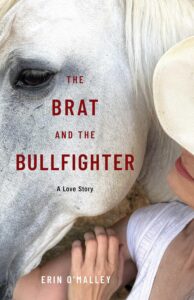 A heartwarming dual-perspective memoir for fans of The Ride of Her Life and Horse Crazy, The Brat and the Bullfighter explores how a misunderstood Lusitano stallion and an uprooted Army brat find healing, belonging, and each other.
Some horses don’t just change your life, they save it.
Arty’s blood runs hot. White hot. A white Lusitano stallion with bullfighting in his bones, he was born on a prestigious Brazilian farm and sold through an elite auction to a private ranch in California. There, human misunderstanding dims his brilliance. Rider after rider mistakes his sensitivity for defiance, eroding his confidence and trust.
As an Army brat, Erin relates. She grew up always moving—the perpetual new kid, never quite belonging, rarely feeling understood. Her love for horses was her only constant. So, when Arty’s owner recognizes he needs something different and offers to sell him to her, she can’t refuse.
What follows isn’t a fairytale. Erin questions everything: her choices, her ability, whether she’s helping or hurting him. But when unexpected loss shatters her, Arty steps forward to light a path through darkness.
Told from both human and horse perspectives, The Brat and the Bullfighter is a dual coming-of-age memoir about trust, love, and the bond that forms between two souls who, in finding each other, finally find home.
BUY HERE
Category: On Writing
Subscribe
If you enjoyed this article, subscribe to receive more just like it.