Edith Netter: On Writing
How to tell a story that’s intimate and true when the people you want to write about didn’t talk about themselves, left no diaries or letters, and are no longer alive? This was my challenge when I wrote “The House at Schumannstrasse 7”, about my grandmother who escaped two countries during two world wars and survived.
As a child I knew something bad had occurred – there was a reason my family left Germany – but no one explained why, until I was in high school, which was during the sixties and people started using the word “Holocaust” to describe what had happened to the Jews. As if a spigot opened, my father began to talk about the past: the house his parents had built in southwestern Germany, where the family lived until the Nazis threw them out and sent my grandfather to Dachau; the internment camps where the British imprisoned my grandfather during WWI because he was German and my father and grandfather during WWII because they were Jews; and the way each member of my family fled Germany, including my grandmother’s escape by “covered carriage.”
No one else in my family spoke of the past, including my grandmother with whom I wasn’t close – she was kind and attentive, but not warm – but I admired her. She was smart, sophisticated, forward-thinking, and strong. She made sure her family got out of Germany before she fled to safety in the United States. I couldn’t imagine how she coped alone – her husband and children were in England – in a foreign country. Her status changed dramatically. She who once had servants in her own home, became a housekeeper for a Cleveland family. She lived a drama I could comprehend, but it sounded awful. This was my thought in high school, but it has stuck with me.
In some respects, my grandmother’s story was ordinary. But I was intrigued. But how to tell her story? Why not focus on the house? I thought. My family cherished it: it was large, modern and beautiful. It had used for many purposes.The local city council even considered making it into a museum. But it wasn’t unique. A book about an expropriated house had been written. There was no reason to write another.
Then, I made a discovery, a gamechanger in fact: the covered carriage my father talked about was in fact. a “sealed train.” Other than brief mention in two academic books, the sealed train has never been written about. Suddenly, I had something new; I’d learn about the train and write about my grandmother and her escape from Germany.
But I needed to access her emotions, so readers would care about her story. I decided to tell it in her voice. My editor disagreed. I did this anyway; it was the only way I could tell her story as if she were experiencing it. I added fictional characters who appeared without my looking for them, to whom my grandmother could talk on the train. I used them to tell more of her story.
When I pitched the book, publishers asked me if it was nonfiction or fiction? My writing group said “nonfiction.” The lawyer in me said “fiction.” My grandmother didn’t write it. There are imaginary characters in it. I decided on creative nonfiction and explained to readers what was and wasn’t imagined.
No one wants to read another Holocaust story I was told. Readers have said the book mattered to them. They could feel my grandmother’s fear. They could travel with her. I think I made the right choices. I hope I did.
—
A retired lawyer, mystery fan and world traveler, Edith uncovers and narrates in the voice of her grandmother stories about her family, Jewish-Germans who survived the Holocaust. She spent years actively researching the past, even retracing her grandmother’s journey to freedom. What she learned was harrowing, unique and new. Her family had not wanted to talk about the Holocaust. Edith has written and edited land use law publications, taught land use law in graduate programs and law schools, been a Loeb Fellow at the Graduate School of Design at Harvard, served on city and nonprofit boards, and co-produced a nationally-televised documentary on women in prison.
Find out more about Edith on her website https://edithnetterauthor.com/
—
The House at Schumannstrasse 7
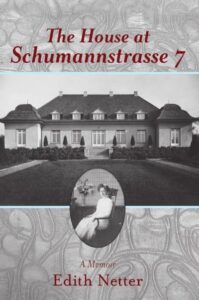 Twice, Alice Rothschild Netter sought safety and asylum in another country: once because she was a German in England during WWI, once because she was a Jew in Germany when the Nazis took power. Born and raised in Germany, nothing in Alice’s childhood foretold what she would experience later.
Her family was affluent. They were a respected part of the community. She was educated and had opportunities for travel. She and her husband were in London in 1915, when he was arrested and imprisoned because he was German.
In Germany, she waited four years for his release so they could restart their lives together. Three children, a treasured house, and a successful business—the family prospered for years, until the Holocaust.
Then, they fled Germany any way they could. Alice took the “sealed train,” a short-lived, never-before-described in the literature service to Lisbon. Alice’s life story, told in her voice, is uniquely personal and accessible. Readers young and old, informed or uninformed about the Holocaust, will be interested in and benefit from reading this true story about the author’s grandmother.
BUY HERE
Category: On Writing
Subscribe
If you enjoyed this article, subscribe to receive more just like it.