Karen Nelson: My Writing Journey
On my bookshelf next to my published novels sits my first book, The Popcorn Popper That Couldn’t Stop Popping, written and illustrated in crayon. I was nine. My main character, Patricia, was seven.
As a child I devoured Winnie the Pooh, Louisa May Alcott, The Five Little Peppers, Aesop’s Fables, Little Lord Fauntleroy, and The Bobbsey Twins, which makes me sound decades older than I am. These were the books on our family shelves, passed down through generations of readers. At the library, I discovered Mrs. Piggle-Wiggle, Judy Blume, and Beverly Cleary. As a ‘tween, I became obsessed with the Dick Francis mysteries set in the Steeplechase world.
These books were my first writing teachers. It’s also the reason I write certain words in British English, towards, backwards, leapt, grey, which I discovered during the editing of my first novel. Not because I was raised in the U.K., I’m a Californian, but because those are the words that I saw on the page as a child. Thank God for search and replace.
My first opportunity to formally study writing was at Colby College, where graduating with a creative writing degree required running a gauntlet. In retrospect, it was probably good training for publishing. The intro to fiction workshop had just fifteen spots.
Priority was given to English majors, which I was not. English classes sucked all the joy out of reading for me. But I was a creative writing minor and made the cut. The real test was earning a spot in the nearly-impossible-to-get second class. I did an end run around the system by taking writing at an American University where I was on a Washington Semester for my major. When I returned to campus, Colby had hired a new faculty member to teach fiction. Richard Russo.
Having a future Pulitzer-prize-winning author read your crappy undergraduate fiction about breaking up with your boyfriend is a gift for which I will forever be grateful. Rick was the first writer who took my work seriously. Where my intro to creative writing professor had been a cheerleader, Rick treated me like a writer.
He wasn’t shy about pointing out what wasn’t working, and because of this, I trusted him. My novel that would become The Last Summer at Feather River started as a short story in his class. He said he wished Jason would emerge from the lake and kill the kids.
I remember sitting in Rick’s office in the library tower on a snowy Maine afternoon when he said, “You don’t read like a writer.” He handed me Best American Short Stories, told me to read a story each week with an eye towards craft, and then come discuss it with him. We did this for the entire semester. I still don’t always read like a writer. Sometimes I just want to escape into a story. But being able to engage your writer’s brain is a critical skill for any author and he gave me that.
After college I continued to seek out workshops, including Napa Valley, Tin House, and then in 2001 I met my mentor, Pam Houston, at Aspen Summer Words. Pam invited me to her ranch for a workshop with several other writers. When four women approached her about a more formal program, Pam said yes, and I know who else to include. Her invitation began our three-decade relationship.
Pam’s is the voice I hear most often when writing. From her, I have learned how to trust my reader; how many concrete details I need before using an abstraction; how to give the reader something to worry about; and how to avoid as many adverbs as possible. I have heard her craft talks so many times I could give them without notes, yet I still learn something each time I listen.
In 2012 we cofounded our nonprofit, Writing By Writers, which has become a literary community much larger than either of us could have imagined. We host workshops with award-winning faculty. Hearing these writers teach their craft has been worth a thousand MFAs. It was at one of our workshops that Richard Bausch tricked me with a writing prompt into starting Claire’s storyline for The Sunken Town.
Publishing had never been my goal. I wrote for myself. But when in 2019 one of my writing peers published her first novel, the idea no longer seemed quite so far-fetched. In March of 2020, we reinvigorated our old writing group over Zoom. I started writing a new novel, but then remembered I had two viable books “in the drawer,” and revising is so much more fun than facing the blank page. The final push came from the writer Melissa Febos, who told me her grad school professor likened getting published to playing “last hand on a hardbody”–the game where whoever keeps their hand on the truck the longest, wins.
I started submitting The Sunken Town in December of 2020. I was thrilled when it was published by Sibylline Press in December of 2024. When my publisher asked if I had any other novels, I dusted off what I called “The Camp Book” and gave it to a trusted reader. Her feedback sent me back to page one for a revision that used every tool I’d learned since writing The Popcorn Popper That Couldn’t Stop Popping. That camp book is now The Last Summer at Feather River, available May 19th.
Two novels and seventeen thousand words into a new manuscript, I’ve discovered each book demands to be written in its own way. With The Sunken Town I had an inciting incident. In Feather River I was writing towards an accident. In this new one, all I know is the secret they are hiding. One thing that doesn’t change is once I get the first draft down, the real fun can start.
—
Karen Nelson is the author of the novels The Last Summer at Feather River and The Sunken Town. She is also the co-founder of the nonprofit Writing By Writers where she hosts writing workshops taught by nationally-known, award-winning authors. Her travel writing has appeared in Coast Magazine, Premium, The Orange County Register, and various other publications nationwide. She holds a degree in creative writing from Colby College and teaches writing at the local high school. When not organizing writing workshops, she can be found hiking with her dog, reading, traveling, experimenting in the kitchen, and hosting dinner parties. She lives in the Silicon Valley.
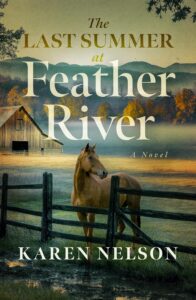 Ten years after an accident that forced her family to close Camp Feather River, Brooke must return to the ranch to care for her grandfather and face the repercussions of their decision.
Brooke once loved spending every summer at Feather River, riding horses, swimming in the lake, and helping her grandfather, Charlie, run the youth camp. But she has not set foot on the property since she and her mother abruptly left that night. Once back at the ranch, Brooke discovers that her family has been hiding more than she knew. While struggling to come to terms with what happened—and her part in it—Brooke realizes the accident might not have been an accident at all.
BUY HERE
Category: On Writing
Subscribe
If you enjoyed this article, subscribe to receive more just like it.