Safe by Claudia Hinz
 I began writing SAFEKEEPING before the pandemic. The first draft of the novel had a different title. There were different characters. A different plot. The novel worked on many levels. It was polished enough to go out on submission to publishers, and the response was largely enthusiastic. But I knew something was missing. Someone was missing from the story of a wounded, young man’s return from war. I had worked hard to imagine the life and inner world of my character, a young Marine nicknamed Privately. I spent a year researching the wars in Iraq and Afghanistan, reading books, listening to podcasts, watching documentaries and films, and interviewing veterans. Nothing was more important than approaching Privately with compassion. I sought to develop a human being on the page, not Hollywood’s version of a war hero or a character flattened by trauma.
I asked veterans to read drafts. My Marine friends generously responded to every text asking about terminology. They answered questions about military acronyms. The logistics of communicating with family during deployment. The weight of combat gear. The tradition of escorting a fallen soldier home to be buried. I wanted to be accurate. And I needed the veterans I interviewed to know I was writing in good faith. I hoped they felt safe with me and knew my heart was with them, as it was with Privately, a character whose presence I had felt for decades but whose story I’d struggled to tell.
With the first draft of the novel, I felt I had done my job. The Marines who read pages gave me a thumbs up. The character of Privately was convincing. The descriptions of war and the challenges of coming home felt credible, but I suspected the story wasn’t complete. As a writer, I am limited by many factors, chief among them, skill. Maybe in another ten years, I could write this novel differently. I might not need to include a mother to bring the fullness of dread, devotion, regret, grief, and yearning for safety. But when I started a new draft of SAFEKEEPING, the outer world intervened. The pandemic began and my husband, a doctor in our local hospital was exposed, and in my mind, daily threatened by the virus. In the past few years, our family had experienced traumas, and we were still hurting and scared. Hearing a phone ring at night made me double over in bed, bile burning up the back of my throat as I struggled for breath. Which one of the kids? Who was hurt? We retreated into separate caves, scared of exacerbating each other’s pain. I think that we imagined we might spare each other. The illusion was that if other family members couldn’t see our tears, or hear our voices break on the phone, they would be a little more okay. We continued this way through the pandemic, and I never said the words aloud to family members: I thought you were going to die.
When I left the house during the pandemic, I started counting. I counted my steps, left foot, right foot, left, right. I counted the seconds from the backdoor to the garage and into the car and down the alley because every second I counted away from my home, was one second closer to returning to it. I began counting inside the house too. Up the stairs to my bedroom, 7… 8… 9… 10. To collect the laundry basket. And back down the stairs with our dirty clothes. Counting as I shoveled sleeves and pant legs into the washing machine. Counting as I hefted the sodden limbs into the dryer. The counting was reassuring proof of progress, the act of doing something in my shrunken world of safety while danger rattled the walls of my family’s home.
There are degrees of danger and safety. My children are white and U.S. citizens. Statistically, they are less likely to be stopped on the road in the middle of the night. They have the safety net of parents who can help them so they will never experience houselessness and food scarcity or lack access to quality health care. The list goes on. Lucky, I think so often. We are so, so lucky. And yet, as my character Tenley, a white, upper-class mother in Dallas, Texas, realizes, not even money and privilege can keep one’s children safe.
I have a dear friend whose grown children are also far away. She, too, worries. She plays a word game on her phone at night. It’s a silly game, she confesses, but she has to complete it every night. It is only after she has finished the game, and put her phone on her nightstand, that she feels a sense of calm. It makes no sense, she says. There is nothing about my phone and this game that has anything to do with anything, but completing it is a ritual, and if I do this same thing every night, I think maybe my children will be okay. I understand this mystical thinking, the notion that some little thing we do as mothers, even a word game, will magically wrap our children in safety. There is a false, but comforting sense of control, as if we might bundle our babies as we did when we tucked them into bed every night. Closing the pages of favorite picture books, promising to read them again tomorrow. Adjusting the door to admit just the right amount of light from the hallway. Repeating the same goodnight phrases: Sleep well, I love you, see you in the morning, pleasant dreams, good sleep. And again, See you in the morning because maybe it wasn’t a given that they would wake safely from the death of sleep, and find me there in the kitchen, making breakfast.
My children were alert to every danger of the dark and what might happen when their eyes were closed to the invisible hazards of the night. Sometimes the nighttime routine was prolonged by an hour with if’s: what if I wake up and feel sick? If I have a nightmare? If I can’t sleep? If I hear a noise? If I call out for you, and you don’t hear me? A sleeping bag was left on the floor next to my bed. I often woke in the middle of the night to the thunder of bare feet down the hallway, my son careening around the corner into our bedroom as if he were being pursued, flinging himself to the floor, and zipping the sleeping bag up to his ears. He was there. Next to me. All he had to do was reach out his arm and find me. Safe.
—
Claudia Hinz lives in Bend, Oregon. She graduated from Harvard and received her master’s degree in literature from Southern Methodist University. She worked as a television reporter for network affiliates in Northern California, Seattle, and Dallas. Her work has been published in The Christian Science Monitor, The Boston Globe, Women Writers, Women’s Books, Story Magazine, Other People’s Flowers, The Wrath Bearing Tree, The Manifest Station, Brevity, and 1859 Oregon’s Magazine. Her novel SAFEKEEPING (MilSpeak Books) will be released September 30, 2026
SAFEKEEPING
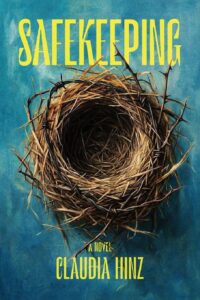 It is 2027, and with the country embroiled in multiple international conflicts, a draft has been instituted in the United States. When Tenley Ward’s nineteen-year-old son draws a low lottery number, she mobilizes fellow PTA mothers in Dallas, Texas, to form the anti-draft organization MOMS-Mothers Opposing More Senselessness.
As the clock ticks down to her son being called up, Tenley is torn between her duties on the home front-three younger children and a husband who resents her time away from the family and the need to propel MOMS into the national spotlight. Enter new volunteer Lance Corporal Leland Marks, nicknamed Privately, a Marine veteran who is struggling to adjust to life at home after combat. Privately is drawn to MOMS’ message, as well as its beautiful and charismatic leader, and though he is young enough to be her son, Tenley can’t deny the fireworks between them.
As they work together to try to garner more support for the organization before the president, currently on a national tour, arrives in Dallas in three weeks’ time, Tenley and Privately grapple with both their personal demons and their own growing attraction to each other. Neither is sure what the future holds-not for the war, the draft, or even their own next steps-but what they do know is that meeting each other has changed everything.
Unpacking the contradictions of motherhood, the devastation of grief, the blind spots of privilege, the fuel of desire, and one’s own purpose, Safekeeping is a thoughtful, poignant novel that will remain with you long after the last page is turned.
PREORDER HERE
Category: On Writing
Subscribe
If you enjoyed this article, subscribe to receive more just like it.