HOME: A Memoir of Family, Forgiveness, and Healing from Complex PTSD by Amy Smyth Miller
Her past held the answers—if she was brave enough to face it. After nearly losing her husband, Amy Smyth Miller’s panic spirals out of control. Therapy reveals a diagnosis she never expected: Complex PTSD. In search of healing, Amy embarks on a harrowing excavation of her past—childhood neglect, homelessness, parental addiction, and a family history shadowed by suicide.
 Amid the wreckage, she discovers the people and circumstances that kept her safe and helped to shape her life: her wise great-grandmother’s teachings, the watchful eyes of caring adults, and her own fierce determination. Each memory is a clue, each family story a piece of the puzzle. But the most elusive truth is buried in a forgotten childhood memory—one that holds the key to her deepest fear. Part investigation, part love letter to survival, Home is a courageous story of trauma and transformation, love and forgiveness, and realizing that sometimes the home you’re searching for is the one you build inside yourself.
Authors Interviewing Their Characters: Adolescent Amy from HOME
Adolescents with complex PTSD have undergone severe and prolonged trauma. They frequently struggle with sadness, mood swings, and a feeling that their emotions are completely overwhelming. They may appear dramatic (Even more so than most children of this age group) and engage in impulsive acts and risk-taking behavior.
For my memoir HOME, I sat down with Adolescent Amy to ask her about her life during this crucial time period. One caveat: I can’t be responsible for what comes out of her mouth; after all, she is Granny Warbonnet’s great-granddaughter.
Author: Thank you for agreeing to speak with me today. I realize this is a bit awkward, as you are my younger self.
Adolescent Amy: Everything about my life is awkward, so go for it.
Author: What was your favorite memory from childhood, and why?
AA: Definitely making piecrust with Granny Warbonnet. She made me feel special, and I felt competent at something. I know that’s a strange word, but feeling like I could do something well was important to me. So much of my life was not in my control.
Author: Why was your great-grandmother called Granny Warbonnet?
AA: I’m not really sure who gave her that name and why, but I can guess about the why part. Half the little town of Pawnee City, Nebraska, was afraid of her, and she scandalized the other half. She had what you’d call “a colorful vocabulary.” She was the only female business owner in Pawnee City. Even Charlie Hall, the local sheriff, approached her from a safe distance. She was the best part of my childhood. In between all our moving, we’d return to her house. It was a place of warmth, safety, and love.
Author: What was the most difficult for you?
AA: Am I allowed to say all of it? Seriously, I didn’t realize how difficult it was until I was older. Our lives were chaotic, but that’s just the way things were. When you don’t have anything to compare it to, you don’t realize all the hardships you’re facing. I knew we moved a lot—19 different schools by the time I was a freshman in high school. Though I would have to say being poor was the hardest for me at the time.
Author: Tell me about that.
AA: I didn’t mind so much the steady diet of Hamburger Helper (without the hamburger) and pancakes, but not having the right clothes made being poor painfully obvious. Having an “in style” wardrobe when you’re a teenager is pretty important. And it was the seventies—bell-bottom jeans, platform shoes, and Gunny Sax dresses were a thing.
Author: Were there any positive experiences in your life? It sounds rather grim.
AA: There were so many. I didn’t realize how many until later. Some people made a huge difference in my life (and probably didn’t realize it): teachers, cafeteria ladies, bus drivers, friends’ parents, and neighbors. I had an amazing Camp Fire Girls leader and some great friends. And there were Las Madres from the lettuce fields, but you’ll have to read the book to find out about them.
Author: What do you want people to take away from your story?
AA: I think for those who’ve experienced trauma, I want them to know they are not forever broken. The skills they learned to survive will one day make them better people. As a child, you don’t get a choice about experiencing trauma, but when you’re an adult, you do get to choose what you will do with those experiences. For everyone else, I want them to know that it doesn’t take much to make a difference in the life of a child.
Author: Any parting thoughts or advice?
AA: Yeah, that whole mixing baby oil with iodine thing to get a suntan wasn’t such a great idea. Wear sunscreen!
—
Amy Smyth Miller is a nationally recognized educator with a bachelor’s degree in special education and a master’s in counseling. She works as an Intervention Specialist in a rural public school district and lives in northern Washington State with her husband, her adult son with special needs, and her rescue dachshund, Oscar.
HOME
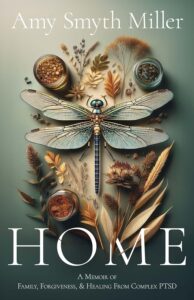 Her past held the answers—if she was brave enough to face it.
After nearly losing her husband, Amy Smyth Miller’s panic spirals out of control. Therapy reveals a diagnosis: Complex PTSD. In search of healing, Amy embarks on a harrowing excavation of her past—childhood neglect, homelessness, parental addiction, and a family history shadowed by suicide. Amid the wreckage, she discovers the people and circumstances that kept her safe and helped to shape her life: her wise great-grandmother’s teachings, the watchful eyes of caring adults, and her own fierce determination. Each memory is a clue, each family story a piece of the puzzle. But the most elusive truth is buried in a forgotten childhood memory—one that holds the key to her deepest fear.
Part investigation, part love letter to survival, Home is a courageous story of trauma and transformation, love and forgiveness, and realizing that sometimes the home you’re searching for is the one you build inside yourself.
BUY HERE
Category: Interviews, On Writing
Subscribe
If you enjoyed this article, subscribe to receive more just like it.