The Story Behind THE HAPPINESS PATHWAY by Charu Moorjani
People kept telling me how beautiful I looked on my wedding day. I couldn’t feel any of it.
 My wedding day should have been the happiest day of my life. Everyone kept telling me it was.
The venue was spectacular, an enormous outdoor farmhouse, the stage dressed like a movie set with performers costumed as Indian gods and goddesses. The music was loud. The relatives were loud.
Everyone was smiling with a certainty I couldn’t seem to find in myself.
I was wearing a designer lehenga with so much Swarovski stonework it weighed close to ten kilograms, shimmering under the lights, pressing into my skin.
People kept telling me how beautiful I looked. How perfect everything was.
I smiled back and I genuinely could not feel a single word of it.
I was sinking. Quietly. In front of everyone.
I can still picture the exact moment I realised something was wrong.
I was sitting on the floor of my apartment in my work clothes, the same ones I’d put on twelve hours earlier, staring at a blank wall while my phone buzzed beside me.
Messages pinging in from family and friends. Wedding news. Baby news. Promotions. Everyone moving forward through this neat, approved version of adulthood we’d all been quietly taught to chase.
And I had done everything right. Stable career. Tick. Marriage before thirty. Tick.
A life that looked beautiful on paper.
So why did I feel like I was watching it all happen to someone else?
Growing up in Delhi, the script was written before I was old enough to read it.
Nobody sat me down and handed me a rulebook. It was softer and more constant than that, woven into daily conversations, into the praise that followed compliance, into the comparisons that arrived like weather.
Be a good daughter. Choose stability over risk. Build a life that makes your family proud. Get married. Have children. Keep everyone comfortable.
And here’s the thing: I wasn’t rebelling against it.
I wanted approval. I liked being seen as responsible and successful and together.
I liked being “the good girl.”
So I followed the path exactly as instructed.
For a long time, I talked myself out of what I was feeling.
When everyone around you tells you that you’re lucky, it feels ungrateful, almost dramatic, to admit you’re unhappy.
So instead, you minimise it. You tell yourself you’re just stressed, or burnt out, or that this is simply what adulthood feels like.
There was no single terrible event. No dramatic betrayal. No obvious reason that would satisfy anyone if I tried to explain.
Just this quiet, persistent feeling like I was disappearing inside the life I’d built.
Then my body made the decision my mind kept deferring.
On my honeymoon, I was diagnosed with Guillain-Barré Syndrome, a rare autoimmune disorder that left me in ICU for a month, unable to move.
Everything stripped back very fast. The career milestones, the social image, the performance of being fine — irrelevant, instantly.
Illness has a brutal way of exposing the truths you’ve been managing around.
And what I found underneath all of it was someone exhausted. Not just physically. Someone who had spent years becoming a version of herself that other people could comfortably accept and had lost track of who she was.
Even then, I didn’t leave. Not for another four years.
Because leaving a marriage as an Indian woman isn’t just a personal decision. It feels public. Like your choices belong to everyone who knows you.
I thought about my parents having to field questions from relatives. About community gossip. About becoming “the divorced woman” people talk about carefully at family dinners.
I worried I hadn’t tried hard enough. That I was selfish. Ungrateful. Weak.
For a long time, those fears kept me exactly where I was.
People romanticise the idea of “choosing yourself.” The reality is far less cinematic.
Choosing yourself can look like sitting in your car crying because you know your life can’t keep going the way it is. It can look like second-guessing every decision for months. It can feel deeply, profoundly lonely.
When I finally left, I didn’t feel powerful. I felt terrified.
There was no movie moment where life suddenly became lighter. There was grief and confusion and guilt and mornings where I genuinely wondered if I had ruined everything.
But slowly, something unfamiliar started happening.
I started hearing my own voice again. Not the voice shaped by expectation and fear and cultural conditioning. My actual voice.
For the first time, happiness stopped meaning achievement. It stopped meaning appearances. It stopped meaning how well I could endure things without complaining.
It became honesty with myself.
Which, for women raised to prioritise harmony over truth, is genuinely one of the most inconvenient things in the world.
I want to be clear: I don’t blame my culture for any of this.
Culture gives you belonging, identity, family, community. There is real beauty in that.
But I do think a lot of women across many cultures quietly lose themselves trying to become who they were taught they should be.
Those years of journaling and rebuilding eventually became my book The Happiness Pathway — an exploration of identity, happiness and what happens when you stop performing your life and start living it.
Because sometimes the scariest thing isn’t failure.
It’s realising you succeeded at becoming someone you were never meant to be.
—
Charu Moorjani is an Australian Author (with an Indian heritage), a mindset coach and a wellbeing storyteller known for her honest memoir style writing and a grounding approach to personal growth. Her debut book, The Happiness Pathway, blends her livid life experiences with practical tools to help readers rebuild their self-worth by creating boundaries without guilt and developing simple daily habits to cultivate lasting happiness. Every chapter in her book includes stories and reflections from her life and little exercises that readers can use to make gentle shifts in their own lives.
With a warm and relatable voice, Charu writes about healing after emotional pain, choosing resilience during time of change and the power of choosing yourself first. Through workshops and community conversations she creates safe space for reflection, connecting to yourself and making a lasting change in your life through simple tools, reminding people that happiness isn’t something you find once, its something you create daily.
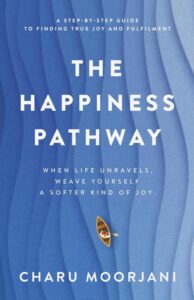
The Happiness Pathway: A step-by-step guide to finding true joy and fulfilment
 To be truly happy.
It’s perhaps the ultimate goal in life and the definitive sign of success and fulfilment. Yet it remains so elusive to so many.
Often the issue is how happiness is framed. Because it isn’t something you chase or find but it’s something you build.
The Happiness Pathway is an honest and empowering interrogation of everything you’ve been taught about happiness. Combining personal storytelling, research-informed insights, and practical exercises, it reveals how life’s hardest moments can become the foundation for healing, resilience, and authentic joy.
The book offers a powerful roadmap to genuine happiness, and connecting with and loving who you truly are.
Inside, you’ll learn how to:
- Redefine happiness beyond external success.
- Heal emotional wounds and rebuild self-trust.
- Set boundaries and reclaim your inner peace.
- Create intentional habits that support lasting wellbeing.
- Design a life that feels aligned, meaningful, and deeply fulfilling.
A guide for those who feel externally successful yet internally unfulfilled, The Happiness Pathway invites you to rethink everything you’ve been taught about finding contentment. It reframes happiness as a set of sustainable skills, not a distant destination you must travel to.
Drawing on her own journey through emotional disruption and identity shifts, the author – Charu Moorjani, offers a grounded, compassionate roadmap for navigating burnout, heartbreak, and transition.
And through a suite of practical micro-habits, the book gives you the tools you need to move beyond survival mode and into intentional living. You’ll learn to heal emotional wounds, set life-changing boundaries, and rebuild the self-trust and self-love that form the foundation of happiness.
The Happiness Pathway is not a book about finding nirvana or perfect bliss. It is instead an intimate, honest guide to creating a fulfilling life in which happiness feels sustainable, honest, entirely yours.
Because happiness is built: one decision, one step, one courageous shift at a time.
BUY HERE
Category: On Writing
Subscribe
If you enjoyed this article, subscribe to receive more just like it.