WRITING AND YOUR SUBCONSCIOUS: HOW TO FUEL YOUR INSPIRATION by Dr. Cristina LePort
 Sometimes, when we write, the words arrive as if someone were dictating them, and we are not entirely aware of how it happens. This is what we call inspiration.
Many writers think of inspiration as a mysterious force. It appears suddenly, like a gift from the gods, and disappears just as unpredictably. When it comes, writing feels effortless. When it does not, the page stays blank. But inspiration is not magic. It is the result of a process that every writer can learn to understand and strengthen.
Rather than a gift from God, inspiration is the subconscious mind responding to a purpose set by the conscious mind.
Consider this beginning of a story. A beautiful girl in an elegant dress walks into a bar and orders a drink. A man approaches her, but she leaves. She crosses the street, calls an Uber and goes to the beach where she joins three girls playing volleyball. After a couple of hours she walks home. At this point you would ask the author “What is the purpose of this story?”
The mind expects purpose. While reading a story, we assume there must be a logical connection between the events. The job of a writer is to have a conscious understanding of the purpose of the story and its logical connections and to communicate it to the reader. As writers, we cannot justify our work by saying, “I wrote it because I felt like it.” Feelings and emotions are important in writing, but cannot be the primary cause of what we create. They are the result of ideas and conclusions that were once conscious and are now stored in our subconscious. That is where inspiration comes from.
The conscious mind can focus on only a limited number of things at once. The vast majority of our knowledge—our memories, language, observations, and beliefs—remains stored in the subconscious. When we write, we rely on that stored knowledge. If we consciously decide, for example, to describe a peaceful sunset at the beach, the subconscious searches through everything we know about sunsets, beaches, language, and offers us words and images that fit that purpose.
This process becomes clear when we consider how much knowledge goes into even a simple paragraph. Describing a sunset requires vocabulary, sensory memory, emotional associations, and an understanding of mood. If we had to consciously choose every word from scratch, the task would be overwhelming. Instead, the subconscious provides the material because it has been trained by experience and practice.
This means inspiration is not innate—it is built.
The more knowledge we store in our subconscious, the richer the material available when we write.
Writers build the material in their subconscious by observing the world, reading widely, and analyzing what they like or dislike. Asking questions such as “Why does this passage move me?” or “Why does this scene fail?” helps clarify the ideas behind our emotional reactions. Introspection strengthens the connection between conscious understanding and subconscious creativity.
Our deeper philosophical beliefs also influence what our subconscious produces. Every writer holds premises about reality, human nature, and the nature of choice—even if they have never articulated them. Do people have free will? Are events governed by cause and effect? Is the world benevolent, hostile, or neutral?
These assumptions shape storytelling. A plot depends on purposeful action and choice. Characters pursue goals, face obstacles, and make decisions. If a writer truly believed that human beings have no choice and that events are purely accidental, it would be impossible to construct a meaningful plot. Stories require conflict, values, and decisions.
Another essential skill for writers is learning to translate abstract ideas into concrete events. Fiction deals with abstractions such as love, courage, justice, fear, but readers cannot observe abstractions directly. They observe actions. Courage might appear as a firefighter entering a burning building. Justice might appear as a witness refusing to lie in court. Love might appear in a gesture, an heroic action, or a moment of attention.
Writers therefore need to train their minds to connect abstractions with many concrete examples. The more examples stored in the subconscious, the easier it becomes for inspiration to provide vivid scenes and actions.
This relationship between abstractions and concrete details forms a kind of circle in storytelling. The writer begins with an abstract purpose—perhaps a theme or central conflict—and inspiration supplies the concrete events that embody it. The reader experiences the process in reverse: from the actions and details on the page, the reader discovers the underlying idea. This is the deeper meaning behind the advice “show, don’t tell.”
Writer’s block often occurs when this process breaks down. Sometimes the writer lacks enough knowledge about the subject to generate convincing concrete scenes. Other times the conscious purpose is unclear or contradictory. When the subconscious receives mixed instructions, it cannot supply the right material. The solution is not to force inspiration but to think more clearly about the story’s purpose, conflict, and meaning.
Ultimately, inspiration is the natural result of a prepared mind. A writer who understands how the subconscious works can guide it deliberately. By observing the world, clarifying ideas, and practicing the craft, the writer fills the subconscious with the raw material of future stories.
Inspiration will still feel magical when it arrives. But it is not a miracle. It is the mind doing exactly what it has been trained to do.
To learn more about this subject, I strongly recommend reading: “The Art Of Fiction” by Ayn Rand, from which I learned many of the ideas expressed in this article.
—
Dr. Cristina LePort was born in Bologna, Italy. She attended medical school at the University of Bologna and then completed her medical training at Long Island College Hospital in Brooklyn and at the University of California, Los Angeles. She is board certified in Internal Medicine and Cardiovascular Diseases and has been practicing medicine for more than thirty years. Cristina is also the Chief Medical Officer and co-founder of Genescient, a biotech company devoted to genetic research on aging and the amelioration of chronic diseases. Medicine and fiction are her twin passions, and she is absolutely thrilled to be able to share her medical thrillers with the world.
Cristina LePort currently resides in Orange County, California, with her husband Peter LePort, a general surgeon. They have three children and three grandchildren.
Website: https://www.cristinaleport.com
Facebook: @cristinaleportauthor
Twitter: @LeportCristina
DEFROSTED
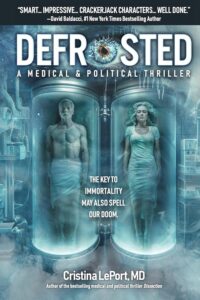 A Frightening Vision of the Future, And an Electrifying New Thriller, from the Acclaimed Author of Dissection and Change of Heart
Dr. Cristina LePort raises the bar with Defrosted, a captivating fusion of science, medicine, and political intrigue that redefines the boundaries of the thriller genre.
Two centuries into the future, cryogenically preserved scientist Dr. Peter Royce and his wife, Monica, awaken to a dystopian world where human worth is dictated by productivity and freedom is a distant memory. A devastating biological entity, known as mitocancer, looms as a global threat, and Peter must uncover the truth of his past to save humanity’s future.
From the icy wilderness of Alaska to the corridors of power in a reimagined Washington, D.C., Defrosted explores the clash of high-tech medical breakthroughs and ethical dilemmas. As power plays escalate and secrets unravel, Peter, Monica, and a cast of vividly drawn characters are thrust into a battle for survival that questions the very essence of humanity.
As Midwest Book Review notes, “This medical & political thriller pairs science, medicine, and cat-and-mouse games… Readers drawn by either the thriller promise or the medical backdrop will find that Defrosted‘s ability to thaw out the truth of purposes, visions, and the consequences of actions yet to be tested on moral and ethical grounds gives much food for thought.”
Perfect for book clubs engaged in debates on medical ethics and cutting-edge technology, Defrosted challenges readers to question where progress ends and humanity begins. A standalone triumph, it cements LePort’s reputation as a master storyteller and a thought leader in speculative and medical fiction.
BUY HERE
—
Category: How To and Tips
Subscribe
If you enjoyed this article, subscribe to receive more just like it.