When Fear Keeps Us From the Truth by Rossana D’Antonio
 When I wrote 26 Seconds: Grief and Blame in the Aftermath of Losing My Brother in a Plane Crash, I knew it would be a heavy book for some people to approach. The title alone carries the weight of what’s inside. It is a memoir born from the deepest heartbreak of my life — losing my brother, Cesare, the pilot of TACA Flight 390. It is also an exposé that pulls back the curtain on the systemic failures that allowed a deadly airport to operate for decades, despite multiple crashes and more than 200 lives lost.
But 26 Seconds is not just a story about catastrophe. It is a story about love, truth, injustice, accountability, redemption, and the long, painful road toward purpose. What it is not, despite what some may assume, is a horror story.
Still, I often hear the same hesitant confession, “Oh, I can’t read it. I’m terrified of flying.”
For a long time, I brushed their comments aside, assuming they were polite ways of avoiding a difficult topic. But as more people shared this fear whether friends, colleagues, acquaintances, and even strangers, I realized it wasn’t avoidance at all. It was genuine, visceral fear.
I want people to know that I understand that fear. Just hours following the crash, I needed to board multiple flights to get home to family. It was that paralyzing fear that was my companion as we crossed three continents in 48 hours. To this day, I mask my mellowed yet chronic fear with a brave label of “heightened awareness.”
I still believe flying is the safest mode of travel. Statistically, we are far more likely to be harmed driving to the airport than boarding a plane. As an engineer, I know this. I cite these facts often, hoping to ease people’s anxiety. And perhaps my very own discomfort. But fear does not respond to statistics. Fear responds to feeling — to the loss of control, to the unknown, to the rare but catastrophic event that sears into our collective consciousness.
So, when someone tells me they’re afraid to read my book, I no longer hear it as rejection. I hear it as honesty. I hear it as self-protection. I hear it as a human response to something that feels overwhelming.
I’ve come to understand that 26 Seconds asks readers to confront the uncomfortable reality that safety is not automatic. That systems fail. That oversight breaks down. That tragedies like Cesare’s are not random acts of fate but preventable failures of design, policy, and accountability.
And that is a hard truth to face, especially for those who already carry fear.
But knowledge is not something to fear. Knowledge is power. Understanding how failures happen is how we prevent them. Understanding where oversight collapses is how we demand better. Understanding the human cost of inaction is how we insist on change.
Cesare’s story is not a story of fear. It is a story of courage — his, and ultimately mine. It is a story of refusing to look away. A story of truth forcing accountability. The airport that claimed his life, and the lives of so many others, was finally shut down because the evidence could no longer be ignored. His death sparked change that has saved countless future lives.
That is not a horror story. That is a story of hope.
I didn’t write 26 Seconds to frighten anyone. I wrote it to honor my brother. To expose what went wrong. To show how systems can be corrected when people refuse to look away. To remind us that safety is not a guarantee — it’s a choice, a priority, a commitment. And sometimes, it is a battle.
To the readers who pushed past their fear, thank you. Thank you for opening your hearts to grief, accountability, healing, and truth. Thank you for helping keep Cesare’s memory alive.
To those still deciding whether to read it, I hear you. Fear is human and I’ve been there. I’ll continue to tell this story, whether or not you ever feel ready to read it. Know that I will keep using my voice through writing, leadership, and advocacy to battle for safety. I will do this for you and every other passenger entrusted to the aviation system. I will keep pushing for accountability because my brother’s life mattered. Because every life lost mattered. Because the system can improve, but only if we are willing to look at it honestly.
And because, as my father always told us, we must live our lives as if we can change the world.
Cesare actually did. And I intend to continue what he began.
—
Rossana D’Antonio is a licensed engineer with expertise in infrastructure design and emergency management and a strong advocate for infrastructure investments, including the Federal Aviation Authority Reauthorization. Shaped by her Italian and Salvadoran parents, D’Antonio is deeply committed to family and understands the value of creating an environment in which everyone feels safe and protected. She finds peace in Malibu, California, where she resides with her husband, Freddie, and puppy, Luna.
Find out more about her on her website https://rossanadantonio.com/
26 SECONDS: GRIEF AND BLAME IN THE AFTERMATH OF LOSING MY BROTHER IN A PLANE CRASH
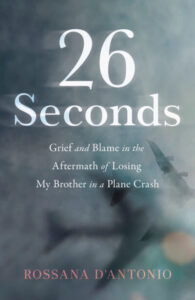 Much as Eric Schollsberg’s Fast Food Nation made people think about the way we eat, this provocative memoir and exposé challenges readers to question why, given its long history of cover-ups and systemic safety gaps, we continue to trust the aviation industry.
On a stormy late May morning in 2008, TACA Airlines Flight 390 crashes at one of the most dangerous airports in the world, Honduras’s Toncontin International Airport. Five people die in the crash—among them Rossana D’Antonio’s brother, pilot Cesare D’Antonio. Suspecting Cesare will be made a scapegoat for the accident, as so often happens to pilots, Rossana decides to leverage her decades of experience as an engineer and set out in search of the truth.
Part memoir, part exposé, 26 Seconds interweaves Rossana’s research regarding other parallel accidents with her own story. Six months after the TACA crash, Captain Sully Sullenberger lands his plane on the Hudson River. Although authorities call his landing a miracle, they also blame him for its necessity. One year after the TACA 390 tragedy, Air France 447 falls from the sky. Again, pilot error.
As Rossana digs deeper, she exposes a culture that is too quick to conclude pilot error and an industry that experiences systemic weaknesses, chooses profits over safety, lies to its customers, and is willing to risk lives to get its planes back up in the sky. Ultimately, she uncovers the smoking gun she’s been looking for—revealing the truth about TACA 390, exposing aviation cover-ups, and challenging us all to question the very systems we’ve been told we can trust with our lives.
BUY HERE
Category: On Writing
Subscribe
If you enjoyed this article, subscribe to receive more just like it.