Authors Interviewing Characters: Micki Pierce
The Route 66 Detective in Missouri: The Route 66 Mystery Series
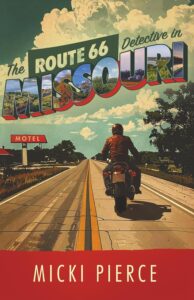 One man. Two wheels. A thousand miles of trouble.
Mac McCarty has spent his life dodging death. First in the dogfights over Europe, then on the lethal wooden planks of the motorcycle racing circuit. Now, he’s a private investigator with a simple beat: the 2,400 miles of asphalt known as Route 66.
In 1937, the highway is a lifeline for some and a graveyard for others.
In the first book of the Route 66 Mystery Series, Mac’s search for the son of a wealthy zinc mine owner takes him deep into the Missouri night. He soon finds himself immersed in a world of Kansas City gangsters, Ozark moonshine, and murder. With the help of a captivating motel owner, Mac plays hard, rides hard, and works harder to close the assignment before more bodies pile up.
Main Street of America in 1937 – As Told By Missouri Locals
The morning rush had come and gone in the café at Our Motor Court, but the smell of biscuits and bacon hung in the air. A few of the regulars lingered over a third or even fourth cup of coffee. Elvie was wiping the counter, while Lydia checked to see if the salt and pepper shakers needed to be topped off. Both looked up as the front door swung open and a young man with a mop of curly hair came rushing in. He took the room in at a glance and made his way to the counter. Pulling a notebook out of his pocket, he slid onto the stool next to Phil.
“They let you eat here with those ink-stained hands?”
“Howdy, Steve,” said the typesetter.
The newcomer looked around the diner again.
“Not much of a crowd. You think there’s some folks here who’ll talk to me?”
“Sure.” Phil cleared his throat. “Everyone, this is Steve. He’s a copy boy at the Springfield Leader and Press, who has dreams of getting picked up as a syndicated journalist. Can you help him out? He said he only has one question to ask.”
Lydia joined Elvie behind the counter and leaned next to the cash register, interested to hear what the others would say.
“This here is Lydia James,” Phil said, nodding toward her. “She’s the owner of all of this. Ask her your question.”
“Me?”
“Sure. I just want to ask what the completion of Route 66 will mean to you.”
“Well,” she said, sliding her hands into her apron pockets. “My husband and I started this place because the road was all anyone could talk about. We knew people were going to need a place to stay and we started out as a tourist camp and did all the cooking outdoors until we got the main building done. People who stayed ended up helping him with the building. He finished the gas station first. That earned enough money to finish the café. Local folks started coming in for breakfast and we were able to finish the upstairs living quarters and the cabins behind us. Right away it seemed like Route 66 was a place that strangers met and became friends, even if they were having hard times themselves.”
“It was good timing to have the road go through when it did,” said Charlie, who was sitting a few stools down. “When the drought hit so hard it turned farms to dust and crop prices hit rock bottom, lots of locals went west to try to find work. Roads out that way were like a patchwork quilt before. State roads were connected to federal highways by rutted out dirt paths and crossroads cattle crossings.”
The would-be reporter was nodding over his notebook now, grinning and scribbling.
“Most of those same locals found their way back on that same road a few years later, Charlie. We wished them well and then welcomed them back.” Elvie chimed in. “The weather helped make the road popular too. Better than what they faced up north or down south Texas and Mexico way.”
“Sixty-six made it a lot easier for me in the ice business, I’ll tell you that. I started with horses and a wagon but after I switched to a truck, it was hard to get out to some places and not blow a tire. People at all the little settlements nearby decided they needed access to the main road and paved the surrounding roads,” Charlie said.
“Truck farmers benefitted too,” Elvie said. “Lydia gets fresh fruits and vegetables from California, corn from Illinois, and beef from Texas for the café that come right down that highway.”
“Not only that,” said Lydia, “but our local farms can easily send things to Chicago or California by truck as well as train.
The tourists keep the motor court going now, though. People are anxious to visit places out west and Route 66 makes it a lot easier with all the inns and filling stations along the way.”
“I read that Cyrus Avery said it’s the most direct road to the Pacific Coast. He’s the one that first called it the Main Street of America,” Phil said.
At the far end of the counter, a tall man wearing a leather bomber jacket stubbed out his cigarette and turned on his stool to look at the others.
“Like most tools, Route 66 is a double-edged sword. It made it easier for you to get some places Charlie, but it also took businesses away from small neighboring towns as it attracted them to build where traffic would support roadside businesses.
The Civilian Conservation Corp and Works Progress Administration, as part of FDR’s second New Deal, have put thousands of young men to work on the road to provide them a chance for economic recovery. If war breaks out in Europe again soon, those same young men will see the transporting of troops and war machines on the road that they built from Naval Station Great Lakes to Fort Wingate in New Mexico and Muroc Field in California.
It seemed to lead to the land of opportunity for the Okies who packed up to find a new Eden but they found out that if you were broke here, you’d be just as broke when you got there and that the mass migration of the vulnerable was also an opportunity for unethical people to take advantage of them.”
Mac McCarty stood and retrieved his trilby hat from the coat rack behind him. He put it on and adjusted it before continuing.
“I’m glad it’s almost complete, but it isn’t some mythical golden way. So, if you want to do a story about it, tell the whole story of its grit as well as its glamour.”
“Are you leaving us, Mac?” Lydia asked.
“As soon as I pack the motorcycle, I’ll be chasing the next mystery right down that road all the way to Santa Fe.”
The bell on the door was still ringing as he walked past the window on his way to his room.
“I hope it brings you back soon.” Lydia whispered.
—
BUY HERE
Micki Pierce grew up in Bordentown, NJ, where she spent much of her childhood reading mysteries set in the early half of the twentieth century. As a reader and a writer, her focus is on period detective fiction. Researching and writing about the hardships of American life in the 1930’s started out as just a hobby. Riding around the Midwest, on her husband’s Harley-Davidson, fueled her interest in the Mother Road. Creating a detective series about a mysterious, motorcycle-riding private eye and the characters he meets along the famous highway is the result. The Route 66 Detective in Missouri is her debut.
Category: On Writing
Subscribe
If you enjoyed this article, subscribe to receive more just like it.