The Mystery Writer Who Can’t Murder by Claudia Hagadus Long
 As many of my long-term readers know, I can write a sex scene with wild abandon. I can craft a fight scene with brio. I can plot with the intricacy of an aerospace engineer, and explore family dynamics like a psychologist on crack. But I have a really hard time killing anyone.
For a normal person, not being able to murder would be, well, expected. Or at least hoped for. But for a mystery writer, it’s a real challenge.
I write two lines of mystery series: The Zara and Lilly series and the Simpato Mysteries. In the Simpato Mysteries, set in a fictional small town in Northern California where wine flows like water and nuns sell cannabis-laced cookies, I can bump off a character and have my sleuth, Sal DeVine, ferret out the murderer with aplomb. Because it’s a funny series, with made-up characters and relentless duck puns, a murder here and there is no problem.
Even though the series touches on real-world problems such as income and status inequality, immigration, or the tension between housing needs and over-development, the stories are light, and what’s a body or two among friends?
But the Zara and Lilly series is deeper, more intense, and more psychologically and historically compelling. Sure, it’s still funny in places, since I can’t seem to help myself, and my people have used humor as a defense mechanism for centuries, but ultimately, the characters are very, very real.
And when my characters are this real, killing them feels like a death.
Zara and Lilly are two sisters of a certain age—arithmetically, they can’t be younger than sixty—daughters of a Holocaust survivor, living in our modern times. They interact like two sisters might. They quarrel, they squabble, they make up, they know things about each other that no one else knows. After all, they’ve known each other since birth! With their parents gone, it’s up to them to carry the torch of the family history, passing on their best and worst traits, their inherited trauma, and their absolutely unbreakable bond. When Zara and Lilly take on mysteries, it’s hard, as their writer and creator of their stories, to kill anyone, knowing how death shakes the underpinnings of a family.
Mysteries need a certain framework: there’s a killing. Dead people don’t tell tales (though as many forensic mysteries have taught us, their bodies do!) There’s a sleuth. If it’s a police procedural, we learn how a brilliant homicide detective solves the killing, against the interests of his department superior. If it’s a “retired, damaged cop/investigator/PI” we watch as the sleuth overcomes his or her personal demons to uncover Truth. And when it’s an amateur sleuth, we follow her through the unwilling stage, the compelling part, and the final-danger-discovery, to bring the malefactor to justice in time to feed her cat. But every one of those stories needs a body.
What’s a deeply empathetic mystery writer to do?
Enter the Art Heist. Art Heist mysteries are a hoot to write, and a pleasure to read.
A heist mystery may have a body somewhere, but it’s the theft of the precious art object that starts the ball rolling. Something valuable, possibly well-known, certainly well-guarded, emphatically precious, is going to disappear. Sometimes, the plot allows us to side with the thief—the object was originally theirs, or their people’s, and was taken unfairly or with malice. If the thief or thieves are charismatic enough, if the plan to steal the art is complex enough, and the current owner is on the wrong side of virtue, we root for the success of the heist.
If the thief is a villain, then thwarting the theft, at great personal risk, or recovering the object after the theft, also at great personal danger, becomes the engine of the story. Justice still has to prevail, at least to a degree, but there’s more leeway in the outcome, as long as any real villain is brought to justice.
All three of the Zara and Lilly adventures are heist mysteries. In Nine Tenths of the Law, Zara and Lilly chase a menorah, stolen from their mother in 1939 by the Nazis, through modern-day New York City. It had been shown at a museum, and before they could make a claim, it had disappeared. Zara and Lilly learned more about their mother’s past, and their own relationship, than they could ever have dreamed of in that chase. In Our Lying Kin, a vengeful thief seeks the recovery of the Archives of Degenerate Art, journals belonging to the Reich.
In the newest Zara and Lilly adventure, Sisters at an Exhibition, a Caravaggio sketch is declared a fraud. Before the curator who authenticated it can defend her findings, the Caravaggio, and she, disappear. Zara and Lilly find themselves drawn into the chase, which takes them from San Francisco to New York City, and then to Alsace, France, where another story lies buried deep below a farmhouse that was burned to the ground during the War.
Is there humor? Well, Lilly never met a man—or a scam—that she didn’t at least wink at! And cynical, methodical Zara’s sarcastic tongue may get them in more trouble than they can handle. (Just wait until you read about the change in Zara’s hairstyle…) But interlaced with the humor, the heist and the hair, there is a twisted tale of a journal kept by the “children of the forest” (children, mostly boys, who hid in the forests to try to survive during World War 2), the realities of rebuilding a life torn apart by loss, and the love that binds the sisters, no matter what their differences.
Maybe with so much loss, there’s no need to have a murder. Certainly, there can be a mystery, and amateur sleuths, and a complex plot full of danger, without adding to the toll of bodies in literature. Enjoy the art heist, stay for the family stories, and root for the art!
—
Claudia Hagadus Long is a lawyer in Calistoga, California. Her nine novels include an historical fiction trilogy beginning JOSEFINA’S SIN (Simon & Schuster); the Zara and Lilly mystery series, including SISTERS AT AN EXHIBITION (Sibylline Press) and NINE TENTHS OF THE LAW (Kasva Press), which has been optioned for a feature film; and the Simpato Mysteries, BEYOND A REASONABLE DUCK, TRUCK A DUCK and MURDER WITHOUT A DUCK (Sibylline Press Digital First) humorous mysteries with cannabis-cookie-selling nuns and plenty of duck puns! She holds a BA mcl from Harvard and a JD from Georgetown University, and has three perfect grandsons. www.claudiahlong.com
SISTERS AT AN EXHIBITION
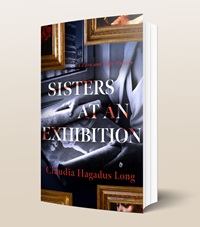 When a prized Caravaggio sketch goes missing from a SF art museum, two sister sleuths take up the search…
Zara, lawyerly and just a little cynical, teams up with her older—by 11 ½ months—sister Lilly, when a possible Caravaggio sketch and its curator both go missing from a museum. Lilly’s never met a man, or a scam, she didn’t at least wink at, so when the major museum donor who was dating the missing curator turns out to be a handsome, wealthy criminal, Lilly is all in to join the chase. Threaded through this modern-day mystery are flashbacks to a journal kept during World War II by the father of (one of) Lilly’s boyfriends. As the search moves from San Francisco to New York City to Alsace, France, the stories come alive in the old barn where the curator and the Caravaggio may, or may not, be hiding. This book is part of the Zara and Lilly mystery series featuring Zara and Lilly, two mature sleuths whose humor, failings, and wisdom prove endearing and entertaining.
BUY HERE
Category: On Writing
Subscribe
If you enjoyed this article, subscribe to receive more just like it.