How Dear Missing Friend Came to Be by Susan McGuirk
Like so many of us, I found myself researching family history a few years back. It was strictly for fun, and I did not have a grand plan of how it would all play out. It wasn’t until I came upon an advertisement looking for a long lost relative that things began to change.
I like to say the protagonist of my new novel, Dear Missing Friend, found me, not the other way around. When I came upon the advertisement searching for my 2nd great aunt, Catherine McGuirk, placed by her husband, I was intrigued. It was in the “Missing Friends” column, which was syndicated to newspapers all over the country in the 1800s. It was where Irish immigrants would try to locate their lost loved ones in the new world. Readers understood that it didn’t matter what paper they had, it was national in scope. Even immigrants who weren’t actively looking for someone would read it because they likely knew someone who was.
My relative’s husband placed the ad from Ohio in 1864, though he did not state his relationship to her. He wrote that he was looking for Catherine and that she lived in Sag Harbor, New York about 20 years before. Any answer would go to a local clergyman. I wondered how a husband could lose a wife, and why he did not identify himself as such, but left it at that.
It wasn’t until I happened upon another advertisement that Michael, the husband, placed four years later still looking for Catherine, that my imagination went into overdrive. Why didn’t she answer him? Was she dead or alive? Was she hiding from him and if so, why? Was there a reason he used her maiden name in the ad instead of his last name, Heffernan? From these questions a story was born.
It took the better part of a decade to do all the research in fits and starts for the book. Along the way I read 50 books on related topics including: Irish history, the history of Native Americans in Eastern Long Island, the history of African American and Portuguese whalers, the history of Sag Harbor, of the whaling industry, of the Gold Rush, of the local maritime Underground Railroad, and of New York City. The full bibliography is on my website, https://susanmcguirk.com. I also have an extensive Notes section at the end of the book with pictures and records of the various lives, including federal and state census records, ship manifests, whaling logs, maps, deeds, newspaper clippings, graves, death and birth records and war service. They are also annotated on my site.
I also traveled to Ireland to explore my family’s ancestral home. A local historian showed me our family’s former farm and the school Cath most likely attended. We visited a nearby castle where he said the family members might have worked during the seasonal harvest for extra money. Walking through the meadows, I could picture Cath and her best friend Susie there as children running down the hill toward the village where her school and the castle were.
One particular setting from the book that holds meaning for me is a house still standing in Sag Harbor that was bought by the character Jane Perdue. She was of mixed heritage, descended from a free Black whaling family and as a member of the Montaukett tribe, which she identified with. For a poor woman of color to save her money in the Sag Harbor Savings Bank for decades and purchase her own house almost 150 years ago, which she owned free and clear, is astonishing. It still sits proudly on Liberty Street, a telling and fitting address.
The main two settings, Sag Harbor and New York City, have much of the past preserved in them. Sag Harbor was economically depressed for most of the century following the whale fishery collapse in the 1850s. Little was torn down or built up for a long time, so it still retains much of the character and flavor of the era. In New York City, gazing down from the Highline onto 14th Street at the still relatively low-rise landscape, now closed to most traffic, it’s easy to still imagine horses lashed to hitching posts along the cobblestone streets.
All the settings used in the book were real places the characters lived, and I researched their travels and pursuits to follow the tale. The deep dive into this story was never boring. I didn’t know where it was going, only that the facts would dictate the direction. It was my job to fill in the whys and wherefores, but the events steered me, not the other way around. It freed my imagination to follow the characters feelings, not having to worry about their pre-ordained destinations.
The final piece of the puzzle was the epistolary format. Letters as a vehicle occurred to me for multiple reasons. First, having only to be concerned with the characters’ motivations and feelings instead of a plot, I felt like I was almost listening to them speak sometimes and letters reflected that. My background was in film programming – reading scripts and writing in-house reviews, so dramatic writing was familiar. Once I had a story to tell, letter writing just seemed natural.
—
Amazon Best Selling author of Dear Missing Friend, Susan McGuirk, posts about heroines of historical fiction on her free newsletter “The Storied Sisters Society” on Substack. While working at HBO, she honed her writing skills composing hundreds of in-house film reviews. She also worked at Anthology Film Archives, a historical film museum. Besides Substack, follow Susan on Instagram, Bluesky, Goodreads, and susanmcguirk.com.
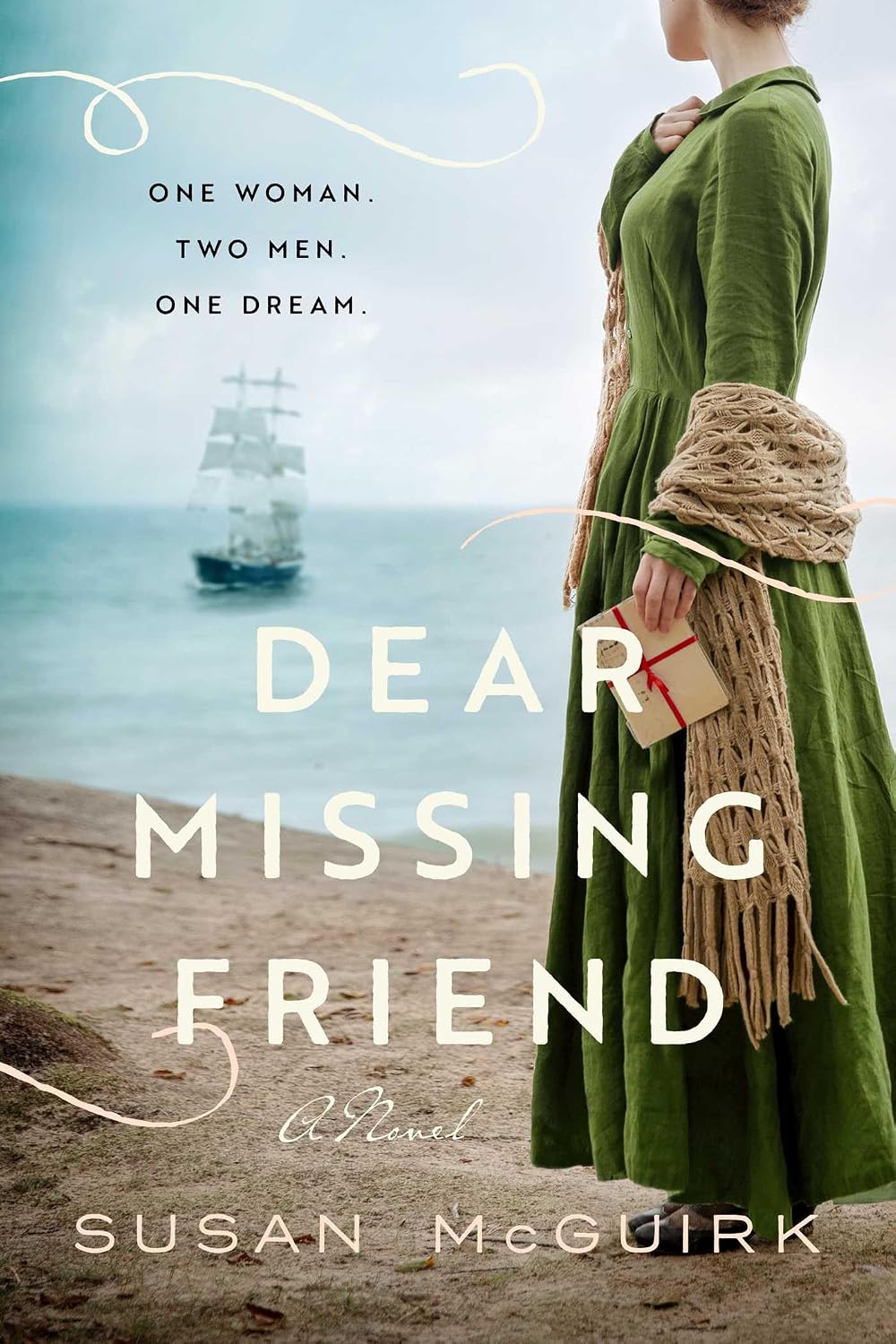
DEAR MISSING FRIEND
 Recommended for readers who enjoy The Dictionary of Lost Words by Pip Williams and An American Beauty by Shana Abé
Three hearts. Love lost. One impossible choice.
A character-driven historical saga featuring the love triangle of a seaman, a governess and a wealthy speculator. Told through letters, the sweep of 19th century events like the gold rush, whaling voyages, and the streets of Manhattan unfold.
At the height of the 1840s whaling era, Catherine McGuirk arrives in Sag Harbor, New York. She has already spurned a marriage proposal from Patrick Lynch on her passage from Ireland and is confident she will find work as a governess, or at least a teacher. The local schoolmaster dismisses her with a smirk. Settling for hotel work has its upside when Cath meets a handsome seaman, Michael Heffernan. Just as she falls in love, he is off on a whaling voyage.
Spending her romance alone spurs Cath to continue her correspondence with Patrick. His ascent as a successful businessman in New York is swift, while Michael promises to give up the sea for marriage to Cath. Yet, when the Gold rush calls, he cannot resist. A brokenhearted Cath moves to New York to revive her dream of becoming a governess. Once in Manhattan, she continues to be torn between her own ambition, her missing husband, and her former beau.
BUY HERE
Category: On Writing
Subscribe
If you enjoyed this article, subscribe to receive more just like it.