The Legacy, with Medusa by Sharon Linnéa
If only Bob was here.
I looked at the brown box sitting on the kitchen table, on a yellow and blue tablecloth decked with sunflowers. If only he could see this.
I used a steak knife to slice the packing tape. Inside sat a stack of beautiful books, topped by a medallion of a Medusa head. Less the Horror than the Grace by Robert Owens Scott.
Bob’s book. The one he’d been working on for years. He should be here.
Although my husband and I had different careers—I worked in publishing and wrote novels, he worked for Trinity Church Wall Street in New York—we shared a dream: we’d one day find a writer’s aerie and write books.
In 2021, we did just that. We moved from the city to a mountainside in North Carolina. I continued working on my mystery series, The Bartender’s Guide to Murder, and he began the novel that had been simmering inside him for the better part of a decade.
It a feminist take Medusa myth set in a snake-handling church in Tennessee in 1920, as women’s suffrage came to a final vote in the Tennessee statehouse.
He’d already done years of research, and he loved bringing us to Appalachian music festivals, storytelling evenings, and to find local mountain art that spoke to him. He was the happiest I’ve seen him.
He finished a draft and asked me to take a look. I did, with trepidation. What happens if a loved one gives us something, well, not that good? Turns out, it was something special. You could tell from the opening words. He asked if he should bother doing a second draft: the answer was hell, yes. He did.
Then we fulfilled another dream and joined some friends on a scuba-diving trip to Roatan, Honduras. Well, he scuba dove. I snorkeled. The third day, I was out with the other snorkelers looking at a spectacular undersea panorama, when I suddenly stopped. I swam back to the boat. Something was wrong.
Sure enough, when our boat returned to dock, the owner of the resort was waiting to take me to the medical center. Bob was dead. He’d been diving with our friends; he’d come up out of the water (he hadn’t been deep), said, “I’m tired,” and was just gone.
As anyone who’s dealt with a deep loss knows, it takes a while to find your footing again.
My next mystery came out but I didn’t have it in me to support the release. (I’m sorry, Death from Beyond!) I didn’t have much in me, at all.
But what about Bob’s book?
I knew I had to get the book out, for two reasons: to honor his legacy, and to address the fact that forces in the U.S. are once again arguing about whether women should even have the vote.
Bob’s favorite genre of horror was folk horror. In it, often, the true dreadfulness doesn’t come from supernatural actors. It comes from what people are willing to do because of their beliefs. Timely, indeed.
Several agents were interested in the book, and several editors as well. I waited months. I’ve worked in publishing, so I know this is normal. As time dragged on and Pete Hegseth and his pastor began to talk about the fact that only the male heads-of-household should vote, I began to feel an urgency. I knew that if an editor called the next day, she’d likely say, “We love it! We’re going to fast-track it—it will come out Spring 2028!” I felt we didn’t have till spring of 2028.
A book where a male feminist weaves a transfixing tale about how women are methodically excluded from politics, churches, and power in family dynamics, felt important. It needed to come out now.
If there’s one thing I know how to do, it’s put out a book. I determined to do it. For Bob. For the rest of us.
I did a first edit then hired an editor who worked with horror. I hired the best designers I could find for the cover and the interiors, and a proofreader who knew the genre and the locale. Michael Beck, who narrates most of John Grisham’s books, signed on to do the audio.
Then early reviews began to come in: “A young seminary graduate, Theophilus Hood, arrives in the mountains as a ‘participant observer,’ expecting to study faith through the clean lens of reason. What he finds instead is a community where belief has teeth, the forest keeps its own counsel, and the line between holiness and horror is perilously thin.” –Angela Yorko Smith, Space & Time Magazine
“This tale is both eerie and beautiful. But beyond the ghost story and the vivid atmosphere, Bob is writing about how institutions silence women; he somehow found a way to make that argument through horror, myth, and history all at once.” –Wesley Strick, screenwriter, Cape Fear
If only, I keep thinking. If only Bob was here.
But as I held his book in my hands, I know that in many ways, he still was.
—
Sharon Linnéa is the author of the bestselling Eden thrillers with Chaplain (COL) Barbara Sherer from St. Martin’s, which follow the exploits of female Army chaplain Jaime Richards. Her biography of Princess Kaiulani of Hawaii won the Carter G. Woodson Award and her biography of Raoul Wallenberg was described as “one of the definitive biographies of the Holocaust” by the Museum of Tolerance. Sharon has been a book editor and an editor at three national magazines, as well as a celebrity ghost. In her youth she wrote Spidey Super Stories for Marvel. She is currently writing the Bartender’s Guide to Murder mystery series, which begins with Death in Tranquility. The most recent book in the series is the 5th, Death as a Fine Art.
http://www.SharonLinnea.com http://BartendersGuidetoMurder.com
Less the Horror than the Grace, Robert Owens Scott
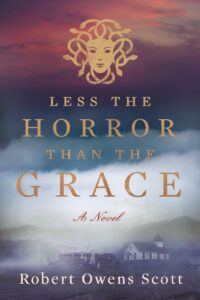 A modern retelling of the Medusa myth set in a snake-handling church in Tennessee in the summer of 1920 as they vote to ratify women’s suffrage for the entire United States.
It’s the summer of 1920 and the hollers of Tennessee are dripping with humidity and tension, the electricity in the air broken only by storms and, if you’re lucky, a travelling revival. The most famous features a lady preacher-who bestows the power on her listeners to become greater than themselves, and to handle the most venomous snakes without fear, investing them with a spiritual power they’ve never known.
Miles away in Nashville, the state legislature is about to vote on Women’s Suffrage. If it passes in Tennessee, it will become law of the land. If it fails, the measure is all but dead. It’s clear the measure will pass or fail on the slimmest margin of votes and both sides are upping the ante by playing dirty.
Elsewhere in Nashville, Theo Hod graduates from seminary. The son of his denomination’s founder, he secretly plots his own course to bring religion into the future by embracing science and the new psychology of Dr. Freud, framing theology which gives new importance to listening to women.
Because of his unconventional views, Theo is sent as a “participant observer” to the mountain hamlet of Parthenon because strange reports have been filtering in. His long journey through the woods and into the mountains is wound with confusion and strange sightings, on top of which, Theo arrives just in time to attend the funeral of the pastor he was supposed to observe-who was killed by a snake bite. The popular female revivalist becomes the new pastor.
Welcomed into the home of the mayor, who’s also the local state legislator, Theo can’t help but notice a strange pall over the town. He finds an unexpected kinship with Minerva, the pastor, who seems to have unusual powers. As Theo becomes immersed in the life of the citizens-falling in love with one of them-he is confused by what seems to be supernatural goings-on. And listening, actually listening, to the women shocks him more than anything.
During the final push of the country’s most famous suffragettes-including the leader, Bernadette Shaw, who can see death in the future of many-Theo fights to find out what’s really going on, is allowed into the fellowship of women and nearly dies for it, before finding an unexpected ally as the legislators ready to vote for women’s suffrage face what Theo knows to be a supernatural battle.
BUY HERE
Category: Contemporary Women Writers, On Writing
Subscribe
If you enjoyed this article, subscribe to receive more just like it.