What Home Means
by Janet Clare
I have recently been made aware that the title of my new novel, True Home seems to have struck a chord with many for whom the words hold very different meanings, most of which have nothing to do with, and are far beyond, the story of my novel.
In my city of Los Angeles, after enduring staggering fires, and, now, along with the threatening political environment in our country, it seems we are all searching for something to help us not only survive, but to go on with hope. Home is where we go to find solace, to recover and nest in the quiet comfort of music, painting, cooking, reading, and so much more. And, when that physical environment is suddenly and violently striped away, whether by fire, or as in Asheville, North Carolina, by a destructive flood, we are left devastated not just by the loss of the things that mark our individual history, but by the real relief found only when we’re home.
Within the framework of home, whether we think of it as a structure still standing, or yet to be recreated, can be found in everything we ever thought about our place in the world. During the L.A. fires if we were fortunate enough not to have lost our own house or apartment, we often knew someone who did. As many of us packed in preparation to evacuate, we looked around as if for the last time, studying the walls that encompass our days, and it wasn’t difficult to imagine the devastation felt by those who returned to burning embers.
If we didn’t personally volunteer to hand someone a meal or clothing, most likely we donated, or, like many, we opened our home to strangers. We reached out to each other and in so doing, we brought the sprawling Los Angeles County together perhaps as nothing had before. This place of many cities without a center but filled with a wealth of powerful and diverse beating hearts. It was a fearful and emotional time and the resulting loss will be with us for a long time.
One wonders then, in this immensely trying time as our government tries to tear us apart ever more, how do we hold on to that time of coming together? Do we have the imagination to continue to rejoice in each person as an individual and artful being? Each of us longing for the same ideal of home as a refuge where we are welcomed and where we welcome others.
Some years ago, I was given a beautiful book called Writers’ Houses. I skimmed through it at the time, not yet daring to call myself a writer, although maybe I was; maybe everyone is a writer, just under the surface. Going back to the book now, I look for what these houses meant to some of the most famous writers in the world. The pictures are stunning, the homes, for the most part, belong to a bygone era. Included is Karen Blixen’s family home in Denmark where she returned and where she died. It is a house of pale walls and lacy drapes sweeping the floors. Yet Africa was in many ways her real home, which was more about the air, the vast sky, and the people. The prologue of Writer’s Houses was written by Marguerite Duras, and she speaks of her home in France as the “spirit of place.” Further on she writes: “I was alone in this house…I was afraid, of course. And then I liked it.” For many of these writers, including Ernest Hemingway in Key West, their houses were, above all, where they could work, and what seems most constant, too, is the feeling of being home
In author Desiree Cooper’s short essay, Picking through the Ruins of your Dying Neighborhood in Electric Literature, she writes about her neighborhood in free fall as homes are bordered up and families forced out. One day, she hesitates before entering a neighbor’s home where items were being sold off and she comes across an “exquisite soup tureen…Williamsburg blue.” She knew even then that she would probably lose her own home, but the tureen felt like an “an inoculation of hope—a talisman to keep the infection from spreading.” After her purchase, she sat in her car and cried. She lost her home, and never used the tureen. Readers can understand her impulse to hold on to a physical remnant of imminent loss, and her resulting sorrow. We have all seen the many photos of people walking through the ruins of their destroyed homes as they searched for some small memento of their lives. How much those scarred pieces meant to them and to no one else.
Loss is loss no matter how it occurs. And whether a mansion, a modest dwelling, a factory, or a small business, when it is suddenly ripped out from under us, we feel it deep in our being. Those of us spared still experience the loss felt by friends and family and yes, strangers, too, and we deeply empathize, or we certainly should, with them all.
Perhaps one of the most profound and endearing statements about what home means was written by Mimi Mwiya in her essay, Home is not a Place, in The Kalahari Review. In it, Ms. Mwiya states: “Wouldn’t it be glorious, if instead of thinking of home as the places that house us, we thought of ourselves as housing our homes, the carriers of our home. Because what we carry in us, no one can take away.” Her words strike at the heart, “carriers of our home,” not only for the truth they convey, but for the considerable comfort they provide. Because ultimately, wherever we are, whatever calamity befalls us, we can go on for we are always home.
—
Janet Clare has had short stories and essays published online and anthologized. Her novel, Time Is the Longest Distance, was published in 2018. True Home is her second novel. She lives in Los Angeles. Visit janetclarewriter.com.
—
TRUE HOME
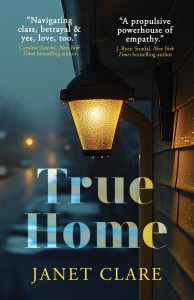 “A propulsive powerhouse of empathy.” J. Ryan Stradal, New York Times bestselling author of Saturday Night at the Lakeside Supper Club
Swanee Burrows, the restless, razor-sharp fifteen-year-old daughter of a scandal-ridden congressman and a flawed yet magnetic socialite, struggles to find her footing as her parents’ bitter and very public divorce spirals out of control. In the rain-soaked landscape of the Pacific Northwest, Swanee’s runaway attempts and the intricate web of deception surrounding her family bring her dangerously close to the edge of no return.
At its heart, True Home is a story about coming-of-age and coming to the truth-a tale of love, betrayal, and the dangerous risks we take to find where we truly belong. Janet Clare invites readers into a world where every relationship is a labyrinth and daring to love might just be the greatest danger of all.
True Home delivers the same piercing emotional clarity as the great domestic dramas of the late 20th century, inviting comparisons to Ordinary People and Endless Love. Yet, Clare forges her own path, presenting a story that feels at once timeless and thrillingly fresh.
BUY HERE
Category: On Writing
Subscribe
If you enjoyed this article, subscribe to receive more just like it.