Power, Fear and Survival: how Six Mile Store Centres Female Characters at the Heart of a Crime Thriller
by A.M. Belsey
Crime fiction is all too often filled with characters who exist as extreme versions of themselves. Police detectives are supernaturally perceptive, able to piece together the most opaque clues to find a killer in moments, while victims, especially female victims, are often portrayed as broken, helpless, totally without agency. But I didn’t want to write my female characters this way. I wanted them to be uncomfortably real, the kind of women I might have been myself if circumstances had been slightly different. The women in Six Mile Store are perceptive. They understand in a vague way what they could do to make their lives better, but they are constrained by imagination, unable to outmaneuver their circumstances, until they are eventually forced to act in an effort to survive.
This subtlety – women suffocated by a lack of imagination – is difficult to portray in crime fiction because so much of the genre is built on momentum. Crime plots usually require action, agency, decision-making. Crime heroines don’t hesitate, they act. But in Six Mile Store, an expectation of inaction is built into the characters’ surrounding culture. They are brought up to be obedient and quiet, to put their trust in a higher power, a holy book, a strong husband. They are not taught the skills that would allow them to fight their way out of bad circumstances and come out on top.
Cultural conditioning like this is hard to portray in crime fiction because when these women become a story’s heroines, much of the book’s action becomes internal and emotional. In a typical crime book, it’s easy to watch a woman kill or be killed. It’s far more difficult to see a woman handcuffed by a poor education, then imprisoned by a diet of lies and male control. Violence may run for a few pages, but the murder of women’s imagination starts long before the crimes central to Six Mile Store, and continues long after the book ends.
But just because Six Mile Store’s characters don’t have the tools to imagine the way out of their predicaments, that doesn’t mean they lack survival instincts. Each woman assesses her situation, and eventually each comes to the conclusion that she must push back, must not allow herself to be held down. Their actions are reactive, raw, and often poorly planned. The problem is, as we all know, that a failure to plan is all too often to plan to fail. Without giving too much of Six Mile Store away, each of my female characters would benefit from thinking around the barriers enforced on them by the men who aim to control them: who have their own reasons to keep their women cowed and misinformed.
For example, when one of my main characters finally makes a decisive, even ruthless, choice toward the end of the novella, to her it feels like she has secured a real victory. But she has acted on information that a man has given her, which he has twisted to suit his own agenda. Her instinct and courage are real, but her agency was compromised long before she was able to make any choices. Another character, realizing too late that the walls have closed in around her, is left with exactly one choice that is truly her own.
The crime genre has room for both of these women, the one who acts on a lie and the one who acts on a terrible truth. But if a woman acts decisively under circumstances like these, where she has been maneuvered into place through forces outside of her control, does she truly act with power? To me, her power may be flawed, but without question it is present. Most real women who escape bad circumstances do so because they find a moment of courage and seize it, not always because they have made meticulous plans. Six Mile Store acknowledges this messy and compromised version of female survival and power, even if the outcome does not feel triumphal.
The setting of Six Mile Store is admittedly specific: rural, religious, conservative. But I believe readers would be mistaken to consider it remote. Every day, the forces that shape my characters – such as controlled information flow, increased religiosity, decreased economic security, and the erosion of female agency – are all too present. They are found everywhere, not just rural communities. Even if the daily realities are different for Honey and Lisa and the other women in Six Mile Store, they are held back by the same tools that have always been used against women. But women have always found ways to survive, even if they have been denied the chance to understand the extent of their own power.
And because real life does push up against these forces, and because my aim was to create crime fiction that is uncomfortably real, I will consider Six Mile Store a success if I leave my readers unsettled.
—
A.M. Belsey was born in Arkansas but moved to the United Kingdom at the age of 21. She works as a publisher and author and splits her time between London and Norfolk with her family.
Six Mile Store by A.M. Belsey (Deixis Press, £7.99) is out now.
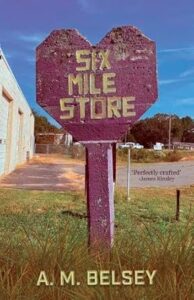 SOMETHING UGLY’S WAITIN’ FOR YOU
Honey’s working weekends down at the Six Mile, trying to figure her life out. Her boyfriend’s about to leave the country, her college advisor hates her guts, her momma ain’t listening, and she’s got this cop breathing down her neck just about all the time.
She finds a friend in her new colleague Lisa, but when one of their regular customers turns up dead, everything goes sideways faster than a greased hog at the county fair…
BUY HERE
Category: On Writing
Subscribe
If you enjoyed this article, subscribe to receive more just like it.