On Writing Betting the Farm – How a Maverick Entrepreneur and a Band of Scientists Changed Agriculture Forever
“Betting the Farm – How a Maverick Entrepreneur and a Band of Scientists Changed Agriculture Forever” chronicles the story of Agrigenetics, a company that pioneered technology to create better plants using gene technologies. It was the early 1980s. The authors Janice Kimpel and Adrienne Clarke are scientists and were both involved in the company, Adrienne as a contracting scientist and Janice as Contracts Research Manager.
It was pre internet, pre zoom, pre mobile phones. However, we would meet at the annual Agrigenetics science meetings, or at other science meetings, several times a year and often at exotic locations in Italy, Mexico, Australia and the US. Of course, we would tack on real holidays at the end of the science meetings, becoming good friends. The wonderful Chief Patent Counsel for Agrigenetics, Lorrie Greenlee, often joined us, especially on skiing adventures.
During these vacations and long after the demise of the company, we would often say the story of Agrigenetics was so amazing that it should be told. Yes, someone should write the book, yes it influenced so many lives, yes it kick-started much of the science that is now commonplace, yes it was such an exciting ride and changed our lives, yes it certainly should be told. But none of us had time to even contemplate writing a book. Nothing was done except to repeat that mantra whenever we met.
Then came the global pandemic due to COVID19 and lockdown. Adrienne was isolated in a remote coastal site in Victoria Australia and Janice in her home in Illinois. The availability of Zoom, the internet, email and international phone calls probably saved our sanity. We said, “well, we don’t know how long we will be in this strange isolation living, so let’s try writing the book”.
How to start? We had both written scientific articles and books, but this would be different. We talked about what the book should cover, mapped out some chapter headings and decided that we would each write a chapter independently and see what we get. We quickly realized that we have completely different writing styles and we would never get an easy flowing book with that approach. We would need a different approach.
We wondered whether the founder of Agrigenetics, David Padwa, might be willing to give us his perspective, if we could track him down. It was over thirty years since we had had any contact with him. After some sleuthing, we made contact with David (then in his late 80s) and remarkably, he was enthusiastic and willing to talk about the whole experience. Due to time differences between the US and Australia, the burden of the interviews mainly fell to Janice. Janice transcribed her interview notes by hand and sent them to Adrienne.
As we mulled over the interviews, a whole back story to Agrigenetics became apparent which we had not been aware of. David and friends raised the equivalent to $300 million for a very risky venture to fund cutting edge research that would lead to better crops- how on earth could someone do this, we wondered? David explained how he did it, and then about the dramatic takeover offers and the boardroom battles.
These were first-person accounts that could only have been publicly revealed decades after the event without fear of legal retribution. David Padwa put us in touch with his ”wingman”, Gene Keluche, who added more detail and color to David’s memories. Gene was the first Native American to earn an MBA degree from Harvard. His rigorous financial and business skills bought order to David’s genius for new ideas. Janice also sourced original documents to verify dates and the substance of what we had learned from interviews with those two remarkable men.
Janice sought out other individuals who had been involved – other contracting scientists, members of the executive team, and employees – all of whom provided a fuller picture of the events surrounding the rise and fall of Agrigenetics. With the benefit of being many years removed from those events, we feel that all the interviewees gave us a thoughtful picture of the role they played. Everyone we interviewed encouraged us to get the story of Agrigenetics into print.
Now we had to turn all these interview notes and our own knowledge of the activities into something that would be interesting for business students, other scientists, patent lawyers, entrepreneurs and perhaps even a general audience. We decided to put the detail of the science into appendices. The narrative would then, hopefully, be easy to read without having to stop and deal with technical terms.
We discussed what would be in each chapter and how the chapters should flow. Our approach, due to our different writing styles, was that Adrienne would write a draft, Janice would revise it and we would go back and forth until we had something that we were both happy with. Adrienne’s adult children who were skilful, constructive but very critical editors helped get it to a final form.
The next hurdle was to find a publisher. We were inspired by the number of rejections that JK Rowling experienced and so persisted through 47 rejections from agents and publishers. We opted to try a hybrid publishing firm, and our book was noticed by Amplify. We had difficult conversations about the cover as we did not like any of their suggestions but fortunately a dog walking friend who happened to be a graphic designer came up with something we loved.
The book was completed without any help from AI; we were in fact the prototype for the brand developed by a friend called Proudly Human. This brand confirmed that our book is original work by the authors without any recourse to AI.
Since we paid Amplify to publish our book, we know that we may never realize a profit. But we felt strongly that it was a great story and the unsolicited reviews we have received confirm that it is a worthwhile addition to the literature on entrepreneurship and ag biotechnology. And who knows, we still have the film rights, so a screenplay writing collaboration might be in our future!
—
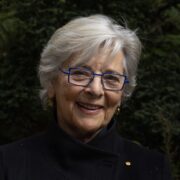 Dr. Adrienne E. Clarke, AC, is one of Australia’s most distinguished scientists. A leader in plant molecular biology, she was one of the original scientists contracted by Agrigenetics in 1982 and went on to a career that spanned molecular biology research, the Lieutenant Governorship of Victoria, and senior roles in corporate governance.
 Dr. Janice Kimpel is a U.S.-based patent agent and biotech business consultant whose work in the CEO office of a start-up vaccine company grew directly out of her early career in plant biology. Together, they have produced an account drawn from primary documents, archival research, and interviews with David Padwa himself before his death in 2023. Their new book is Betting the Farm: How a Maverick Entrepreneur and a Band of Scientists Changed Agriculture Forever. Learn more at bettingthefarmbook.com.
Betting the Farm: How a Maverick Entrepreneur and a Band of Scientists Changed Agriculture Forever
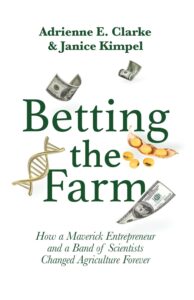 This is the tale of a wild corporate ride at the beginning of the agricultural biotechnology revolution. In their eyewitness account, two scientists who participated at the start of the genetically modified crops revolution tell how David Padwa, a charismatic entrepreneur who saw the promise of the new technology as a way to feed people and protect the environment, set out to make it happen.
David, along with his “wingman” and fellow entrepreneur, Gene Keluche, the first Native American with a Harvard MBA, and his money man, Gilbert de Botton, head of the Rothschilds bank in Switzerland, started the seed company Agrigenetics. They then raised today’s equivalent of hundreds of millions of dollars through a limited partnership and contracted the world’s best academic scientists to discover new useful genes and get them into seeds.
The times were alive with competing startups; big oil, chemical, and pharma companies were also getting into the game, and hustlers were ever present. Takeover offers, unintended consequences of government legislation, soaring interest rates, stock market volatility, and huge egos had to be managed. Though well before the advent of the internet, the lessons from this extraordinary venture are as relevant today as they were forty years ago.
BUY HERE
Category: On Writing
Subscribe
If you enjoyed this article, subscribe to receive more just like it.