Florence Nightingale, Hallucinogens and the Apocalypse: How I Wrote Ink Honey Blossom By Liza Losada
 Ink Honey Blossom is a novel born of illness and isolation. The world was two months into the COVID lockdown, and I was lying on the floor reading about a ceremonial trading system in Papua New Guinea called the Kula Ring. Sacred beads and seashells are exchanged between islands creating a unique gift economy which fosters peace, social connection and trust. These are sacred items that absorb the history, power and prestige of their past owners. They are not currency, nor are they precious gemstones, nor can they belong to anyone. Their value lies in the act of giving them away and the relationships formed between those who share them. Like so many early genre readers, I was a kid who wished for my own magical item, an amulet, a discovered locket, a magic cloak that allows flight. So, when it came time to write my own tales, I was easily inspired by the Kula Ring and built the magical system of Ink Honey Blossom.
Ink, the 15-year-old protagonist, becomes the current custodian of a charmed object and must decide how to use the power it bestows. Eight hundred years before she was born, a global pandemic threatened to wipe out the entire male population. The survival of this post-pandemic society rests in the bodies of young women like Ink and the hallucinogenic trances only they can provide. The story follows Ink and her friends who are held prisoner in The Nectar House, one of hundreds of establishments all over the world that provide these services to the men afflicted with the deadly disease. Each night, captive girls catalyze and administer a powerful psychedelic drug that restores the men’s health while simultaneously depleting their own with each encounter.
Ink is a prisoner, anchored in her one room library, destined to live out her short life in her one room library, only able to talk to the other captive girls through her window and across a courtyard. Ink tries to better the brief and brutal lives of the other House Girls as best she can, but she has no power in a socially sanctioned system designed to exploit her. When a rare artifact comes into her possession, she is gifted with an unprecedented ability. Now she must make a difficult choice to stay imprisoned and use the newfound power to help the girls in the House or lead herself and a handful of her friends to freedom.
Because Ink Honey Blossom is a story about captivity, enclosed spaces and the restricted and claustrophobic existence of these trapped girls, I knew the stakes had to feel big. By choosing the genre of dystopian fiction, my protagonist had to face the dangers of overarching human institutions like corrupt governments and ancient, unquestioned traditions. I wanted to use speculative fiction to illuminate the real-world attitudes and patterns of gendered violence that can result from similar trends, both past and present, ones that could occur in the face of societal collapse and when institutional control over women’s bodies becomes the accepted norm.
By placing women and girls at the center of a system that depends on their suffering, I could not only expose the mechanics of harm in the name of greater good, but also celebrate the individual resilience of women and use their emotional connections and the power of their relationships as the ultimate act of resistance, rebellion and, ultimately, survival.
When Ink finally has some power of her own, she becomes burdened by the decisions and the moral injury of having to choose who to help and why. As a nurse psychotherapist, I have had the honor of listening to the stories of veterans, aid workers and medical professionals faced with similar decisions. As I was writing the novel, COVID had spread to all corners of the world, and these issues were brought to the forefront as resources were as limited as the skilled personnel who had to face the psychological and spiritual distress of ethical decision-making during times of crisis. I treated some of these workers while my own practice was overflowing, and there were times when I too had to make similar choices of who I could treat all while experiencing, for the first time in my career, the same traumatic events as all my patients.
Around this time, I became trained as a psychedelic psychotherapist engaged in research for the treatment of mental disorders like depression and PTSD through the use of psychedelic substances. The area of study was and is exciting and groundbreaking. Yet, despite the headlines and cool edginess of the topic, I found that what I liked most about the work was sitting. For me, that was the best part. Simply sitting for eight hours with someone who is having a psychedelic experience and I, a nurse, a human being, was with them providing a safe, reliable anchor for them and a witness to their experience. I was not called upon to interpret, guide, treat or analyze. I only had to hold space while allowing the participant’s inner healing intelligence and psyche to help them with the work they needed to do. The many hours of quiet fellowship felt so right as an individual and as a nurse. Many aspects of psychedelic therapy parallel the nursing process which prioritizes safety monitoring and comfort while respecting the autonomy of the other person and trusting their healing process.
The kinds of hallucinogenic trances facilitated by the girls in Ink Honey Blossom are very different from my own experiences, but they were certainly inspired by the therapeutic use of self, and the trance scenes were among my favorite to write. I was allowed to get weird, get spiritual, play with narrative braids and metaphors that had carried the characters throughout the book. As a writer of speculative fiction, or a writer of anything, isn’t that one of the gifts we enjoy? A gift that we give freely in hopes that the recipient also experiences the thrill, the heartbreak and the magic of the words designed to hold power and experience and the potential of connection and healing. It is my sincere hope that the readers of Ink Honey Blossom enjoy and receive these gifts in the spirit in which they are given.
—
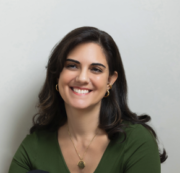
Liza Losada is an advanced practice nurse psychotherapist specializing in post-traumatic stress disorder and adolescent psychology. As a trained psychedelic psychotherapist, she engages in research studying the use of psychedelic drugs in the treatment of mental health disorders. She holds a degree in literature from Wesleyan University, and a master’s in psychiatric nursing from the University of Maryland. Her work is inspired by the intersection of her clinical career, her cultural background, and the resilience of her patient population. When not putting her protagonists in peril, she lives in Maryland where she enjoys making dioramas and book art alongside her family and two wonder pups. Ink Honey Blossom is her first published novel.
Find out more about Liza on her website https://www.lizalosadaauthorpage.org/
Follow her on Instagram https://www.instagram.com/lizalosada/
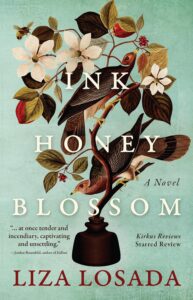
INK HONEY BLOSSOM
 “Perfect for readers of Margaret Atwood and Octavia Butler. A tale of survival, trauma, and resistance in a world built on the backs of young girls.”
800 years ago, the Blight Plague almost wiped out the male population. Now they must rely on young girls to survive.
Beyond the iron bars of Ink’s only window, grows a mass murderer of little girls in the form of a lush, golden tree. Eight hundred years ago, the Blight Plague almost wiped out the male population. Only the hallucinogen culled from the Sonagachi tree can slow the progression of the incurable disease. If not for the drug administered and catalyzed by imprisoned House Girls around the world, men would die young and by the thousands.
Each night, fifteen-year-old Ink and her friends at The Nectar House use the powerful hallucinogen to curate a bespoke trance-like experience which prolongs the life of their sick Blight customers by replenishing their health while simultaneously depleting their own. Years of captivity and the betrayal that got her sold have toughened Ink’s heart while her body weakens every day. Ink has no power, no freedom, and little sympathy.
Armed only with her wits and locked in her one room library, she tries to improve the brief and brutal life of the other House Girls, but only the girls Ink deems special and worthy of her altruism. When a beloved friend goes missing, Ink knows her efforts are not enough to bring her back or keep her other friends from being sold to other houses. One night, a Blight arrives with a magical item that grants Ink an unprecedented ability and the possibility of escape. Ink must decide whether to stay and help those she can in the time she has left or lead a handful of friends to freedom. If either course fails, if she’s caught or outsmarted, she and everyone she’s trying to save will be buried along with the other dead House Girls who feed the vile Sonagachi tree.
For readers of Margaret Atwood and Octavia E. Butler.
BUY HERE
Category: On Writing
Subscribe
If you enjoyed this article, subscribe to receive more just like it.