The Process of Writing The Feminine Code By Sabrina Bendory
 When my publishers approached me three months after the release of my book Detached and asked if I’d be open to writing another book — one that dove deeper into toxic relationship dynamics and explored dark feminine energy — I was intrigued. When they said they wanted it as soon as possible, I thought they had lost their minds.
Another book? Now?
I was barely recovered from the emotional exhaustion of the previous one. The days that bled from one to the next. The hours of writing and rewriting. Being jolted awake from a deep sleep because an idea came to me in a dream. Keeping a pen and paper nearby when I showered — because we all know the best ideas come in the shower and if you don’t write them down immediately, they evaporate.
The questioning and second-guessing. Is this good? Will they get it? Do I need to explain this more? Did I over-explain this?
The moments of euphoria — Oh my God, this is the greatest book ever written — followed immediately by devastation — This book is garbage, no one will read this.
And then finally feeling bold enough to submit. Books are never really done. But there is a moment when you pass your threshold — when you just can’t sit with this thing anymore. You’ve gone as far as you can go, and you send it out to a pair of fresh eyes.
The edits. The revisions. The “wait, I forgot! We need to add one more thing!”
And then the end. It’s ready. It’s being printed. And then the anticipation for launch day. Is anyone going to buy this? Did I just waste a year of my life? What if they hate it? What if I fail?
I finally landed on the conclusion — and was impressively unwavering in my conviction — that this book is actually good. Like, really good.
The book became something of a sensation. And after many months, I let out a long exhale. I’ve done it.
I was basking in the feeling of finally being finished when my publishers noticed that certain sections of Detached were going viral — specifically the sections on detaching from toxic people and relationships. So they asked if I wanted to write a follow-up book that examined those themes more deeply.
And I did. But I was so mentally drained. Forget about the fact that I had just finished writing a book — I also had a coaching career, clients, a podcast, and four young children.
But I said yes.
Because toxic relationships are, unfortunately, something I know in my bones.
I was ravaged by a trauma bond in my very early twenties that hollowed me out. I was never the same after that. And now, as a coach, I sit with client after client who is trying to pick up the pieces after being gutted by what they thought was true love — but turned out to be anything but.
I took a few weeks. I thought it out, mapped it out, and then was off to the races.
I tend to hyperfixate when I write books. I go into a zone and nothing exists outside of it. For this book, I went a bit method. I went back through my old diary entries — read the heartwrenching words of my younger self trying to make sense of what felt so incomprehensible. Trying to understand a dynamic that was so toxic, yet so addicting. Trying to figure out why she was staying with a man who could be so cruel.
Some entries were almost impossible to read. I wanted to reach through the pages and shake the younger version of myself — to tell her none of this was love, that she wasn’t difficult to love, that one day she’d understand exactly why she couldn’t walk away.
There was no one to explain what was happening back then. No social media with talking-head videos breaking down narcissism, trauma bonds, attachment wounds. The aftermath of these relationships is brutal, and that pain deserves expression. It deserves validation.
Once I really remembered and inhabited that space, I put on Taylor Swift’s The Tortured Poets Department and I got to work.
The book tumbled out of me at a rate faster than I could have imagined. I didn’t think I had anything left to say — I thought Detached covered it all. I was very wrong.
Every spare hour became another trip into my writing cave. I gave expression to an experience that leaves so many women shell-shocked and disoriented.
One incident that I keep coming back to — with “Nick,” the toxic relationship that always lived in the recesses of my mind — was when he told me, to my face, that he chose me because he knew he could never “breed” with someone like me. There was no risk of him getting too attached or hurt. I was just… stunned.
Common sense would say I should leave. That’s what you do when someone tells you to your face you’re defective and not good enough, right? But I didn’t leave. Instead, I worked harder to try and get him to love me.
Why? Why did I do that? Why do so many women do the same? What’s the mechanism? Where did we learn to abandon ourselves like this?
I thought about it deeply and realized it came down to a few things: a culture that made women suppress their needs in the pursuit of being chosen. Biology that gives you a rush when someone is inconsistent. A nervous system that gravitates toward the familiar — if chaos is all you’ve known, that is what you will continue to choose. And the childhood wounds beneath all of it.
That became Part One of the book — understanding how we were programmed.
Next, I examined the mechanics of a toxic relationship. Why do we stay when we know better? How do these people get us so firmly in their grip? I decoded love-bombing, gaslighting, the push-pull cycle, manufactured intimacy — not to scare women, but so they could finally see the machinery behind what felt like magic.
And finally, I wrote a new code for women to live by. Not silly “rules” about when to text back or accept dates — a true embodiment of power, self-respect, and magnetism. The Laws of Feminine Power. Silence and mystery. Standards. Absence. Emotional regulation. Internal codes that change how you move through the world.
It was a heavy and intense experience, but also cathartic in many ways.
I released the book from a place of calm. I knew I had written the book I was meant to write — the one that so many women have lived but never had the language for.
And while the next book has already started writing itself in my head, this time I’ll be taking a bit more of a beat. Because two books in one year was a lot. But it also taught me something I needed to learn: I can really do anything.
The greatest irony is that I thought I was writing a book to help other women understand why they stayed. I didn’t realize until I finished it that I had finally answered that question for myself, too.
——————
Sabrina Bendory is a relationship expert, bestselling author of Detached and The Feminine Code, and host of the You Will Be OK podcast. For more than 17 years, she has helped people build healthier relationships by combining psychological insight with practical, actionable advice on self-worth, attachment, and emotional well-being.
The Feminine Code: The Unspoken Laws of Power, Magnetism, and Self-Respect
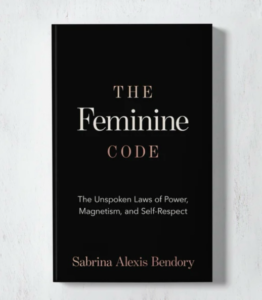 For the woman who will never lose herself again.
You loved hard. You stayed too long. You gave more than you had—and called it devotion.
And when it fell apart, you didn’t just lose him. You lost yourself. Your judgment. Your instincts. Your ability to trust that you even know what love is anymore.
This book is for the woman who is done—but still doesn’t understand why she keeps ending up here.
The Feminine Code exposes the invisible programming that taught you to over-give, over-stay, and shrink yourself in the name of being chosen. It isn’t just about relationships. It’s about every time you’ve walked into a room and made yourself smaller. Every boundary you swallowed. Every time you confused being needed with being loved.
If love has left you questioning your worth, your judgment, or your power—this book will show you exactly what went wrong.
And how to make sure it never happens again.
BUY HERE
Category: On Writing
Subscribe
If you enjoyed this article, subscribe to receive more just like it.