Staying Still By Hannah Adams
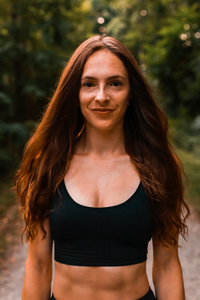 As a yoga teacher, I often say to my students, as they arrive in the fifth or sixth downward-facing dog of the class, that they have never done this downward dog before, and they will never do it again. Their task is to be still with it, to experience themselves within the pose, and to experience it fully before the moment is gone.
This is often the moment in class when students start pedaling their feet, trying to move through the tension in their calves that has accumulated over a lifetime of getting from point A to B.
I tell them, in my warmest of tones, to stop pedaling. That’s how the tension got there to begin with. You need to be still and feel within the stillness what is actually happening. When you sense what is happening more thoroughly, the tension will usually let itself go.
I see my students fighting with their stillness, uncomfortably fidgeting, trying to make the pose something other than what it is. I remind them that the stillness itself feels really good. It is their resistance to the stillness that is uncomfortable.
They pause, take a slower and deeper breath, and their heels start to settle down. They allow themselves to be where they are, without the anxiety of how they want the pose to be, without trying to make it into something it is not. They accept the moment and their downward-facing dog for whatever it is and whatever it isn’t. And by doing so, their calves relax.
As a yoga teacher, I must sell my students on the present moment. I must help them realize that the present is actually this wonderful place that holds all the keys to the things they want to accomplish in the future.
Similarly, as a poet, I package the present moment in a pretty and palatable way. My most recent book, The Mouth of a River, contains many poems that encourage the reader to pause and be with the profundity of simple things.
Stillness 2
When I am still,
I notice the cherries growing on the tree.
I notice all the movements of the bee,
the butterflies with red spots
and the subtle nods of the leaves
acknowledging the wind.
When I am still,
I notice how the light moves on the water,
how the clouds open and close for the sun.
Even the sounds of the birds
are a moving echo through open air.
How dare I move so much so
that I might miss this.
It makes perfect sense
to sense
so perfectly
that I must be still
to be moved
so deeply
by the day.
The experience of practicing yoga, for me, is very similar to the experience of writing a poem. When I slow down and pause in a mundane moment, I see that its very nature is poetic. I don’t make something into a poem as much as I notice that, in some sense, it already is one.
Similarly, without changing the yoga pose itself, I can realize that my experience within the pose can change quite a bit by altering my attention. When I offer the yoga pose my fuller attention, I may feel sensations in my body I hadn’t noticed before. I might experience something profound, or perhaps find meaning simply in being available to something new in the moment as it happens.
Even if I have seen a hundred setting suns, the one slipping out of view in front of me is one I have never seen before and will never see again. When I am still enough to experience the moment in front of me and within me as it happens, the poem appears.
When we cultivate this sense of presence, more poems begin to unveil themselves. In the stillness, we begin to see the artistry of fleeting things and experience how we are not so separate from what surrounds us. Metaphor becomes a way of expressing that relationship—of expressing more clearly what something truly is.
Part of my job as a yoga teacher is to make the present an experience my students find interesting enough to hang out in—to highlight how a single breath is full of so many wonderful properties that it deserves our undivided attention.
My goal is to package the present moment with words that invite you to listen—as a reader or as a yoga student—so that you may arrive where you actually are and not miss what is happening right in front of you, nor within you.
—
THE MOUTH OF A RIVER
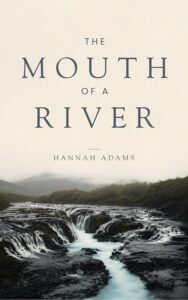 The Mouth of a River is a contemporary free verse poetry collection full of reverence for the little things and acceptance of life’s big unknowns.
With warmth, curiosity, and honesty, Hannah Adams writes about nature, embodiment, joy, grief, relationships, and the beauty of simply being alive. Each section of the collection draws from different aspects of a river’s landscape and movement.
The section “The Mouth” explores language— how words shape our experience, reveal it, and sometimes fail to contain it.
The section “Body of Water” features poems influenced by the author’s work as a yoga teacher and somatic specialist. Readers who practice yoga, meditation, or the Alexander Technique may recognize these themes throughout.
This collection encourages you to pay closer attention—to the natural world, to yourself, and to the words we use to try to capture it all.
Enjoy the dive.
BUY HERE
Hannah Adams is a poet and yoga teacher originally from Boston, Massachusetts. She spent many years living in India and across Latin America—Brazil, Guatemala, Peru, Argentina, and Mexico—experiences that deeply inform her work. Her previous collection, One Carry-On Item, pays tribute to those years abroad.
Rooted in spoken-word poetry, she has represented Boston and Philadelphia on numerous slam teams and competed individually as a finalist in the Women of the World Poetry Slam.
Her lifelong study of movement—from dance and boxing to yoga, Pilates, and the Alexander Technique—alongside her studies in philosophy, has shaped her understanding of the body as a source of knowledge, language, and presence.
Her latest collection, The Mouth of a River, is shaped by the philosophy and discipline of her yoga practice, the Alexander Technique, and her connection to nature’s simple and profound beauty. Her work explores the meeting place between body and spirit, movement and stillness, and the inner and outer landscapes we inhabit.
To learn more, visit https://www.HannahAdams.fit
Category: On Writing
Subscribe
If you enjoyed this article, subscribe to receive more just like it.