On Writing ONLY GIRLS BLEED by Elaine Lawless
I took it personally when the Supreme Court eliminated the federal right to abortion in the United States on June 22, 2022. Not because I had ever had or needed an abortion, or thought I might become pregnant again, but because for fifty years, I had, like all women in my country, assumed I was in control of my life and my body in all reproductive matters. Earlier, the Roe v Wade landmark decision of 1973 had insured women’s right to an abortion based on a pregnant person’s “constitutional right to liberty and privacy,” as protected by the Fourteenth Amendment of the Constitution.
I had always enjoyed lawful access to medical birth control dispensed by my doctor, and I knew that should I ever find myself with a problematic or an unwanted pregnancy, safe access to medical care of my choosing would be available to me. And I trusted that organizations like Planned Parenthood, doctors, and hospitals stood ready to assist me with access to the safest procedures available. Certainly, I took this safety for granted, as did every woman in America. It never occurred to us that this right could be taken away by a single vote.
When women’s right to reproductive care in the US was stripped away, none of this was any longer true for my two daughters, my colleagues, my friends, my nieces, or my students. Even before the decision became public on June 22, fear was in the air. We were hearing rumors that the Supreme Court was poised to decide on a case that might erase the right to abortion care in the US. I heard that Planned Parenthood clinics might lose their federal funding and would close their doors, that each individual state would be tasked with making and enforcing their own abortion laws and bans, and that access to safe reproductive care in general could disappear.
Once the Court announced its decision to rescind Roe v Wade, the public response was intense. State legislatures were furiously writing and passing new, conflicting laws about abortion, including total bans and “trigger laws” to prosecute anyone who helped a pregnant person cross state lines for an abortion, to prosecute doctors who continued to offer abortion services, and even laws to prosecute patients who sought an abortion.
Within months, women would have no assurances that they could continue to have reproductive care, birth control, medical assistance for their pregnancies, access to abortion, or help with miscarriages or IVF. Access to abortion care became criminal overnight, and the situation for women in the US before 1973 reverted back to reports of botched abortions, back-alley doctors working without licenses, and long travel times for women seeking help. Funding was withheld, clinics were shuttered, and secret societies of “facilitators” were organized to help support and fund pregnant women and girls across state lines to find the few open clinics who are willing to help with legal abortions.
By 2022, I had already published several scholarly, nonfiction books on American women’s lives and their stories, particularly women who live precariously in crisis situations, who face discrimination every single day, who live in safe shelters hiding from abusive husbands, and some who will spend the rest of their lives in prison for retaliating against the violence of a husband, a father, or a brother.
But the stories I was hearing from the lips of women about the loss of pregnancy care were especially alarming. Today it is just as common to hear stories about women jailed for experiencing miscarriages, for freezing their eggs with the intention of seeking IVF, for ordering medical abortion pills online, and even those who choose to use birth control.
When the rumors became reality, I knew I wanted to write a book about what was happening to women’s rights in the U.S., but I also knew I would not write another scholarly book about women’s experiences. I felt it would be more powerful and important to write a fictionalized story about ordinary women and girls facing the new laws and restrictions, one that was gripping and powerful, that would grab readers and make them care. I needed to write a novel.
ONLY GIRLS BLEED is that novel. I was inspired by the stories I began to hear from women who lived in different parts of Missouri, many from areas with few resources for their medical, financial, and emotional needs. I heard stories about pregnant women who could not find open clinics but had no money to travel elsewhere for care and didn’t know where to go. I heard about young girls impregnated by men via rape or incest, who were too small and young to carry, much less birth, a child.
I heard a judge talk about a case that was particularly stressing to her, as she felt there was nothing she could do to help a young woman with her ectopic pregnancy in the face of doctors and hospitals who refused to do a procedure that would terminate her pregnancy and save her life. I read about a female abortion care doctor, who chose to offer a termination procedure to a woman in Oklahoma and was jailed for it. I read a story online about an Ohio mother who had left home and was crossing state lines seeking abortion care for her ten-year-old pregnant daughter. This story stayed with me the longest.
When I sat down to begin writing my novel, ONLY GIRLS BLEED, the story of Alice and Molly came to me right away.
Alice could have been me, many years ago as a young mother living in a depressed, isolated place carved out of sand alongside the Mississippi River. She lives with her young daughter, far from any urban areas and has few resources for a young wife who has become a single mother through no fault of her own. I knew all the roads and highways Alice would have to drive to leave southern Missouri and drive toward St. Louis.
I knew the motels where she’d have to stay. I could imagine her meeting friendly women, who could help her cross state lines into Kansas, and the attitudes she would face from people in her state, including the police. I knew the risks she was taking, and I knew the possibility that she could go to prison. I also knew that as Molly’s mother, Alice would brave whatever faced the two of them, and she would protect her daughter against all odds and find a way to find help for her, no matter what.
ONLY GIRLS BLEED is not an actual story of a mother and daughter, but it very well could be. All over America, women and girls are facing hardships they’ve never faced before, with no recourse in the law to protect them or save them from harm. Margaret Atwood has warned us that we must never assume this cannot happen anywhere, at any time, for it already has and probably will, again, and again.
—
ONLY GIRLS BLEED
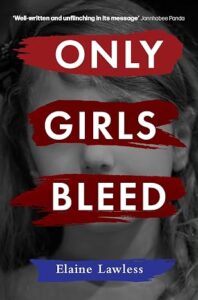 An emotional debut novel exploring the devastating human consequences of the overturning of Roe v. Wade in America.
In the isolated Missouri Bootheel, Alice Campbell is barely holding her life together. Her husband has vanished without explanation. Her young daughter, Molly, has suddenly lost the ability to walk and is tormented by night terrors no doctor can explain. Then Alice uncovers the unthinkable truth behind her daughter’s suffering.
In a moment of confrontation and chaos, Alice flees with Molly, unsure whether the man responsible is dead or alive. Now on the run, mother and daughter drift between cheap motels along Interstate 55, pursued by the past, by the police, and by a future neither is prepared to face.
Taut, urgent, and deeply compassionate, this novel is a haunting portrait of maternal love, survival, and moral reckoning in a fractured America.
BUY HERE
—
Elaine is an academic specialising in folklore, religion, women’s studies, and gender studies and Only Girls Bleed is her first fiction novel. It was inspired and informed by Elaine’s many years of ethnographic research on the lives and stories of women facing crisis and discrimination. She has spent decades conducting fieldwork in rural Missouri, interviewing women living in poverty, volunteering in domestic violence shelters, and documenting the compounding crises faced by women with the least access to healthcare.
Find out more about Elaine on her website https://elainelawless.com/
Category: On Writing
Subscribe
If you enjoyed this article, subscribe to receive more just like it.