Traditional versus Indie Publishing: What’s the score? by Laura Wilkinson
A view from a traditionally published author who has recently self-published a novel.
First off, despite the title, I don’t see it as competition.
Increasing numbers of authors are hybrid – putting out books from both sides of the publishing fence. The reasons for this are myriad, but aside from a small percentage of authors who regularly hit the bestsellers lists, finding multiple income streams has always been vital for writers. I am an author, tutor, editor and book coach/mentor. Self-publishing will become, I hope, another income stream and a way to continue writing stories I believe in, regardless of whether sales and marketing departments of traditional publishers think readers want it.
If that sounds bitter, I don’t mean it to. While none of my seven traditionally published novels have set the world alight, traditional publishing has been pretty good to me. I’ve had editors whose input made the book stronger, publicity peeps who worked hard to promote my work, and I’ve met some of the nicest people on the planet.
So why self-publish What The Ocean Keeps? When we went on submission the feedback my agent received was, mostly, in the vein of ‘editors love it, but sales and marketing don’t think readers want WW1 fiction.’ After a few near-misses and acquisitions meetings, I put it in a virtual drawer. But three years later, I still hadn’t let go and then In Memoriam was released… I decided I would try to find out for myself if readers are interested or not.
When I started out, traditional was the only way for me. I simply didn’t have the confidence or self-belief to put work out independently. I needed reassurance my work was good enough and I dreamed of seeing my novels in stores (this also fed my ego – don’t judge me). If this is you too, traditional is your path. The same is true of appearances at literary festivals – they are generally the preserve of the traditionally published.
Because most self-publishers use print-on-demand technology for physical books, you won’t see your book in Waterstones or Barnes & Noble. To print the quantities needed to offer the discounts retailers require means high upfront costs as well as hefty ongoing storage fees. Also, retailers demand sale or return which can be ruinous. You can select destroy instead of return but that feels criminal. It’s worth saying that POD quality is extremely high – most readers cannot tell the difference, and I’m pleased as punch with mine.
I was stony broke when I wrote my first book and with traditional publishing, you don’t have any upfront costs. You should get an advance. To self-publish professionally you will need to invest your own cash though there are ways to budget if you have the time, inclination or skillset. I typeset What the Ocean Keeps myself. I have an author friend who is also an editor and my agent, who comes from an editorial background, did sterling work on the book too. But there’s copy editing, proofing, cover design and that’s after you’ve bought how-to books, courses and ISBNs. Then there’s advertising…
Of course, one of the challenges of selling fiction is discoverability and I’ve found this is the greatest challenge for *every* publisher, unless the marketing budget is HUGE or you’re already a household name.
While this possibly reads like a thumbs up for traditional, it’s not as simple as it might first appear. In a traditional house most books will have the attention of a publicist for a few months prior to and a couple of weeks post publication and they will be juggling promotion of several books, not just yours. After this, it’s sink or swim for your book baby.
Not so as a self-publisher. You can promote your book for as long as you wish – or your bank balance allows. And if you get it right, your incoming royalties will cover further costs plus some. It’s too early for me to say if my strategies (mostly focused on Facebook ads) will pay off, but if the early ads don’t work, I can redesign, rewrite and try again. My traditional publishers ran publicity boosts in the form of countdown deals and 99p eBook offers but these all happened in the early months after publication and I had no say whatsoever in whether they ran ads at all.
If you go the traditional route, you will have very little control. Over your cover, your title, how your book is described and marketed. I have had covers I loathed, and there’s one that is such a misrepresentation of the novel I no longer mention it to anyone.
It’s been a pleasure choosing and working with my cover designer (who is brilliant). I spent ages choosing my title – from a ‘short’ list of dozens. I canvassed opinion on the title and did the same with the visuals and copy for the ads and social media posts.
My learning curve is steep. Do I have a preference? I *love* the control of independent publishing and the sense my novel’s destiny is in my hands. After all, no one is going to back my book with the same passion as me.
I don’t love the extra admin. For What The Ocean Keeps to succeed, I’ll still need a hefty dose of luck – but that’s no different to traditional publishing – and I have a fabulous group of cheerleaders. Book people, whether trad, indie or hybrid are almost universally supportive, generous and smart.
—
Laura Wilkinson is a novelist, creative writing tutor, and structural editor with a career spanning fifteen years. She is the author of seven contemporary novels for adults (two published under a pseudonym) including That Night in New York, Crossing the Line, The Family Line, Redemption Song, and Skin Deep, published by Headline Accent and Legend Times. Her short fiction has appeared in magazines and anthologies.
—
What The Ocean Keeps: A compelling World War I love story inspired by true events
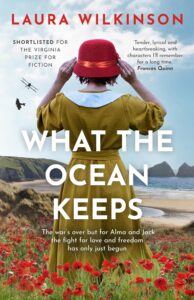 ‘A compelling, beautifully written and almost unbearably poignant love story that shines a light on the forgotten aftermath of war.’ Frances Quinn, best-selling author of The Lost Passenger
Shortlisted for the Virginia Prize for Fiction
The war’s over but for Alma and Jack the fight for love and freedom has only just begun
North Wales, 1918
The guns in Europe have fallen silent but for Alma peace brings only hardship in the Welsh seaside town she calls home. After welcome independence as a munitions’ worker, she is trapped by a painful arrangement with Bron, the man who saved her family from destitution. And for Jack, a Canadian soldier who fought for Britain, it means degradation in the overcrowded, feverish repatriation camp where thousands wait for the chance to sail home.
When Alma and Jack meet in the shanty town which serves the camp, they fall passionately in love – and their romance becomes the one chance of escape. But dreams are fragile. Bron wants Alma for himself. Ships across the Atlantic are delayed time and again, Spanish ‘flu spreads and the men – their sacrifice and bravery in the trenches ignored – are rebellious.
Inspired by the true events of the Kinmel Park mutiny, What The Ocean Keeps is a heart wrenching, unforgettable love story that weaves a woman’s search for freedom with a soldier’s struggle to return home as the world reels in the aftermath of World War 1 and pandemic.
BUY HERE
Category: How To and Tips
Subscribe
If you enjoyed this article, subscribe to receive more just like it.