Election Antics & Historical Fiction by Maureen Brady
When researching my historical novel, Tessa’s Landing, I came across a piece about a New York City election that happened when my protagonist, sixteen-year-old Tessa, was still a greenhorn. She arrived in America toward the end of 1846, at the height of the potato famine.
I was surprised to learn that election day then was a day you might want to lock your doors and stay home, as there were gangs like the Bowery Boys out on the streets intimidating voters with more than words, using violent instruments like bats and knives. The Irish were among them, hired by Tammany Hall.
Tammany was founded in 1789 as a craftsmen’s society, its name derived from Tamanend, the legendary chief of the Delaware Indians, known for his wisdom and love of liberty. Founded as a fraternal order with democratic principles, its governing members were called the native term “sachems.”
Not until 1834 did New York State amend its constitution to allow the New York City mayor to be elected instead of appointed by state government. Tammany then evolved further as a political organization.
By 1855, thirty-four percent of voters in New York City were Irish immigrants, and Tammany Hall gained its power by offering support to the immigrant population flooding into Manhattan because of the famine in Ireland. The Tammany bosses provided help with legal assistance, food, jobs, and also helped with citizenship and naturalization services at a time when virtually no government support existed.
Tammany represented benevolence at the same time corruption grew wildly within the organization—threats to fair elections one facet of it. Tammany Hall became known as a thoroughly corrupt organization, giving favors and taking bribes.
Somehow, our democracy survived this volatile period. Tammany Hall lost its power when journalists exposed its corrupt acts and people demanded political reforms and greater accountability. And our voters were able to go out on the streets on voting day less likely to be intimidated.
As a child, I recall vacations in a small town in the Poconos where my father grew up. His older brother, Uncle Dan, owned the local bar, that was very much fashioned after an Irish pub. It was the center of local gossip, with a dance floor in the adjacent room for Saturday night entertainment. This was in the 1950s, a century after that explosion of Irish immigrants nurtured by Tammany Hall. But Uncle Dan was always talking up the next election and would eagerly share the news with my dad of how he either gained or lost a patronage job after the election, depending upon a win or loss by the Democrats.
I can still recall my puzzlement because, clearly, he did not go to work when granted a patronage job. He just went on tending the bar and endlessly gossiping with the locals. When I asked questions about this, no one seemed able or willing to answer.
My first time working on a political campaign was for Bella Abzug’s first run for office in 1970. The campaign was idealistic and straight-forward, lots of envelope stuffing, phone-calling, knocking on doors and having real conversations with people who opened their doors. We showed up during rush hour at subway stops and herded together a crowd for Bella to wow with her wide hat and loud voice, amplified by the megaphone.
When it came time for the election, we were required to attend a session to prepare us for poll watching. Young and naïve, I was aghast at the number and ways to cheat we were instructed to watch for. A blind person being helped to vote by an unreliable helper who might draw the wrong lever was one that struck me as appalling. Voter’s addresses being challenged, though there was no legal requirement for ID, the slowing down of voting queues to discourage turn out, the use of excessive police presence, intentional misdirection of elderly people to the wrong voting machine were some of the most egregious methods.
I was assigned as a poll watcher at a district on the Lower East Side and fortunately, did not encounter anything overt enough to require me to confront a cheater, though I was shaking in my boots, worried that would happen. I went away from that experience happy to be part of Bella’s victory, making her a Representative to the US House for the 19th District. But I was also left with a bit of cynicism about our own electoral process; cynicism which would grow in the years to come.
Now, having advanced in years to this age of overt corruption in politics, it becomes more difficult to hold out hope for a fairer and more regulated process in this country. The history of our past elections does encourage me, a little. Somehow, we survived those mid-nineteenth century times of street gangs with names like Plug Uglies, Dead Rabbits, Bowery Boys, and Bloodtubs, who performed stunts like kidnapping and confinement (holding someone till the polls closed), forced intoxication, and disguises for repeat voting.
Is it possible for the shenanigans of today to lead to more legal regulation to keep us safer from corruption? Will the younger, jaded population emerge with a desire and the energy for cleaning up the present mess? One can only hope.
—
Maureen Brady is the author of the novels Getaway; Ginger’s Fire; Folly; and Give Me Your Good Ear; a collection of short stories, The Question She Put to Herself; and the nonfiction books Daybreak: Meditations for Women Survivors of Childhood Sexual Abuse; Midlife: Meditations for Women; and Beyond Survival. She lives between Woodstock, New York, and New York City. Her newest novel, Tessa’s Landing (Rootstock Publishing), releases August 25, 2026.
Tessa’s Landing
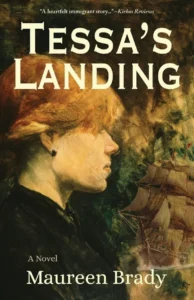 In 1847, Tessa O’Melia, sixteen years old and the eldest of six children, lives off the West Coast of Ireland. Her mother’s soup is little more than water and her childhood friend has died from the potato famine plaguing the region. Tessa vowed to never leave her home and family, but when her father is jailed, leaving the family even more penniless, Tessa is sent to America for a marriage of convenience, with hope to send money back to her family. While her journey on the famine ship is isolating and tumultuous, her red-headed temper and youthful curiosity carry her through.
In Tessa’s Landing we see the sorrow and triumph of the Irish immigrant experience, and how one girl’s self-determination leads to survival in a new world.
BUY HERE
Category: On Writing
Subscribe
If you enjoyed this article, subscribe to receive more just like it.