Because I Have Lived It by Joanne E. Betzler
Joanne E. Betzler – author of Nothing to Discuss – Breaking From 20 Years of Intimate Partner Violence
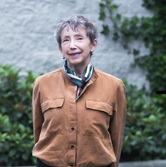 I grew up believing that abuse means visible scars and bruises. Broken bones. There was zero physical evidence that my 20-year marriage had swallowed me whole and erased my identity. From my insider perspective, the union was simply a bad one. Why would I reveal the challenges I’d taken such pains to conceal? Who would believe me?
Just shy of my 39th birthday, my sister’s death inspired a life-altering epiphany of my truth and empowered me to leave my encapsulated life of career-control, activity-accountability, social isolation, and the salacious and alcoholic aggressions that had slowly eroded my confidence and sense of self.
But it still took over 25 years for me to shed my cloak of shame and find the courage to share my story.
As I cobbled together my narrative, occasional newspaper articles stunned me by describing abusive scenarios oddly similar to mine and gave my experiences names: Coercive Control (CC) and Intimate Partner Violence (IPV).
I felt validated. No longer alone.
The concept of a world filled with voiceless women/people with untold stories (many of theirs, life-threatening) sent me on a quest to understand more.
As I wrote, I asked:
How does a person find themselves in such a relationship? Is their abuse, like mine, their normal? Why is it so difficult to step away? Are there strict cultural, religious, or financial barriers destroying their confidence? Do they fear for their lives? Are they, like me, shamed by their truth and their own weakness?
Both personal memoirs and professional publications on domestic violence now crowd my bookshelf and my Kindle. All have one common denominator: SILENCE.
As I wrote, I learned:
The effects of domestic violence are mostly hidden, deeply embedded for so long that they become a way of life for the victim. It’s their familiar. The very names CC and IPV imply shame, fear, and secrecy. They steal the victim’s voice, their agency, and often blind them to their own truth, leaving them incapable of speaking.
Survivor silence only shields perpetrators, and naming the abuse is crucial for victim empowerment and universal understanding.
There’s no way of knowing how many cases go unreported. Anecdotal information collected by various advocates shows that the number of victims is much higher than statistics indicate. Numerous marginalized people feel intimidated by and/or mistrust authorities, so they fear reporting their abuse. Potential recourse, both physical and psychological, from an abuser is another barrier. As is ignorance.
Now, as my manuscript makes its way into the world, I ask:
How do we eradicate those barriers and break that silence? How can we let survivors feel safe in speaking out so that society, as a whole, learns to recognise the complex challenges they face?
When my editor asked me the ‘Why’ of my manuscript, I pictured a sea of people, all genders, all walks of life, all races, and sizes, standing arm-in-arm, shoulder-to-shoulder in solidarity and peaceful resistance, as they chant the words of Twisted Sister’s ‘We’re Not Gonna Take It’ (1999).
My answer was simple: “I want to start a revolution of women/people who have had their voices stolen by CC and IPV.”
But was my voice loud enough?
Obviously, a single voice is not loud enough but imagine the sound of thousands.
I now recognise that I’ve joined a revolution-in-progress. A handful of courageous survivors have begun the daunting process of sharing. Lots of good work is being done behind the scenes by victim-advocates promoting reliable support for non-profit groups that offer aid and urge governments to move quickly to declare CC and IPV an epidemic and an indictable offence.
I want to see the revolution become a tsunami of voices, growing higher, stronger, and solidifying until no person can escape the truth. The more people speak out, one by one, the cause for change can grow into a fortified community of understanding and support.
It may have taken me more than a quarter-century to find the courage to speak my truth, but my hope is to inspire other controlled and abused women/people to take back their stolen voices the way sharing my story has allowed me to reclaim my own.
It’s time to make some noise!
—
NOTHING TO DISCUSS
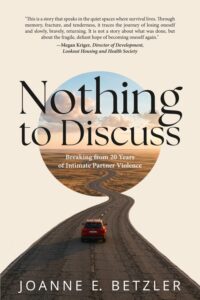 For almost twenty years, Joanne’s husband dragged their family city to city in search of the perfect job, the perfect lifestyle. His imposed prurient and alcoholic tendencies slowly eroded her confidence, her sense of self, and thwarted her every quest for a career. As her sister’s funeral winds down, a simple phone call offering her temporary employment cracks open a window of friendship, discovery, and growth.
Nothing to Discuss reads like a novel and weaves three distinct threads as the author navigates her grief while reconciling past challenges with her enlightened new world. Friendship and trust develop at work. Confiding in her boss helps her gain insight into her controlling, alcohol-riddled marriage. Her emotional growth gives Joanne confidence to claim the agency she seeks.
BUY HERE
The process of writing Nothing to Discuss became Joanne E Betzler’s vehicle to understanding the many complexities of Intimate Partner Violence. Born and raised in Alberta, Canada, Joanne has lived in both Edmonton and Calgary. She now lives in New Westminster, B.C. She earned her Creative Writing Certificate from Simon Fraser University’s famed The Writer’s Studio. Her essays have appeared in The Globe and Mail and Resonance: Essays on the Craft and Life of Writing (Anvil Press) and the New West Writers Anthology. Joanne fuels her writing momentum by connecting with other writers through The Forever Writers Apothecary, Royal City Literary Arts Society (RCLAS), and offering writing consults through Simon Fraser University’s The Writer’s Studio public library program and Word Vancouver.
https://www.facebook.com/joanne.betzler/
https://www.instagram.com/joannebetzlerwrites/
https://bsky.app/profile/jo-betzler.bsky.socia
https://substack.com/@joanneebetzler1
Category: Contemporary Women Writers, On Writing
Subscribe
If you enjoyed this article, subscribe to receive more just like it.