Restoration Not Theft: Writing Other People’s Stories By Denise Derya Brandt
 My Turkish mother once ran away from an arranged marriage. I shared this information about her often, proud of her courage at such a young age. Her father wanted her to marry a relative who was like an older brother to her. She didn’t want to, so she ran away to Istanbul, where she met my father, an American airman stationed in Turkey. They fell in love and had a civil wedding in Istanbul, with no family present, because her father had disowned her. Six years later, she reconciled with her father, and eventually her entire family fell in love with my father too.
That story wasn’t true; at least it wasn’t the whole truth. The truth was my mother went through with the arranged marriage. I only found this out by accident, after her death, during a trip to Istanbul, when my aunt tried to hide a photograph of my mother in a wedding dress, her brows furrowed, and standing next to a man who was not my father.
During my journey back home, I kept thinking about that photograph and wondering why my mother had hidden the truth, especially when what she had told me was so close to it. She had spent decades insisting she had escaped before the arranged marriage. Factually, that was false. As a portrait of who she was and what she wanted, though, maybe it was true.
When I got home, I opened a new notebook and wrote my mother’s Turkish name, Ayten, at the top of the page. I made a list of knowns and unknowns; the unknowns list was much longer, and I realized it was too late to uncover her real story. My mother was gone. My aunts didn’t fully know the story, and the men who might have known it were gone, too.
I was angry and sad on my mother’s behalf about what she had been forced to endure. And I was disappointed she hadn’t confided in me. I wanted to understand why. So, as a way to process, I decided to write a novel, a work of fiction primarily about my mother, inspired by my parents. I would write to explore and understand my mother’s truth, and my imagination would fill in the gaps. But almost as soon as I made the decision, worries emerged. Did I have the right to write my mother’s story, especially one she’d hidden from me? If she were alive, would she view it as a betrayal of her privacy? Grappling with these questions and writing Istanbul Dreaming taught me three things.
- Writing this story wasn’t a betrayal. For anyone writing inherited stories, the real obstacle usually is not legal or even ethical. It’s often fear of getting it wrong, of upsetting the people still living, of insisting that a story someone worked hard to bury deserves to exist in daylight. A story like my mother’s could have remained hidden, and I grappled with using it and her as inspiration. But ultimately, I decided that when a woman has been silenced by shame or family loyalty, and she’s no longer here to correct the record herself, telling her story can be a brave form of restoration.
- Follow the want, not the record. I would never know everything my mother lived through, but I knew what she had wanted, feared, and buried. And that was enough to start with, enough to explore and invent character Ayten’s motivations and desires. And staying loyal to that, rather than to the facts I did or did not have, kept the book honest instead of speculative.
- Fiction offers freedom. In early drafts of Istanbul Dreaming, I tried to adhere to the facts and timeline I knew to be true, but this wasn’t working for the story. The stakes were not high enough. Then a friend reminded me I was writing fiction. My protagonist Ayten is not my mother, though they share a first name; she’s a character I could move through the story freely, make choices for, put in rooms I never witnessed. Fiction provides cover. Fiction lets you tell the true thing without pretending to know exactly how it all happened.
I’m glad I wrote a book inspired by my mother’s story. I think, now, that she rewrote her own narrative, telling me the version of the story she wished had been true, the one where she had been courageous enough to escape before anyone could force her hand. And that’s okay. Writing to try to understand and fill in the gaps provided me with the opportunity to imagine, not the woman who kept secrets, but the young woman in the photograph with the furrowed brows, who wanted something different from the life arranged for her. Istanbul Dreaming is how I honor her.
—
Denise Derya Brandt worked in international development for twenty-plus years and led women’s health projects in Afghanistan, Liberia, and Myanmar before becoming a published author. A Book Incubator graduate, 2024 Women’s Fiction Writers Association Rising Star Award finalist, and 2025 Poets & Writers Publicity Incubator Fellow, Denise has degrees from Arizona State and London School of Economics. As a Turkish American, she claims she can fool tourists but not taxi drivers! Raised in Arizona, Denise now lives in Northern Kentucky with her husband.
Find out more about Denise on her website https://www.denisederyabrandt.com/
Follow her on Facebook
ISTANBUL DREAMING
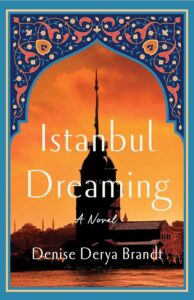 For fans of Alka Joshi and Marjan Kamali, a gripping historical novel set in 1950s Turkey about a young woman who flees an arranged marriage to pursue independence in Istanbul, where she finds forbidden love with an American airman.
In 1950s Turkey, against the backdrop of the social and political unrest that will culminate in Turkey’s 1960 military coup d’état, a dutiful daughter is torn between family expectations and her dream of becoming a modern Turkish woman.
One night, seventeen-year-old Ayten sneaks away to Istanbul for a night of dancing with her best friend. When her father discovers her rebellion, he forces her into an arranged religious marriage to a distant relative who bullied her as a child. Initially, Ayten resigns herself to her fate—but after her husband sexually assaults her on their wedding night, she flees him and her family for haven in Istanbul.
Living with friends and working as a seamstress at her friend’s boutique, Ayten tries to rebuild her life. Then she meets Earl, an American airman, and they begin to fall in love—but as their connection deepens, secrets and her past threaten to upend all she’s built. Torn between her family and a future with Earl, Ayten must decide what she’s willing to sacrifice for freedom and forbidden love.
BUY HERE
Category: On Writing
Subscribe
If you enjoyed this article, subscribe to receive more just like it.