Because My Fingers Tingle
by Grace Sammon
 A few weeks ago, I read an essay by a successful novelist who announced she was stepping away from writing. Not pausing. Not regrouping. Stepping away.
Her reasoning was thoughtful and honest. She wrote eloquently, as novelists do, about the work of writing a novel, followed by the equally exhausting labor of getting that book into the world. The endless additional skill sets — marketing, platform-building, branding, pitching, networking. The time. The money. The emotional stamina. And the quiet, crushing recognition that even with talent, discipline, and multiple published books, she would likely never “break through” to the level of success where she was a bestseller or had movie rights purchased.
I closed the essay and sat very still. Her musings were painfully familiar. I resonated with every word.
Writers rarely elaborate on this part of the journey. We talk about craft, inspiration, process, and the supportive community of readers and writers. We speak less often about the attrition: the number of gifted writers who slowly disappear because the economics, the timelines, and the emotional toll become unsustainable.
Even in the best-case scenario — a beautifully written, agented manuscript — the time between typing “The End” and a book in a reader’s hands is often two years or more. Publishing moves slowly. Life does not.
Time becomes a factor. Not just calendar time, but life-time. How many books do we realistically have in us? How many years can we keep pouring our best attention into work that may or may not find its audience? And, for many authors, will we even recoup our hard-invested dollars?
These are not cynical questions. They are honest ones. I’ve asked them myself.
And yet. I am still here. Still writing, revising, earning royalties, and still believing, stubbornly, in the work.
Not because I believe I will win a Pulitzer, or that I expect my novels to become cultural phenomena. While I can hope for those things, and I do, something deeper than ambition keeps pulling me back to the page, fingers on the keyboard, rearranging letters into words, words into what I hope is lyrical prose.
There is a particular kind of magic when a sentence finally lands — when a character surprises me, when an emotional truth emerges that I didn’t know I was carrying. Writing, at its best, is not manufacturing; it is discovery.
What continues to astonish me, after eight books, numerous articles, and multiple awards, is how deeply readers engage with a story when the author gets it right. A thoughtful book club discussion — whether in a living room or on Zoom is pure happiness for an author. A podcast conversation can feel like two strangers recognizing something essential in one another. A reader’s email that says, “This helped me name something I’ve never been able to articulate,” can sustain me for months.
These are not definable metrics. They will never trend. But they matter.
I sometimes think of myself as a kind of literary “cub reporter.” Not the big-name network reporter covering wars or disasters, but the local newscaster uncovering intimate stories filled with interiority, a rich sense of place, complicated families, female friendships, and flawed but resilient characters seeking to leave their mark on the world. My novels — The Eves and my upcoming The Reliable Narrator — circle these questions again and again: How do we heal hurt? What happens when we stay silent too long? What does it cost to become invisible? What does it take to speak anyway? What does it mean to leave a legacy?
These are not market-friendly questions. They are human ones.
Which brings us, inevitably, to AI.
Like many writers, I’ve experimented with its ability to draft, summarize, and mimic. Used thoughtfully, it becomes part of a writer’s toolbox, much like its AI cousins, spellcheck, Grammarly, or search engines.
But after spending time with it, I’ve become increasingly convinced of this distinction: AI can sometimes produce beautiful language. It cannot produce meaning. It cannot say the words that erupt in my head and splash onto my desktop screen.
AI does not know what it feels like to be a child who learned early how to disappear. It does not know the ache of watching friendships erode. It does not know the private negotiations women make with their own visibility, aging, and worth. It does not know regret. Or love. Or the strange way memory reshapes itself over time.
It can assemble sentences about these things. But it cannot inhabit them.
What I believe readers are seeking is not polished output but a connection to the feeling that another human being has articulated something they have only dreamed about saying or doing.
That is not a technological function. It is a human one.
The essay that unsettled me so deeply was not wrong. The economics are harsh. The timelines are long. The odds for limited “success” are real. No amount of passion alters those facts.
For me, the mistake is in believing that “breaking through” is the only meaningful outcome.
What if success is not bestseller lists, but resonance?
What if it is not mass reach, but precise connection?
What if the sheer joy of what my tingling fingers hovering above the keyboard create is enough?
As I finish the last draft of this article, I sit very still.
There’s a book to market, another story brewing, and a reader awaits.
—
Grace Sammon is an award-winning author and radio host. She is the recipient of the 2025 Indies United Publishing House Award for Inspirational Woman in Literature, Media, and Journalism. Learn more about Grace at www.gracesammon.net
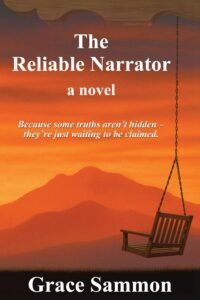 Darby Small has made invisibility an art. As one of New York’s most sought-after ghostwriters, she tells other people’s stories so seamlessly they forget she was ever there. In an age of AI-generated prose, she is prized for what machines cannot do: capture a voice so authentic it feels lived-in. For Darby, disappearing into other lives is both her superpower and her refuge.
Then comes a late-night message from Phoebe Zaslove, Darby’s truest friend—fearless, magnetic, and now terminally ill. For reasons Darby cannot name, the women have not spoken in a year. But Phoebe is running out of time and makes one final request: Write my story.
Set between the wooded banks of New York’s Hudson River and Albuquerque’s lush North Valley, The Reliable Narrator is a layered, emotionally charged novel about the unbreakable bond between friends, the legacies carried from mothers to daughters, and the truths we bury to survive. As Darby walks Phoebe into the last chapter of her life, she is forced to confront her own traumas, her family’s silences, and the realization that fragments of her truth have been hiding in plain sight in every book she has ever ghostwritten.
With piercing insight and lyrical prose, The Reliable Narrator asks:
What stories do we inherit? Which do we dare to tell? What is the price of silence?
Because some truths aren’t hidden, they are simply waiting to be claimed.
BUY HERE
Category: On Writing
Subscribe
If you enjoyed this article, subscribe to receive more just like it.