Bianca’s Cure, Gigi Berardi
In Bianca’s Cure by Gigi Berardi (She Writes Press, February 10, 2026), Berardi brings her own training and expertise, first as a biologist at University of California San Diego and then as a social scientist at Cornell, in tackling provocative subjects to uncover the who and why of science, as much as the what and how. The third of three books on the topic of science Berardi has written while at Western Washington University (including Finding Balance in 2005 and FoodWISE in 2020, which garnered 12 writing awards), Bianca’s Cure is yet another call to action—championing observation, systematic thought, and critical science as ways in which to view and interpret the world. “Science is under attack now more than ever,” says Berardi. “My book is an anthem to critical science, by women—a renaissance version of Lessons in Chemistry, with secrets and strategies of women breaking through science hierarchies even at that time.” In Bianca’s Cure, the secret is the herb, artemisia, and the medical mystery, malaria—its very name an Italian word suggesting the most commonly held belief at the time of the disease’s cause, “bad air.” Malaria still exists today as one of the world’s deadliest diseases.
In fact, the Nobel Prize in Physiology or Medicine was awarded in 2015 to the Chinese woman scientist Tu Youyou, who, without a doctorate or medical degree, with her team discovered the anti-malaria drug artemisinin, derived from artemisia—what she called in the title to her Nobel Lecture “A gift from traditional Chinese medicine to the world.”
The impassioned bond between Francesco de Medici and Bianca Capello is at the core of Berardi’s history-driven dive into medicine, politics, love, and ultimately death in Renaissance Florence. Malaria killed many of the Medicis, but traces of the poison arsenic were recently found in Francesco’s remains. Even more sinister: Bianca’s remains have never been found. To this day, what happened to Bianca and Francesco remains one of the greatest mysteries surrounding Renaissance Italy’s legendary Medicis.
Early reviews call Berardi’s story “imaginative and persuasive,” highlighting Bianca’s intelligence and the Florentine setting, where “innovation and suspicion co-existed, especially for non-conforming women like Bianca.” As the plot unfolds, readers see that in the same rooms “bright with fresco dust and furnace light, medicine and poison look dangerously alike.”
Early Praise for Bianca’s Cure
“In the tradition of the best historical fiction, Gigi Berardi takes a little-known woman with a life shrouded in mystery and imagines the emotional glue for a riveting story. As the alchemy of Berardi’s writing breathes life into the alchemy of Bianca’s cure, you will be held under her spell.”— Jude Berman, author of The Vow, a 2024 Kirkus Best Indie Book
“Gigi Berardi’s stirring account of Bianca Capello’s relentless pursuit of a cure for the heat disease is fiction at its best. Her voice-driven narrative skillfully describes the tortuous path a woman scientist takes to do her work and at the same time manage children, household, and realm. Readers of historical fiction and science both will enjoy the gripping tale.”—Ruth Sofield, Ph.D., Professor of Environmental Toxicology and Chemistry, College of the Environment, Western Washington University
“Berardi writes with heart and quiet ferocity.” — Goodreads Reviewer
“… a rich and immersive piece of historical fiction.” —Netgalley Reviewer
“Berardi’s writing captures the vividness of the Florentine court, the tension between alchemy and early medicine, and the complexities of ambition, desire, and survival.” —Netgalley Reviewer
“What stands out is how the novel blends factual mystery with imaginative storytelling.” —Netgalley Reviewer
“Bianca’s Cure is an elegant, compelling read with both intellectual depth and emotional drive. It will especially appeal to readers who enjoy historical fiction with a strong female protagonist, a scientific edge, and a touch of mystery.”
A tale exploring science and feminism didn’t start out that way. Berardi tossed out the first 100,000 words—all written from the standpoint of Francesco. “That story sounded flat, this version resonates.” —Netgalley Reviewer
The novel depicts a science uniquely imagined and executed by women where they were free to do it—annexes to palaces, orphanages, hospitals, and convents. Scholarly texts like Daughters of Alchemy: Women and Scientific Culture in Early Modern Italy by Meredith K. Ray detail women’s oral and written histories of alchemic sciences; Nuns and Nunneries in Renaissance Florence by Sharon T. Strocchia suggests that as many as one out of eight women in Florence were nuns. Taking care of the sick, commanding resources, positioning themselves to do what they could—all within their highly-structured days of prayer and communal work—still allowed for the practice of both art and science. Much of men’s alchemy at the time paled in comparison to what women were achieving. The time structure in nunneries, but also in palaces, offered unique women’s spaces for imagination and experimentation.
All this is to suggest that Florence is not just a romantic, evocative setting for novelists or travel destination for tourists, but a place, too, of science created, contested, and protected by women. The protagonist in Berardi’s novel experiments with a cure, even in the confinement set by her time, thus epitomizing the journey women have made across centuries and cultures to create useful science. —Netgalley Reviewer
—
GIGI BERARDI teaches food and writing classes at Western Washington University and in Global Learning Programs. A Fulbright scholar, she holds three graduate degrees, but considers herself mostly a professional writer. She has authored over 300 popular articles and reviews for print and broadcast media—much of these on the arts and in reference to her widely-read book, Finding Balance. As one reviewer noted, “Once in a while a book comes along which makes me wish I had written it—such a book is Finding Balance.” Her book, FoodWISE, received a DOZEN WRITING AWARDS AND over 30 endorsements, including from Michael Pollan, “[it’s] full of wisdom” and Forbes, hailing it as one of nineteen noteworthy food books. Her newest work is historical fiction, a chilling retelling of a woman scientist’s search for a malarial cure in Renaissance Florence.
Find more about Gigi on her website https://gigiberardi.com/
—
BIANCA’S CURE
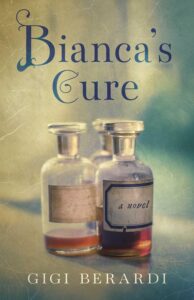 For fans of Lessons in Chemistry, a based-in-fact novel imagining young Renaissance noblewoman Bianca Capello’s experiences as she pursues a cure for malaria in the Medicis’ Florence.
Florence, 1563. Forbidden from practicing her herbal cures in Venice, the young noblewoman Bianca Capello flees to Florence, where the ruling Medici family practices alchemy. There, she wins herself an invitation to their palace, and, as it turns out, a path to the duke regent Francesco’s bed.
The impassioned bond between Francesco de Medici and Bianca is at the core of this fact-driven dive into medicine, politics, love, and ultimately death in Renaissance Florence. Malaria killed many of the Medicis, but traces of the poison arsenic were recently found in Francesco’s remains. Even more sinister: Bianca’s remains have never been found. To this day, what happened to Bianca and Francesco remains one of the greatest mysteries surrounding Renaissance Italy’s legendary Medicis.
Bianca’s Cure probes what might have been as Bianca’s quest for a malaria cure—in palaces, gardens, sick rooms, and whorehouses—collides with Francesco’s intensifying illness. Her main tool is the herb artemisia—medicine still used today. A woman who dared to practice science well ahead of her time, Bianca fights off self-doubt until she believes herself invincible. But is she? When only she stands between Francesco and death, her skill may save him or doom them both.
BUY HERE
Category: On Writing
Subscribe
If you enjoyed this article, subscribe to receive more just like it.