Crow Fans will Tell you these Birds are Characters. This Writer Took that Literally By Pam McGaffin
Like many a modern romance, my love for crows started online.
In 2015, while scrolling Facebook, I saw the story the British Broadcasting Corporation did on Gabi Mann, “The girl who gets gifts from birds.”
Then 8-year-old Gabi shared with the BBC reporter the more than eighty small objects – pieces of glass, buttons, earrings, beads, paperclips, hardware bits, and one pearl-colored heart –she’d received from crows. The story didn’t just charm me. It inspired a book.
Shade of Wings, forthcoming May 26 by She Writes Press, is a speculative novel from the point of view of crows trying to survive a pandemic. Guess what else inspired me? Covid — not to be confused with corvid – had us all homebound. What better excuse to write?
The book became a labor of love that took more than seven years, including the year or two I spent just searching for a plot.
A Romeo and Juliet retelling between a crow and a raven? Yeah, no. A survival story? Now we’re getting somewhere. Animals and survival go hand in glove, particularly when the writer is living through a pandemic.
After many false starts and messy drafts, I finally found my story in a real-life event: the 1999 outbreak of West Nile virus during an unusually hot New York City spring/summer.
Duncan, my moody crow protagonist, must overcome a secret shame to care for his younger siblings after their parents die from a mysterious illness killing the city’s crows.
One of the first signs of West Nile’s arrival in the United States was dead birds. The virus, spread by infected mosquitoes, proved 100 percent fatal to crows. Months after they started dying, doctors saw the first human cases of encephalitis (brain swelling). Seven people died.
My novel has three human characters: a Queens girl and her grandmother who get gifts from the crows they feed; and a Bronx Zoo veterinarian/pathologist based on real-life hero Dr. Tracey McNamara.
After several zoo birds died of encephalitis (and a colleague accidently stuck himself with a contaminated needle), McNamara urged federal health authorities to investigate a possible link between dead birds and sick humans. She suspected the virus was new to the Western Hemisphere. Her hunches, initially rejected, proved correct.
McNamara is now a professor of pathology at Western University of Health Sciences College of Veterinary Medicine in Pomona, California. During an hours-long phone call, she helped me fine-tune the scenes based on her experience.
To research crows, I turned to John M. Marzluff, professor emeritus of wildlife science at the University of Washington. With illustrator Tony Angell, he literally wrote the book(s) on crows: In the Company of Crows and Ravens (Yale University, 2005) and Gifts of the Crow: How Perception, Emotion, and Thought Allow Smart Birds to Behave Like Humans (Atria Paperback, 2012).
The more I learned, the more I came to love and respect these amazing birds. This inevitably led to buying shelled, unsalted peanuts in bulk. Be forewarned. Once you start feeding crows, you’re committed for life.
Now my husband, Mark, and I can’t go a block without “our crows” swooping down to greet us, heads tilted in expectation. One responds with a quick caw-caw as if saying “thank you.”
They not only know us, they know our pit-chow, Mars. A friend walking our dog as a favor said he was “pestered” by crows.
I realize we’re doing this more for our enjoyment than their need. We’re careful not to give them so many peanuts that they become a neighborhood nuisance. My rationale, however selfish, is that I’m feeding the muse.
Crows are amusing. I’ve watched them try to jam one too many peanuts in their beaks only to spill the whole load and have to start over again.
They’re beautiful. One can’t help but admire how their finely patterned feathers shine blue in the sun.
They’re resilient. I worried over a crow with a pronounced limp who nevertheless managed to care for her (assuming sex here) young.
They’re comforting. Watching them go about their business despite all the chaos in our world gives me hope that we, too, will persevere. My mood lifts when I see groups of crows flying east to their evening roost.
I’m not alone in my appreciation. In researching my book, I’ve discovered a vast and enthusiastic fandom. A simple Google search reveals “dozens, if not hundreds” of active social media groups devoted to crows and other corvids. Fans even have their own TikTok called CrowTok.
I’ve joined several groups on Facebook. Crow Lovers (500k members), Crows are Awesome (254K), and The Official Crow, Raven & Other Corvids Fan Page (180K) entertain and enlighten me with photos, videos, close-encounters, information, speculation, and tips on how best to befriend your neighborhood murder.
These people are serious. One man who feeds an “attempted murder” earnestly fretted over what to do about his birds while he was on vacation. “When I get home . . . will my friends return?” He was assured that they would.
Yep, these clever birds have trained us well.
It was only a matter of time before they got their own Day. A group of enthusiasts on a road trip started International Crow and Raven Appreciation Day or ICRAD. On April 27, celebrants are encouraged to wear black to “honor the intelligence, adaptability, and ecological importance of corvids.”
Their popularity isn’t a passing fad. Humans, crows and ravens have been interacting since corvids discovered the bounties of our hunts, crops and battlefields. They show up frequently in our art, culture and literature. Northwest Native myth credits Raven with bringing light to a dark world.
Author and expert Marzluff writes about this “cultural coevolution.” Humans, he says, provide safe living spaces and food for crows in exchange for intellectual, emotional, and aesthetic stimulation.
Crows have influenced human culture more than pigeons, squirrels and other urban wildlife because they’re so similar to us, he notes. We’re both gregarious, family grouped, long-lived, adaptable and intelligent. “To a surprising extent, to know the crow is to know ourselves,” he writes.
I think crows have much to teach us if we stop to pay attention. They’re devoted partners and parents, as anyone who’s been head-checked during the spring breeding season knows. They’re also highly social and learn from each other.
Piss off one crow pair and you’re likely to become persona non grata to their offspring. Likewise, befriending a crow family will probably earn the trust of future generations.
They may even reward you with a gift or two.
—
SHADE OF WINGS
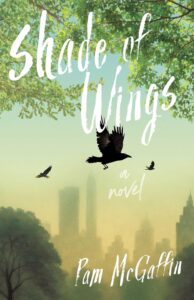 For fans of Laline Paull, a speculative young adult novel about a family of New York City crows struggling to survive the outbreak of West Nile virus during the sizzling summer of 1999.
Four-year-old Duncan needs to hurry up and find a mate—at least, according to his sister, Cloud. But she doesn’t know about the mistake that’s preventing him from leaving their family to start another.
Though he’s the eldest, Duncan doesn’t see himself as a father. Yet that’s what he must become when both his parents die of the mysterious illness that’s killing crows across New York City. He devotes himself to caring for his siblings, including three fledglings—but he soon discovers he can’t protect them from the “blind death.”
Meanwhile, a zoo pathologist’s worst fears are realized. It starts with dead flamingos. Then critically ill New Yorkers start showing up in hospital emergency rooms.
Some blame the crows.
BUY HERE
Category: On Writing
Subscribe
If you enjoyed this article, subscribe to receive more just like it.