The Rewards of Writing a Book, 15 Minutes at a Time by Carolyn McConnell
I didn’t set out to write about witches.
While I was writing my book Motherhood Discounted, I encountered Sylvia Federici’s work on the European witch hunts and became fascinated by her insights about their role in controlling women’s reproductive powers. But I was trying to write a work of sober political analysis, and witches seemed a little out there. So I studied the witch hunts, but didn’t put them in my book, at first.
Because I was writing this book while raising two small children, going to law school, and working fulltime, I wrote in 15-minute chunks—all the time I could grab to myself. So the writing went slowly. As time went on, attacks on women’s reproductive freedoms grew sharper. The previously unthinkable—losing the abortion right that I had taken for granted my whole life—became a likelihood and then a reality. As American politics got crazier, seeing parallels between modern American politics and 17th-century witch hunts stopped seeming crazy.
The claim that Bill and Hilary Clinton were torturing children in the basement of a pizza parlor in Washington DC became a political rallying cry, and the belief that a cabal of cannibalistic Satanic child molesters was in league with the deep state emerged as a powerful movement. I knew exactly what I was looking at. These were witchcraft tales. In 17th-century Europe, in an inversion of women’s association with the birthing and nurturing of children, accusations of witchcraft often centered around women harming children.
Witches were believed to especially target children and drink the blood of babies as part of their satanic rites. Then and now, these crusades used the urgent claim that children needed protection from out-of-control women to justify punishment and control of women.
I began noticing references to witches everywhere: When Pat Robertson was running for president in 1992, he railed against a feminist movement “that encourages women to leave their husbands, kill their children, practice witchcraft, destroy capitalism, and become lesbians.” In 2025, activists pushing for a ban on abortion pills in Texas described their opponents as “pro-abortion witches”—echoes of a 1484 witchhunter’s warning that “destroying the generative force in women” and “procuring abortion” were among the foremost methods of witches.
So I began writing this into my book. I knew it was an important part of the story I was telling about the ongoing effort to control women’s reproductive capacities. But to tell about the witch hunts required covering hundreds of years of history, and it was dizzying. These parts of the book weren’t yet working. The material needed to be grounded in real, individual lives.
It occurred to me that I had family who were early settlers of New England. Had they witnessed any witch hunts? I knew my wonderfully named ancestor Ulalia Burt had come to New England in the mid-17th century, but I didn’t know exactly where she had lived. With a little research I learned that she had arrived in Springfield, Massachusetts, in 1638—just in time for one of the very first witch hunts in America. And she and her family did not just witness the witch hunt; they benefitted from it.
After their neighbors were accused of witchcraft and dispossessed, Ulalia’s son acquired their house and land. This acquisition became the foundation for solid family prosperity, a dark part of my family heritage. This was the last piece in turning a wacky detour into a solid chapter and in turn, a theme running through the book.
I don’t really recommend writing a book in 15-minute increments. But I’m here to reassure all those mothers who desperately want to write that it can be done. And there are some benefits.
—
Carolyn McConnell is a lawyer and activist dedicated to resisting attacks on public services. She has published extensively on reproductive rights, feminism, and women’s history. She holds graduate degrees in philosophy from Johns Hopkins University and nonfiction writing from the University of Iowa. She lives in Seattle.
MOTHERHOOD DISCOUNTED
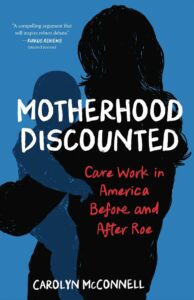 For readers trying to make sense of America’s political turmoil and eroding reproductive rights, an incisive examination, enhanced with personal stories, of how care work has been extracted and compelled throughout American history.
In the wake of Dobbs, and now with the country in the grip of Trump and a resurgent far right, the question everyone seems to be asking is—How could this happen in America? Lawyer Carolyn McConnell has a few ideas.
After becoming a mother, McConnell was forced to face the myth of autonomy that American individualism breeds: the idea that independence is always good and dependence always bad. Why does America have such a problem offering social support for care work, she wondered, when mothering is the essential work of reproducing society?
In Motherhood Discounted, McConnell turns a searching eye on autonomy, asking what it is and what it is for. Tracing this myth’s development through American history, she frames each episode with personal stories and incisive analysis. In doing so, she offers women readers of all ages seeking to understand their own experiences in these disturbing times a potent explanation for how we got here—and sounds a clarion call for political change.
BUY HERE
Category: On Writing
Subscribe
If you enjoyed this article, subscribe to receive more just like it.