Identity Theft, Second Edition: Rediscovering Ourselves After Stroke: Excerpt
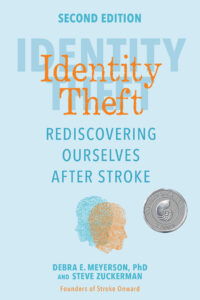 Identity Theft, Second Edition is an award-winning book that follows Stanford professor Debra Meyerson’s journey to recover from a severe stroke that initially left her physically incapacitated and unable to speak. In addition to providing realistic expectations for the hard work needed to regain everyday capabilities, Meyerson and Zuckerman focus on the less frequently documented emotional journey as she and her family rebuild identity in recovery.
Virtually every stroke survivor is haunted by questions like “Who am I now?” and “How do I rebuild a meaningful and rewarding life?” after losing so much of what they had before—capabilities, careers and jobs, relationships, and more. This is a book full of hope for survivors—from stroke or other life-changing injuries or illnesses—as well as their care partners, families, and communities.
The first edition of Identity Theft centers on Debra’s experience: her stroke, her extraordinary efforts to recover, and her journey to redefine herself. But she also draws on her skills as a social scientist, sharing stories from several dozen fellow survivors, family members, friends, colleagues, therapists, and doctors she has met and interviewed. By sharing this diversity of experiences, Debra highlights how every stroke is different and every recovery is different. She provides a valuable look at the broad possibilities for successfully navigating the challenging physical recovery—and the equally difficult and frequently unspoken emotional journey toward rebuilding one’s identity and a rewarding life after a trauma like stroke.
This second edition is written by Debra and her husband, Steve Zuckerman. As they have shared in countless talks, “Just as the original book was headed to the printers, we decided that ‘the finish line had become a new starting line.’” They co-founded the nonprofit Stroke Onward, where they have been working side by side to build an organization that can catalyze change in the healthcare system to better integrate the emotional journey of rebuilding identity into a lifelong recovery process. This edition draws on five more years of experience as a post-stroke couple and what they’ve learned from thousands more survivors, family members, and healthcare professionals. They’ve added new insights about the long-term recovery process and how we can change the stroke system of care to better support all survivors and their families.
EXCERPT
“My name is Debra Meyerson.” In 2009, this was a casual self-introduction at the beginning of a lecture at Stanford University. The tone was strong and authoritative, five words opening the door to thousands more over the course of two hours as I confidently led a class through a presentation and discussion about topics like gender, diversity, social change, and identity.
“My name is Debra Meyerson.” In 2011, this same phrase comes out weak, a faltering melody with an almost nursery-rhyme cadence. The five uneven words are an achievement, the result of a year of speech therapy. A severe stroke in September 2010 robbed me of all speech, and after a year of intensive therapy, my own name still gave me trouble. In times of stress or fatigue, Is till fall back on singing the phrase, using a melody to unlock the words.
“My name is Debra Meyerson.” Who is Debra Meyerson now, in 2018, as I write the first edition of this book? I am alive, and for that I am lucky and grateful. I live with significant disabilities: no functional use of my right hand, a significant limp, and significantly diminished speech. I can say my own name, and much more, but at times I still struggle to find the simplest of words. This brings me to laughter on my good days and tears of frustration on the bad. I cherish the same values, love the same family, work with the same determination. But I can no longer teach, talk as easily with family and friends, or ride a bike on my own.
“My name is Debra Meyerson.” Strokes don’t just create physical and mental disabilities, they can also steal our identities. Much of my pre-stroke life became inaccessible. Understanding and accepting the loss of my old life was one of the hardest parts of my recovery and rebuilding process. Along with the constant rehab and speech therapy aimed at physical recovery, I’ve spent the past eight years working to regain my sense of self, trying to answer the question: who am I now?
***
As a professor at Stanford’s Graduate School of Education and Graduate School of Business for fifteen years, I studied how personal identity shapes people’s experiences in their organizational lives. My first book, Tempered Radicals: How People Use Difference to Inspire Change at Work (since reprinted as Rocking the Boat: How Tempered Radicals Effect Change Without Making Trouble), examined people who maintained multiple identities and worked to align their personal and organizational lives. I had planned to continue this work, building and sharing knowledge about how each of our identities shapes our experiences and our environments. Had I been able to proceed with that work, perhaps I would now be publishing a book exploring how we can use a more complete understanding of our multiple identities to improve the way organizations handle difference and conflict.
Instead, I find myself grappling to understand my own identity. My stroke took away my capacity to work as I did before, many of my abilities, and many of the other pieces of the life I had built over five decades. Although my physical capabilities were erased nearly overnight, there was no analogous “identity switch” that signaled how my sense of self had changed. But over time, this change became clear. Activities I loved were out of reach; colleagues, friends, and strangers treated me differently; family dynamics changed dramatically. I even noticed my own attitude changing in certain ways.
I have gradually regained some of the capabilities I initially lost, and the recovery of my identity has been an equally difficult journey, one that took me about three years to even recognize. Following my stroke, I found numerous resources to help me understand my journey to recover physically, but there was a profound lack of guidance when I faced the emotional challenge of rebuilding my sense of self in this new and maddening circumstance. As I talked with other stroke survivors, I found this to be an extremely common frustration.
For many of us, clarifying essential elements of our selves is critical to regaining capability and confidence, whatever physical challenges remain. As we try to restore parts of the identities we had before the stroke, we are also reinventing new ones — all the while grasping for tools to help us think about how our lives should be evolving. Do we stay determined not to let the stroke win and keep battling for more recovery? Or do we accept that we need to let go of our past selves? Or both?
I was confused and struggling. But I was still thinking like a social scientist. I tried to make sense of the experiences that I and others in my new community of survivors were going through. Was their sense of self shattered like mine? How did it evolve with time? Did they ever lose hope? How did they balance the time and rigor of rehabilitation with an acceptance of their newfound limitations? How did they maximize life within those constraints? Did they, as I did, eventually discover some silver linings—ways in which some things were actually better after stroke, in spite of all the frustrations?
While exploring these questions, I was ushered into a whole community built around poststroke life — a community I never had reason to notice before. I encountered it at therapy centers and speech clinics, through survivor support groups meeting in coffee shops, on Facebook and other communities, as well — colleagues struggling with the loss of a partner, survivors recovering from brain injuries, and even just friends facing the realities of older age. The more I thought and talked about it, the more I realized how many of us are united in this journey to understand and shape our own identities in the face of life changes.
In the stroke community, whenever talk turned to the question of self-image and the psychological impact of stroke, people’s eyes lit up with interest. Yet, I met very few survivors who had received any kind of formal psychological support or counseling; at best, some had benefited from talking with an empathetic speech or physical therapist. This is hardly surprising, given that many survivors receive only the barest of physical and occupational therapy, let alone emotional counseling.
I realized that telling the story of my own journey might assist other survivors, as well as those who love and support them. And, frankly, I knew the process would help me better understand my own experience and allow me to reclaim what I loved most about being a professor: helping to create and share knowledge. I also knew I wanted to share the stories of other stroke survivors. As I talked with them, I discovered many similarities, but I found the equally numerous differences in our experiences even more interesting. Their stories became part of mine, expanding my understanding and shaping this book with a broader perspective that I hope will be more helpful to the survivor community than just my own.
BUY HERE
—
Previously a tenured professor at Stanford University, Debra Meyerson studied, wrote, lectured, and taught about diversity, gender, identity, and organizational change. In September 2010, Debra’s life and career were derailed by a severe stroke that initially left her paralyzed on the right side and completely mute. Years of intensive therapy and a relentless work ethic enabled Debra to regain her independence, but she still lives with physical limitations and speech challenges. Debra wrote Identity Theft to help other survivors and those closest to them navigate the emotional journey that she found very difficult—and rewarding. Debra lives with her husband in Menlo Park, California, and has three grown children.
Steve Zuckerman is Debra’s husband and life partner since 1988, and her carepartner since her stroke in 2010. He had a successful first career as a business leader and then, in 2006, launched West Coast operations for Self-Help, a nationally recognized nonprofit financial and policy institution with a mission to create and protect ownership and economic opportunity for underserved communities. After co-founding Self-Help Federal Credit Union in 2008 and serving as president for twelve years, he stepped out of his leadership role (still working there part-time) to launch and build Stroke Onward, with Debra, to support stroke survivors and their families and catalyze change in the stroke system of care.
Their 4,500-mile bike ride called Stroke Across America in 2022 helped raise awareness for Stroke Onward and stroke survivorship care. The trip is the subject of a 30-minute documentary produced by WCNY (Syracuse, NY) that will air on November 9 and is currently raising sponsorship funding for national PBS distribution.
Category: On Writing
Subscribe
If you enjoyed this article, subscribe to receive more just like it.