LONDON SOJOURN: Rewriting Life After Retirement by Rebecca Knuth, excerpt
LONDON SOJOURN: Rewriting Life After Retirement
by Rebecca Knuth
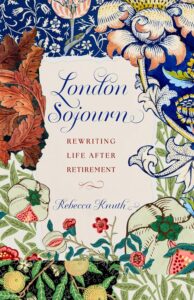 For fans of Eat, Pray, Love and Without Reservations, a captivating memoir of one woman’s bold leap into reinvention—trading academia for adventure, storytelling, and self-discovery in the heart of London.
What happens when a burnt-out professor trades academia for a fresh start in the city of her dreams—only to find reinvention far tougher than she imagined?
At sixty-five, Rebecca Knuth walks away from the security and status of academia, determined to reimagine herself in London. She craves more—more creativity, more stories, more life. Immersing herself in the city’s literary and cultural world, she enrolls in a creative nonfiction masters program, trains as a guide, joins the prestigious London Library, and reclaims her voice as a writer. London becomes her muse, a place of transformation where shedding her old identity is inseparable from rebuilding herself as a woman. But change is never simple.
Her mother’s health declines. Rebecca lands in intensive care. She’s harassed on the Underground. Exhaustion takes hold. Doubt creeps in—about her ambition, her motivation, even her sense of belonging. Where exactly is home?
A memoir of reinvention, resilience, and self-discovery, London Sojourn speaks to retirees, creatives, and seekers longing to step beyond certainty into something new.
She Writes Press, imprint of The Stable Group, distributed by Simon & Schuster
EXCERPT
But I had long lived under the mandate of writing like an academic, which seemed to preempt not only creativity but impact. I hadn’t always seen it that way. In my late thirties, weary of traditional roles—teaching children and looking for a mate—an academic career offered a way out. A generous fellowship meant a doctoral program and immersion in academia. Brains counted and energy pulsed through my veins. Classmates nicknamed me “the Terminator” as I barreled through the program in three years and hired English students to teach me to edit my papers. Publications, the currency of academia, were necessary for getting hired and promoted so I took them seriously.
At Indiana University, I traded the quasi-paternalistic supervision of school principals for academic advisers. They prepared me for an authority system, where one is constrained by professional expectations and gatekeepers who pass judgment on tenure, promotion, and the quality of one’s research. As a doctoral student, I had to take in feedback and guidance, while forging an independent identity. My aspirations were boundless as I learned to write in an academic style, embrace comparative methods, and fashion a global research niche. I attended conferences in Pittsburgh, Paris (at UNESCO), Barcelona, and Quebec City, and researched my dissertation on an international organization in Jamaica.
My ricochet off the doctoral program into an assistant professor’s post at the University of Hawaii meant a quick transition upon graduation. The first night in Hawaii was sleepless—I was leaving my son, my dog, my house, the university, everything. At a furniture store, the tears dripped down my face to the astonishment of the store clerk who thought moving to Hawaii was a good thing. And it turned out to be. This job allowed me to make my mark as a scholar, a leader, and an instructor committed to her students. Even when administrative duties were overwhelming (as program chair, I led the reconstruction of facilities destroyed by a flood), I was sustained by a passion for teaching and research.
I wanted to know why people destroyed books and libraries and all I could find were descriptive accounts of historic losses, such as that of the Library of Alexandria. I began gathering shadow references scattered through travel books (the experience of stepping on burned texts in abandoned Tibetan monasteries) or biographies and memoirs (the subject’s library is lost in a bombing attack) or in accounts of ethnic conflict (a Bosnian librarian’s reaction to the destruction of the National Library of Sarajevo). I felt mentally alive when determining global patterns in the modern destruction of books and libraries and publishing books with case studies of Afghanistan, Cambodia, Serbia, Kuwait, China (during the Cultural Revolution), Britain (strategic bombing during the Second World War), civil war, regime change, and ethnic conflict. I craved the vitality of being all in.
In competition, mostly with myself, I studied what it took to get rank and doubled the normal production of papers and service. Women had to do more. I began as an assistant professor, moved up to associate level, and then to full professor. But after almost two decades at Hawaii, I was disgusted with university politics and academic writing and felt restless, stagnant, and apathetic.
In the face of incessant demands and expectations, I kept returning to London for respite and cultural stimulation. I experimented with spending longer periods there, and built a curriculum around the city for two University of Hawaii Study Abroad semesters at Roehampton University. But I never felt that I had a professional role there. I desultorily pursued networking with British educators, to little effect. Perhaps these opportunities didn’t exist for short-term coordinators. A fellowship at the University of London failed to integrate me into British academia, but then it had been difficult to bond with American professors—my area of expertise was fairly idiosyncratic.
However, in 2012, an Oxford conference on “The Secularization of Monastic Libraries,” realigned my mental plates. While I wasn’t there to network or accrue credit through presenting, I was sad to have no one with whom to discuss the ideas behind my books, Libricide and Burning Books and Levelling Libraries. As the conference began, I had an attack of hiccups that seemed to mock my hallowed surroundings, St. Anne’s College. But then, as I listened to the talks, I was jolted into engagement with the ideas. The disruption of monastic life in the seventeenth and eighteenth centuries pushed books into private hands and university and national libraries dedicated themselves to the ideal that cultural heritage belonged to the people. The accounts of regional secularization, presented by European librarians at the conference, came together in patterns and filled the black holes in my understanding of the role of libraries in education and modern culture. I fell in love with ideas all over again.
Ironically, the epitome of hubris and narrowness, the academic librarian who had given me my only bad reviews (shooting down the books one by one) was at this conference. It was a pivotal moment in which I also realized that he and the other librarian-scholars (indeed, most academics) weren’t my people. While valuing the information such scholars deliver and using it to distill patterns, I no longer wanted to speak to an academic choir; instead, I’d tell stories that anyone could understand. Near retirement, I needn’t jostle for position or care about academic orthodoxy, scripted presentations to peers, and formulaic writing.
Even with this new understanding, it was challenging to let go of academia. In one last attempt at playing the game, in chasing the holy grail of funding and awards, I parlayed my interest in censorship and fighting silencing into an application for a Guggenheim Fellowship. These support scholarship and original approaches. I had such faith in the material I was probing and called in favors (for recommendations) and invested my time, energy, and importantly, my ego, in applying. After a long wait, they turned me down, and I felt like I never seemed to be able to pull off a certain kind of intellectual success, like I didn’t know all the rules or criteria, or that what interested me wasn’t trendy. Was I playing a chump’s game in this application and academic writing in general? Disappointed but not devastated, I didn’t lose faith in the proposed book itself and was surprised how quickly I bounced back. There is life after deflation and maybe the prize (acknowledgment and financial support) wasn’t what I really needed. Maybe I had invested too much in the facade of “success” and professional priorities had crowded out personal. Getting the award would have slowed down coming to terms with what I really wanted to do—which was change my life significantly.
Two years later I arrived in London parched from twenty years in academia. But it was London, a place I associated with transformation, and nothing was standing in the way—except, perhaps, myself. I knew how to learn. To pursue the ideas I’m entranced with, I’d need to be my own Guggenheim. I decided to democratize knowledge by writing popularly. What I didn’t realize was that I knew very little about myself. Could becoming a student again and learning to write creatively be my entrée into self-understanding?
BUY HERE
REBECCA KNUTH is a retired professor and expert on censorship and cultural destruction. Formerly at the University of Hawaii, she authored Libricide: The Regime-Sponsored Destruction of Books and Libraries in the 20th Century and has contributed to Smithsonian Magazine, Cabinet, History News Network, CBC Radio, and more. Transitioning to creative nonfiction, she earned another master’s degree, her third, to add to her doctorate, and immersed herself in London’s literary scene. Now a full-time writer, she published Emily Dickinson Had to Have Curls in 2024. She lives in Portland, Oregon where she coordinated the Sylvia Beach Writers Conference as part of the Oregon Writers Colony. Learn more at rebeccaknuth.com
Category: Contemporary Women Writers, On Writing
Subscribe
If you enjoyed this article, subscribe to receive more just like it.