Murdered for a Dress: A Kashmiri Daughter’s Story
By Huma Sheikh
 It is the night of July 13, 2003. My last living image of my father, Ghulam Nabi Sheikh, a famous Kashmiri singer and producer with Radio Kashmir, stays with me. He sits cross-legged across from me on the bottom bunk of the train. His right hand, holding a dripping mutton cube wrapped in roti, stretches toward me.
“Come on over. Let’s eat together,” he says. I’m not hungry but go anyway. As I turn to climb back to my bunk, he pats the seat beside him. “You are going to be on your own now. You’ve got to be brave and focus on your dreams.” Then softly: “Just don’t forget me.”
Around midnight, a nightmare of knives slicing the back of my father’s neck jolts me awake. My father is gone from his bunk. His friend Jawahar Saroor offers me water, but my throat burns. What follows is an unending nightmare.
My father had disappeared. On July 15, the Railway Police returned his bloody khan suit, coral ring, and flip-flops, wrapped in plastic, to my uncle. They also handed over a photo of the dead body—but no body. The local police in Mukeria, Punjab, had cremated my father in less than five hours, though a mortuary was available. How could they cremate a visibly circumcised Muslim man, who must be buried, and in such haste?
That morning, before our trip, my father had come down the wooden stairs wearing a blue pathani or khan suit. My mother pressed her palm to her forehead. “You can’t wear this outfit. It’s not safe for a trip across India,” she said. “Don’t we often read about the police harassing Kashmiris on trains?”
It was an anxious time for Muslims in India—much like today, when Islamophobia and hate crimes rise unchecked. The Hindu-nationalist government led by Narendra Modi had long cast Muslims as outsiders. My father’s khan suit—an outfit common among Kashmiri Muslims—made him an easy target. His clothing identified him as Kashmiri, and in the eyes of Modi’s partisans, that meant “terrorist.”
In Kashmir, the khan dress, or kameez yazair, is a loose-fitting, knee-length tunic with wide pants, a humble daily wear across communities for centuries. Yet this small difference in cut and texture has become a marker of danger. In India, what you wear can get you murdered. A khan suit’s simple Kashmir connection can turn it into a terrorist outfit. I should know—my father was killed for it.
“Don’t worry, I’ll be okay,” he had told my mother. He kissed her forehead, slung his small bag across his chest, and we left home. As our cab passed through familiar neighborhoods, I remember thinking how peaceful the streets looked at dawn. By evening, he would be gone forever.
Sixteen years later, in 2019, Modi announced that “you can identify the dissidents by their clothes.” His words echoed the same prejudice that killed my father. Across India, non-Muslims began wearing skullcaps and burqas in protest, carrying signs that asked, “Mr Modi, identify me by my dress.”
That August, India revoked Article 370, the law granting limited autonomy to Jammu and Kashmir. Overnight, my homeland was placed under a military siege. My mother, in Delhi, paced our apartment in panic. Phone lines were cut. My grandparents were unreachable. On television, we saw our leaders placed under house arrest. The valley had become an open-air prison.
I was in Florida, finishing my PhD, when I read that two million people in India risked becoming stateless under new citizenship laws. My grandmother—my Appai, who had lived her entire life in Kashmir—had no birth certificate. When I called her, she whispered “Modi” and changed the subject, afraid the call was being monitored.
When I finally visited Kashmir that summer, my mother greeted me at the top of the stairs of my uncle’s home. We had aged nine years since our last meeting. She removed my hat, examined my face, and smiled through her wrinkles. My siblings planned a family reunion that fall at my father’s house, where we would listen to his Ghazals, play his harmonium, and eat his favorite foods. I had planned to write him a thank-you letter, to say I was brave and focused as he asked me to be.
That reunion never happened.
In many ways, this story became the seed of my forthcoming poetry chapbook, Qasida for When I Became a Woman. The poems rise from the same place of grief and defiance—where a daughter searches for her father’s voice and her own. Writing the book allowed me to transform memory into art, to honor what was lost while speaking against the silence that still surrounds Kashmir.
I have spent years reflecting on those final hours on the train. I thank God I woke up that night, that I saw his empty bunk. His words—be brave, focus on your dreams—became a refrain guiding me through the years. But I have never forgotten his bloodied clothes, the weight of the plastic bag, the picture of his swollen face.
After his murder, I filed a complaint with the Railway Police and human-rights organizations. The Punjab and Chandigarh High Court took suo motu cognizance of the case. For three years, the lawsuit dragged through discrepancies. The policemen who hurried my father’s cremation were suspended—then reinstated within months. A travesty of justice.
I looked at the photo of his remains once, three years later. His face was purple-bruised, his eye sunken, his coral ring missing. His blue khan suit, darkened by blood, mocked every image I had of him singing in his practice room, his voice rising above the harmonium. That beautiful voice—gone forever.
My father was murdered for what he wore, for who he was, for where he came from. His khan dress—ordinary, elegant, unmistakably Kashmiri—became the symbol of both his life and his disappearance. And it remains my reminder of how fragile identity can be in a country that refuses to see its own people as human.
—
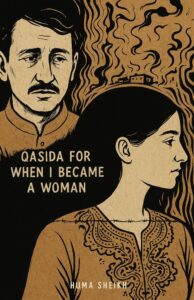 Huma Sheikh will be releasing her new poetry chapbook Qasida for When I Became a Woman (on January 9, 2026, published by Finishing Line Press, ISBN: 979-8-89990-168-3).
Qasida for When I Became a Woman reshapes the classical Arabic ode into a contemporary elegy of grief, resilience, and renewal. Set against the backdrop of war-torn Kashmir, these poems grapple with the unsolved murder of the poet’s father, the silences of disappearance, and the cultural restrictions placed on a young woman coming of age under military occupation. Through a blending of inherited forms and her own lyrical voice, Huma Sheikh creates a testament where violence and tenderness, absence and presence, exile and belonging coexist. Intimate yet political, this collection transforms trauma into testimony and loss into art, affirming that even in the darkest corners, memory, survival, and hope endure.
—
Huma Sheikh was born in war-torn Kashmir. A recipient of fellowships from Callaloo (Brown University), the William Joiner Institute (UMass Boston), the University of Massachusetts Amherst, and the East-West Center (Hawaii), she has also studied literary nonfiction with Christina Thompson at Harvard.
She has served as assistant online editor for The Southeast Review, fiction screener for Orison Books, editor for the Journal on Kashmiri Literature and Diasporic Writing, and worked as a stringer and reporter for Plain Talk weekly and Ka Leo newspapers in South Dakota and Hawaii.
After earning a degree in journalism, Sheikh worked with United News of India, Hindustan Times, Press Trust of India, and Xinhua News in Beijing. She holds a Master’s in Journalism and Communication Studies from the University of South Dakota, a Master’s in English Literature from Texas A&M University, a Master’s in Creative Writing from Long Island University (Brooklyn), and a PhD in English from Florida State University.
Sheikh is the winner of the Adam M. Johnson Fellowship and the Charles Gordone Award. Her poem “My Legs are Salwar Starchy” was selected by the Community of Literary Magazines and Presses (CLMP) as a featured read for Arab American Heritage Month. Her memoir was a finalist at Black Lawrence Press and Sundress Publications, and her poetry collection was shortlisted for the Our Own Chapbook Prize by Radix Media.
Her work has appeared in The Kenyon Review, Consequence, Prism International, Cincinnati Review, Arrowsmith, Rumpus, and others. Her poetry collection and memoir are both forthcoming.
Sheikh has taught as Visiting Teaching Faculty in the Department of English at Florida State University. She currently teaches writing at George Mason University.
Find out more about Huma on her website https://www.humasheikh.me/
Category: Contemporary Women Writers
Subscribe
If you enjoyed this article, subscribe to receive more just like it.