The Baby’s Cry, the Blank Page, and the Myth of the Writing Mother
By Caroline Lea
I once tried to revise a sex scene while cooking dinner for my family. Reader, it was a disaster: the chicken was burned and had to be binned; the characters lost interest in each other. Everyone cried.
In an ideal world, the mythical figure of the writing mother would also be an achievable reality. After all, both writing and mothering involve organisation, the ability to deal with frustration and the awareness, at fairly frequent intervals, that you are probably getting everything wrong. However, as I write this article, I’m ignoring my two sons, one of whom is trying to reheat a flatbread in the oven and has just discovered the chicken that I cooked late last night and then forgot about. At least e.coli, once consumed, has the definite sense of direction that my daily writing routine lacks.
My new novel, Love, Sex & Frankenstein, reimagines the infamous and chaotic summer of 1816, when eighteen-year-old Mary Shelley, still grieving the death of her first baby and trying to care for her second, was trapped in a stormy Swiss villa with Lord Byron, her lover Percy Shelley, and her tempestuous stepsister Claire Clairmont. Most of us would have spiralled into some sort of emotional breakdown but Mary, after a few false starts and a dose of writers’ block, began crafting one of the most famous and perennially republished works of fiction of the last 200 years. Fittingly, she also took her fear, isolation and pain and created a monster.
How did she do it? In a house full of chaos, hysterics, alcohol, opium, sexual gymnastics and Byron’s semi-feral menagerie, how did this girl balance parenting and a relationship in crisis with writing? It’s clear that Byron’s infamous challenge (that all the residents of the house write a ghost story) formed the original spark. But while I was writing my own novel, navigating writer’s block and the chaos of my own household (admittedly, and somewhat sadly, sans Byron’s monkey), the crucial element that I kept returning to was that Mary expected herself to write and she didn’t give up. In motherhood, as in writing, at least half the battle is won by showing up relentlessly.
Perseverance is … I do apologise, the smoke alarm has just gone off (that pesky flatbread)… Perseverance is the wrong word. Producing art requires an obsessive level of focus, while being a good mother, society tells us, requires near-constant self-sacrifice. There is little room in that cultural narrative for the mother who is squeezing in ten minutes of writing time while her children nap – yet this is more realistic and was how I wrote my first novel. To write while parenting, you need a ruthless determination and also, I’m sorry to say, a fair measure of selfishness. I am fierce about carving out time to write. Sometimes that means ignoring my children. Sometimes that means ignoring my partner. Sometimes, that means staying up until 3am and then being a vile, exhausted zombie the next day. Always, it involves a cycle of guilt and trying to crush the guilt. I tell myself that making up people in my head is a real job (because it is); I tell myself that I am teaching my children to be self-sufficient. I tell myself that if I sit in front of my computer, inspiration will come (in spite of the smoke alarm, the chicken, the flatbread). Sometimes, some of these things feel true.
Mary Shelley famously carved out time to write in that hectic villa, but let’s not forget that she had a nanny to help with the baby. And her parents were writers: young Mary had grown up beneath the shadow of her revered dead mother, Mary Wollstonecraft, who, with her book, A Vindication of the Rights of Woman had fundamentally reshaped society’s thinking on women’s roles and autonomy. And yes, she had written that book while travelling around Europe with her infant daughter. It’s fair to say that Mary Shelley’s circumstances, both personally and as a young mother, were unique. We can’t all be gifted a month in an isolated, inspirationally chaotic villa, complete with a writing challenge set by a sexy poet and a sense of expectation brought on by deceased, overachieving parents. Still, apart from carving out time and being happy with being a ‘good enough’ parent (thank you, Donald Winnicott) what useable lessons can you and I draw from young Mary?
Motherhood has brought all my emotions closer to the surface. Wherever possible, I try to challenge my guilt, fear and rage into my writing. I realise I’ve made it sound like these are the main emotions related to motherhood, which is not always the case. In all seriousness, parenting has taught me lessons about myself that I never wanted to learn. I have to think and rethink everything I say. I have to consider my negative emotional responses and their impact. I have to apologise frequently to my children. And in the midst of all this, the empathy and compassion I (try to) develop, makes my characters more convoluted and complex.
I often feel like I’m neglecting something: a child, a draft, a PE kit which is growing its own putrid ecosystem. And perhaps, along with embracing the ‘good enough’ parent, it’s helpful to embrace the ‘good enough’ writer: this approach is a genuinely helpful way to get through to the end of a draft, or any given writing day. Having compassion for yourself and accepting that you will write badly and parent badly is a helpful mindset. I wrote the first draft of Love, Sex & Frankenstein in pieces, dictated into my phone on walks, scribbled in notes between school runs, and polished at 3am to the soundtrack of the washing machine. So while it might seem like a contradiction, to nurture a child and create a fictional monster I do think it’s possible to do both, especially if you release the idea of perfection and tell yourself, as Mary Shelley did, that you are a writer. You are.
I have to go now. I haven’t yet managed to squeeze in any time to beat my messy draft into shape. Besides, I can smell burning.
—
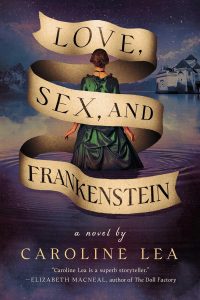 An evocative, haunting retelling of the summer that should have broken Mary Shelley, but instead inspired her to write her masterpiece.
Villa Diodati, Lake Geneva, 1816: the dark summer that birthed a monster.
Eighteen-year-old Mary Shelley has fled London with her lover, Percy Shelley, and her sister, Claire. Tormented by Shelley’s betrayals, haunted by the loss of their baby, and suspicious of her sister’s intentions, Mary seeks a refuge.
But Lord Byron’s villa, lying under ominous, ash-shrouded skies, feels more like a trap. When Byron suggests each guest write a supernatural tale, Mary is as drawn to the challenge as she is, unexpectedly, to Byron himself.
And so an idea begins to form in her mind . . . It spills out of her in thick, black ink. A thing given life by her imagination.
Day and night, it possesses her. Her heart, her desires.
But is she in control, or is it?
In this hauntingly evocative feminist retelling, Caroline Lea delves into the female rage, creative madness and steamy scandal that bore the world’s most famous work of gothic fiction.
BUY HERE
Caroline Lea is the critically acclaimed author of The Glass Woman, The Metal Heart, and Prize Women. She lives in England.
Category: Contemporary Women Writers, How To and Tips
Subscribe
If you enjoyed this article, subscribe to receive more just like it.