A Story That Waited 70 Years to Be Written
By Marcella Luiso Flanagan and Phyllis Clare Orlowski
Marcella Luiso Flanagan is 91 years old. For most of her life, she carried a story she knew mattered, but didn’t yet feel ready to tell.
Her niece, Phyllis Clare Orlowski, grew up knowing there was something quietly significant about her aunt’s past—especially the months Marcella spent in Bari, Italy in 1948. It wasn’t a story often told, but it was always present.
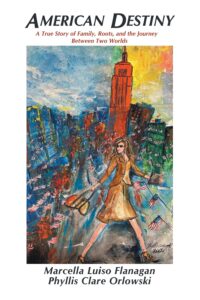
Over time, both women came to feel that this wasn’t just a memory, but something worth shaping and sharing. What began as a screenplay later became a book, American Destiny—a project that unfolded across decades, and eventually became a collaboration between them.
What neither of them expected was how much the process would deepen their relationship, and bring new understanding to their shared history, their family, and the idea of what it means to carry a story for a lifetime.
This is a conversation about how that story finally came to life.
Phyllis leans forward slightly, smiling. “I’ve been thinking about when this story really began for you. Do you remember when you first felt like it was something you needed to write?”
Marcella pauses for a moment. “I think I always knew. I just didn’t act on it.”
She looks out for a second, as if tracing something back. “Those months in Italy, in 1948—they stayed with me. Not in a loud way, but in a quiet, persistent way. I would think about them at different points in my life and feel that there was something there, something meaningful. But there was always something else that needed my attention first.”
“Family,” Phyllis says gently.
“Yes,” Marcella nods. “My parents, my work, responsibilities. Life filled in the space.”
Phyllis tilts her head. “Seventy years is a long time for a story to stay with someone. What made you finally decide to begin?”
Marcella smiles, a little knowingly. “I reached a point where I thought, if I don’t do this now, I may never do it.”
“I was seventy,” she continues, “and I enrolled in a screenplay writing class at NYU. I remember walking into that classroom and realizing I was much older than everyone else.”
Phyllis laughs softly. “Did that throw you?”
“At first,” Marcella says. “But once I started writing, it didn’t matter anymore. The work took over.”
She pauses. “Although… it wasn’t easy.”
“What was hardest?” Phyllis asks.
“Memory,” Marcella says, without hesitation. “People think memory is clear, but it isn’t. It comes in pieces—a moment, a feeling, an image. And then sometimes nothing. I had to be patient with it.”
She adds quietly, “And then there were the emotions. You don’t just remember what happened—you feel it again.”
Phyllis nods. “I remember when you first shared the screenplay with me. I could see how much of yourself was in it. But it also felt like the story was still unfolding.”
Marcella looks at her. “I think you were right.”
“There was something about turning it into a book that felt different,” Phyllis continues. “Not rewriting it, but… expanding it.”
“Reflecting on it,” Marcella says. “A screenplay shows moments. A book allows you to understand them.”
They sit with that for a second.
“What was it like for you,” Phyllis asks, “working on something so personal with someone else?”
Marcella’s expression softens. “It required trust.”
“These were my memories,” she says, “but you helped me see them more clearly. You asked questions I hadn’t asked myself. Sometimes you helped me understand why something mattered, not just that it happened.”
Phyllis smiles. “I was very aware that it was your voice that mattered most.”
She pauses, choosing her words. “For me, it felt like translating—not between languages, but between memory and narrative. How do you take something that lives inside someone and help shape it into something others can understand, without losing its truth?”
Marcella nods slowly. “That’s exactly right.”
“There were moments that surprised both of us,” Phyllis adds. “Things you remembered after so many years.”
“Yes,” Marcella says. “That surprised me too. It made me realize the story had never really left me. It was still there, just waiting.”
Phyllis looks at her. “Do you think the story could have been written earlier?”
Marcella shakes her head. “No. I needed the time. I needed everything that came after—my work, my family, even loss—to understand what those months in Italy really meant.”
She pauses. “Without that, it would have been a different story.”
Phyllis nods. “For me, working on this together changed how I understood our family. It made everything feel more connected—our history, our roots, even the choices that shaped both of our lives.”
“I felt that too,” Marcella says. “It wasn’t just about finishing a book. It was about understanding where we came from.”
There’s a quiet moment between them.
“When we finished,” Phyllis says, “it didn’t feel like you had created something new.”
Marcella smiles. “No. It felt like I had finally completed something that had always been there.”
“And now?” Phyllis asks.
Marcella looks thoughtful. “Now I think about how long the story stayed with me—and how it never disappeared.”
She looks back at Phyllis. “People sometimes think if they wait too long, it’s too late. But I don’t believe that.”
“Some stories need time,” she says. “Some dreams do too.”
She smiles, gently but with certainty. “In God’s good time.”
American Destiny invites readers into a story of memory, resilience, and the enduring power of family. Marcella and Phyllis encourage readers to engage with the book, share it with others, and spark conversations about the stories that shape us. To learn more, ask questions, or purchase the book, visit: https://www.americandestinystory.com/.
 Marcella Luiso Flanagan remembers every detail of July 3, 1948, when she and her family boarded a former military transport ship to cross the Atlantic back to Italy, and the months that followed, like it was yesterday.
They spent five unforgettable months in postwar Italy. They were joyous yet filled with uncertainty as her parents struggled to reconcile the country they once knew with the one they found.
The devastation of war, and the devaluation of the lira, forced them to make the heart-wrenching decision to return to America. They left Italy on December 1, 1948, and went back to their home in Westchester, New York.
Those five short months would change the course of Marcella’s life forever, and in American Destiny – with the help of her niece – she recalls how her family navigated the journey along with its painful decisions.
Category: Interviews, On Writing
Subscribe
If you enjoyed this article, subscribe to receive more just like it.