When Reality Keeps Rewriting Your Fiction By Denise Fletcher
There’s a difficult balancing act in writing contemporary political crime fiction. The story must feel believable, but only just. The stakes need to sit right at the fringes of credibility without ever tipping over into the fanciful. The highs must be high. The lows low. The corruption must feel uncomfortable to read. And all the while, the reader must stay connected, glued to the pages thinking: yes, I believe that could happen.
That’s an increasingly difficult task when writing against the backdrop of modern politics and organised crime. Every time I thought I had pushed the storyline of Unspoken to its limits, the real world proved me wrong and my fictional world suddenly read like old news. Increasingly, we have become desensitised to political scandal, institutional failure and corporate corruption linked to organised crime.
Still, when I completed Unspoken in December 2024, I didn’t expect the line between fiction and reality to blur so quickly.
Unspoken opens during a federal election campaign centred in the electorate of Farrer. Of the 150 House of Representatives seats, I chose Farrer because the Riverina remains deeply connected to one of Australia’s most confronting organised crime stories, the 1977 suspected murder of anti-drug campaigner Donald Mackay.
Fast forward to 2026, and the resignation of former Liberal leader Sussan Ley, the Member for Farrer. A by-election was triggered, thrusting the electorate into the national spotlight. Suddenly readers were messaging me saying, ‘Of all the electorates! How did you pick that?’ It looked as though I had somehow timed the release of my novel and its opening scene to one of the biggest political stories in the country.
Another thread woven through Unspoken is the government’s use of tobacco excise to reduce smoking rates and improve public health. The idea first took shape as I followed the establishment of the Illicit Tobacco Taskforce in 2018 and the growing debate around whether successive increases in tobacco excise were unintentionally creating opportunities for organised crime.
Today, the issue dominates media coverage, with parliamentary inquiries and law enforcement debate increasingly focused on whether Australia’s tobacco excise is fuelling the very criminal activity governments are trying to suppress.
And it’s not just the organised crime aspect of Unspoken drifting closer to reality.
Early in the novel, the political environment is introduced this way:
For more than seventy years, Australian politics had followed a simple pattern: two major parties trading places, each taking a turn to govern while the other waited in opposition.
By the time Unspoken begins, cracks have already appeared in the well-worn system, with independents evolving from isolated protest candidates into a genuine and enduring force within Australian politics. At one point in the novel, the question is asked: When does a large bloc of independents working together become a political party?
That’s a question that has sat at the forefront of media commentary over recent days.
Of course, fiction is always drawn from the real world. Readers want stories that feel authentic and recognisable. But there’s something slightly unnerving when events continue drifting closer to the fictional world you created.
Perhaps that’s inevitable. Writers draw from what already exists around them and then ask the obvious question: what comes next?
At its heart, Unspoken was never really about politics itself. It’s about ordinary people caught inside systems far bigger and more powerful than themselves. About ambition, loyalty, vulnerability and survival. About what happens when good people become trapped between power, pressure and silence.
Still, I’ll admit this much: as reality keeps inching closer to fiction, I’m crossing my fingers that the ending of Unspoken remains firmly in the realm of imagination.
—
D A Fletcher spent nearly twenty years working at the heart of Australian politics — across the Senate, the House of Representatives and the Tasmanian House of Assembly — advising a former President of the Senate, heading media and communications for a shadow minister, and holding senior executive roles within a major political party. Before politics she worked in corporate finance in Western Australia and was a teacher in Tasmania. Unspoken, her debut novel, is inspired by her years inside the corridors of power and offers readers a rare glimpse into the people and pressures that shape political life. She is based in Launceston, Tasmania.
https://www.dafletcherauthor.com/
https://www.linkedin.com/in/denise-fletcher-6b5829184/
https://www.simonandschuster.com.au/authors/Denise-A-Fletcher/260825765
UNSPOKEN
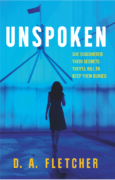 In the final week before a federal election, political adviser Francis McGuire is tasked with one job: launching the Opposition’s flagship health policy.
Every detail is in place.
Until the party’s ruthless campaign strategist decides to sabotage it.
When his plan backfires, Francis is made the scapegoat. Publicly shamed and hunted by the press, she flees to a small town on Western Australia’s south coast — the same place she escaped after her father’s fatal car accident years earlier.
But what awaits her is far more dangerous than political betrayal: organised crime; corruption reaching the highest office in the land; a coldblooded contest for power and control; and a murder that threatens to fracture the nation itself.
As enemies close in, Francis must decide how much she’s willing to risk to expose the truth.
Can she do that – or will the truth remain Unspoken?
Category: Contemporary Women Writers, On Writing
Subscribe
If you enjoyed this article, subscribe to receive more just like it.