Connecting Through Story by Virginia Kantra
by Virginia Kantra
We are born storytellers.
From the time we are toddlers feeding dolls or talking on play phones, we use our imaginations to tell familiar stories. I used to enact elaborate scenarios with my toys on my bedroom floor and—later—in front of the bathroom mirror, casting myself as the hero of my fairly boring and sometimes lonely childhood.
Other stories we absorb from other people, parents, teachers, and classmates. Repeated and internalized, they become part of our identity. I’m the smart one. I’m the responsible one. I’m the fat or the funny one. These stories aren’t necessarily true. They can be aspirational or limiting, but they all provide a kind of script. You can do anything, we tell ourselves as we grow into adulthood. I’m going to write two thousand words today. Or, You’ll never amount to much (aka, My first book was a fluke and I’m an imposter).
And then there are the stories that come to us from books.
As a child, I read for comfort and entertainment. Books don’t judge. They never have other plans on a Saturday night. The characters I read about became my friends. Beezus and Ramona. Harriet the Spy. Meg and Jo and Beth and Amy. Dorothy Gale. And, of course, Anne Shirley.
Like Laurie watching the March sisters from next door, I observed other families, trying to figure out how to be a daughter, a sister, a female navigating the world. Like that toddler playing pretend, reading allowed me to imagine myself in different roles. From the safety of my room, I could explore other lives and other choices on the path to my best, truest self. Following along on their journey made me feel less alone. Reading about characters from different times and lands developed my understanding and empathy for characters who weren’t exactly like me: Ged, the Wizard of Earthsea; Karana, on the Island of Blue Dolphins.
I devoured books like the peanut butter sandwiches in my lunch box, tasty and satisfying and sometimes forgotten by dinner. But the stories I remember best felt true. Scenes impressed on my growing brain like real life events, the memories sharp and vivid even decades later: the warm water-lily sea in The Voyage of the Dawn Treader shaped my understanding of faith; the shocking grief of Beth’s death in Little Women introduced me to death; the irrepressible exuberance of Anne Shirley renaming the White Way of Delight fed my own imagination.
The books I read came of age with me, becoming more complex: The Diary of Anne Frank, The Outsiders, Animal Farm. Each one broadened my darker, sometimes deeper, view of the world. I was still reading for comfort and pleasure. But as my reading expanded, so did my understanding.
Storytellers are born, but writers are made. Reading taught me to pay attention to the beauty of a tree standing in sunlight or the nuances of a character’s expression. Writing makes me do the same. Gradually I developed the intellectual framework, the moral scaffolding, and the vocabulary I needed to write my own stories.
As writers, it can be helpful to ask, What stories define you? What do you tell yourself? What were you told? At what age? What are the foundational books that stick with you, that you return to again and again?
My old friends have not changed over the years, but I have. Revisiting them reveals how much.
My child’s eye view of Marmee, Marilla and all those wicked stepmothers developed as I became a mother and now a grandmother. Team Laurie and Team Bhaer gave way to a scale of male romantic leads from Heathcliff to Rochester to Darcy. (Although a piece of my heart will always belong to Gilbert Blythe, first and best of book boyfriends.)
As a reader, the books I loved gave me a safe place to explore difficult subjects. As a writer turning to classic stories for inspiration, I have used the comfort and familiarity of beloved books to explore grief and resilience, Covid and book bans. In Anne of a Different Island, the heroine imagines herself as a modern-day Anne of Green Gables. But after the death of her beloved father sends her home to Mackinac Island, she discovers the difference between her real life and fiction and must decide between the love she imagined and the future she really wants.
Of course, there’s a huge challenge in reimagining a classic, because so many readers know and love the original, and they’re going to bring their own feelings and memories of reading the book (or watching the movie or the series) to your story. I’m not sure you can ever live up to that kind of expectation. You can only be true to yourself, to your own experience, your own emotions.
As a writer, I am still exploring the mother-daughter dynamic and the delicate romantic balance of intimacy and independence. I write to Figure Stuff Out. Interestingly, the more I write for myself, the more readers connect to my stories. The more authentic I am, the more my readers can identify with my words. That authenticity of voice is something AI can never replicate.
Writing is a dialogue, communicating with other hearts and minds through words on a page. Nothing makes me happier than when I hear back from a reader in person or online, completing the circle of connection. Through the power of story, we can walk in someone else’s shoes and see through their eyes. We become kindred spirits. And isn’t that connection what the world needs right now?
https://www.facebook.com/VirginiaKantraBooks
https://www.instagram.com/virginiakantra/
https://virginiakantra.substack.com/
—
New York Times bestselling author Virginia Kantra is a big believer in the power of stories—the ones we grow up with and the ones we tell ourselves. She has written over thirty novels about strong women, messy families, and the journey to find yourself. Her books have received numerous awards as well as starred reviews from Publishers Weekly and Booklist and praise in People and USA Today.
Her latest release, Anne of a Different Island, inspired by Anne of Green Gables, is available January 20, 2026.
A woman learns to be the heroine of her own life in this heartfelt novel inspired by Anne of Green Gables by New York Times bestselling author Virginia Kantra.
She believed life could follow a plotline—until the story she was living unraveled.
ANNE OF A DIFFERENT ISLAND
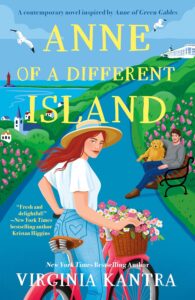 Anne Gallagher has always lived by the book. Anne of Green Gables, that is. Growing up on Mackinac Island, she saw herself as her namesake: the same impulsive charm, the same wild imagination, even the same red hair (dyed, but still). She followed in Anne Shirley’s fictional footsteps, chasing dreams of teaching and writing, and falling for her very own storybook hero.
But when a string of real-life plot twists—a failing romance, a fight with the administration, and the sudden death of her beloved father—pulls her back to the island she once couldn’t wait to leave, Anne is forced to face a truth no story ever prepared her for. Sometimes, life doesn’t follow a script.
Back in the house she grew up in, Anne must confront her past and the people she left behind, including Joe Miller, the boy who once called her “The Pest.” It’s time to figure out what she wants and rewrite her story to create her own happy ending. Not the book version. The real one.
BUY HERE
Category: How To and Tips
Subscribe
If you enjoyed this article, subscribe to receive more just like it.