Debuting at 40: The Case for the Late-Blooming Author
By Amy Rossi
Here’s a confession.
Somewhere in the quiet period after selling my book – edits turned in, waiting on the next round – I got too curious. I googled the title and found it mentioned in an article about debut book deals.
What was interesting to me was how debut was used interchangeably with young. What was even more interesting is how, once upon a time, I would have been flattered, but the assumption, the flattening out, made me want to own all 40 of my years.
Despite the persisting notion that MFA programs produce a cadre of 25-year-olds writing the same thing year after year, every debut novel comes into the world differently. Often, when you hear about a woman publishing her debut at my age or later, it’s linked to motherhood because so much of our society is not set up for mothers. This is not one of those stories. For most of my publishing journey, I was single, and children are not in my plan, meaning I had a lot of time that others don’t. This is still how long it took. And for a while, I was embarrassed about that.
I used to always be ahead of the curve – for better or for worse. I could have lived without being the first of my friends to wear a bra. And being the youngest in my grade meant being the last to get my driver’s license. But it also meant graduating from college, securing an apartment, and starting a real office job all before I turned 22.
Eventually, though, everyone around me started finding their purposes and partners and settling down, and I was still looking for more. It turned out I was late to being a late bloomer, and I had to figure how to catch up to my dreams. I let go of that 20s stability I’d been so proud of to focus on writing, get an MFA, and finally put my novel out into the world.
It’s not that I thought it would be easy. I’d accumulated enough grad school and story rejections to understand that much. When I graduated at 31 with a manuscript that I’d be ready to query a few months later, I didn’t have a timetable in mind. Before 40, though, for sure. Right?
The Cover Girl, comes out on August 5. And I’ll be 41 in September.
It wasn’t my first book. I spent three-and-half years after grad school trying to find an agent for the novel I went to grad school to write, watching it look so easy for everyone else. And after I found the right agent, my social media feed filled with what felt like endless Publisher’s Marketplace screenshots, including one from a writer who was so young their youth was highlighted in their deal announcement for a book with a gut-punchingly similar premise to mine.
I took it personally. I was deeply aware of every passing year, of how little I had to show for it. Publishing a book is extremely hard, but when you’re in proximity to those who find success at it, it becomes all too easy to forget how hard it is. Instead, I felt like I’d done something wrong. If I’d been faster. If I just used my time better.
But that’s if I’m viewing the time I spent finding an agent, getting my novel ready for submission, hoping it found a home, shelving that book, writing another one, and going out on submission again as wasted.
What being a late bloomer – as a debut novelist and other things in life – has taught me is to think about time differently. Instead of watching years slip away, think about what they add up to. I don’t regret that it took me nearly 37 years for me to meet my partner because those solo years were rich and full of experiences, getting to know myself, getting to know the world. Finding that no fit was better than the wrong fit.
If I can give myself that understanding, I can give my book the same. Those years helped me build patience, stamina, and perseverance I didn’t think possible. I learned how hard I can work, and I’ve learned how to talk about failure openly. I learned what I want to keep private and what to share publicly. I’ve gained some hard-earned perspective on what’s truly important.
But while these lessons have been valuable, they can also present a kind of trap. One of the hardest things I’ve learned is not to fall into myth-making – a long road to publication doesn’t mean I earned it more or value it more than someone who found an agent and sold their book in a matter of months. It just means I did it differently.
As more and more novelists put their first books out in their 40s, 50s, and 60s, hopefully the concept of what a debut author looks like can evolve – and ease that urge to feel behind when others arrive at the goal on a different timeline. Our paths are as unique as our books.
—
Amy Rossi received her MFA from Louisiana State University, and she lives in North Carolina, by way of Massachusetts, with her partner and two dogs. The Cover Girl is her first novel.
THE COVER GIRL
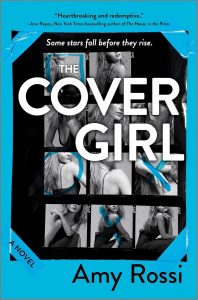 “Thrilling and glamorous as its runways and backstage parties, The Cover Girl is also heartbreaking and redemptive with an ending that made me cry. Birdie is a singular, unforgettable character whose story encapsulates so much of what led up to the #MeToo movement, and why the movement was so necessary.”
—Ana Reyes, New York Times bestselling author of The House in the Pines
Find them early enough, and they will always be her girls.
Birdie Rhodes was only thirteen when legendary modeling agent Harriet Goldman discovered her in a department store and transformed her into one of Harriet’s Girls. What followed felt like the start of something incredible, a chance for shy Birdie to express herself in front of the camera. But two years later, she meets a thirty-one-year-old rock star, and her teenage heart falls hard as he leads her into a new life, despite Harriet’s warnings. Then, as abruptly as it began, it’s over, like a lipstick-smeared fever dream. Birdie tries hard to forget that time—starting over in Paris, in the dying embers of the LA punk scene, in Boston at the height of the AIDS crisis. She’s not that person anymore. At least, that’s what she’s been telling herself.
Decades later, Birdie lives a quiet life. She works modest gigs, takes Pilates and mostly keeps to herself. Maybe it’s not the glamor she once envisioned, but it’s peaceful. Comfortable. Then a letter arrives, inviting Birdie to celebrate Harriet’s fifty-year career. Except Birdie hasn’t spoken to her in nearly thirty years—with good reason.
Almost famous, almost destroyed, Birdie can only make her own future if she reckons with her past—the fame, the trauma, the opportunities she gave up for a man who brought her into a life she wasn’t ready for. Just like she’s not ready now. But the painful truth waits for nobody. Not even Birdie Rhodes.
For fans of My Dark Vanessa and Taylor Jenkins Reid, this striking debut novel explores the dizzying fallout of being seen and not heard in a high-stakes industry that leaves no silhouette unscathed.
BUY HERE
Category: On Writing
Subscribe
If you enjoyed this article, subscribe to receive more just like it.